](https://deep-paper.org/en/paper/file-3460/images/cover.png)
Have you ever read a sentence that felt like a brick wall because of a single, obscure word? In English, you might stumble over “esoteric” and wish the writer had just used “mysterious.” In Chinese, the challenge is often compounded by Chengyu (four-character idioms) or rapidly evolving internet slang.
This process of making text easier to read by swapping difficult words for simpler equivalents is called Lexical Simplification (LS). It’s a vital tool for language learners, children, and people with cognitive impairments.
For a long time, the solution seemed to be “just use a bigger AI model.” After all, GPT-4 is a linguistic genius. But GPT-4 is also expensive and slow. Conversely, smaller, cheaper models often lack the nuance to handle complex Chinese vocabulary.
In a fascinating research paper titled “Optimizing Chinese Lexical Simplification Across Word Types: A Hybrid Approach,” researchers propose a smarter way forward. Instead of relying solely on a massive model or struggling with a weak one, they developed a system that teaches small models to punch above their weight and knows exactly when to call in the “big guns.”
In this post, we will tear down their methodology, exploring how they used Knowledge Distillation and Retrieval-Based Interpretation Augmentation (RIA) to build a state-of-the-art simplification system.
The Challenge: Context and Word Types
To understand the solution, we first need to understand the nuances of the problem. Chinese Lexical Simplification (CLS) isn’t just about finding synonyms; it’s about context.
The researchers identified that model performance varies drastically depending on the type of word being simplified. They categorized complex words into three buckets:
- Content Words: Standard complex words found in the dictionary (e.g., “melancholic”).
- Chinese Idioms (Chengyu): Traditional phrases that carry heavy cultural and semantic weight.
- Out-of-Dictionary (OOD) Words: New vocabulary, primarily internet slang.
The Baseline Gap
The team started by testing existing models. They compared BERT-LS (an older, unsupervised method), small Large Language Models (LLMs) like ChatGLM and Qwen-Chat (approx. 7 billion parameters), and the massive GPT-4.
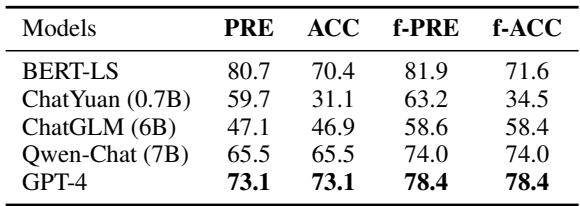
As shown in Table 1, the gap is clear. GPT-4 leads the pack with an accuracy of 73.1%. The smaller models trail significantly. For example, ChatYuan (0.7B parameters) only achieves 31.1% accuracy.
However, the aggregate score hides the interesting details. GPT-4 excels at general content words but struggles slightly with the structural constraints of Chinese idioms compared to BERT-LS.
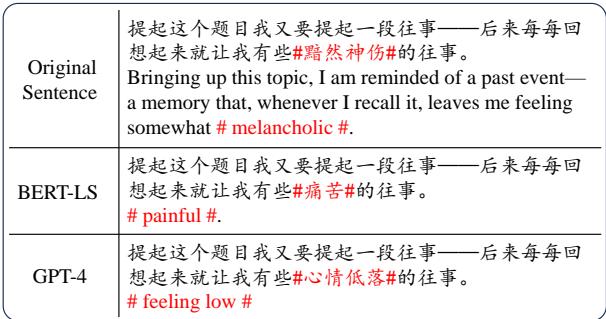
In Figure 3, we see an example of an idiom simplification. The original text uses “黯然神伤” (melancholic/heartbroken). BERT-LS swaps it for “痛苦” (painful), while GPT-4 offers “心情低落” (feeling low). Both are acceptable, but they show how different models approach the trade-off between meaning preservation and simplification.
The real nightmare for all models, however, is OOD words.
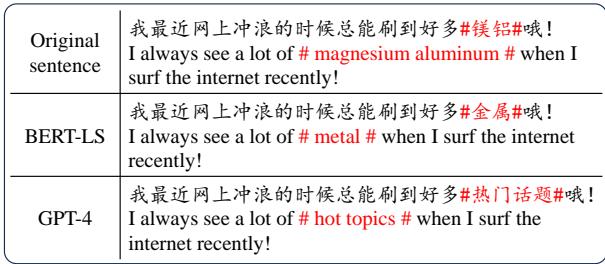
Look at Figure 4. The sentence contains the term “magnesium aluminum” (#镁铝#). In Chinese internet slang, this sounds like “Meilv” (#美女#), which means “beautiful woman.”
- BERT-LS takes it literally and guesses “metal.”
- GPT-4 guesses “hot topics.”
Both fail because they lack the specific cultural knowledge of this slang term. This highlights the core problem: Small models lack reasoning, large models are expensive, and all models struggle with new slang.
The Solution: A Hybrid Framework
The authors propose a system that doesn’t just rely on one model. Instead, it uses a Word Type-Aware Controller to decide how to process a sentence.
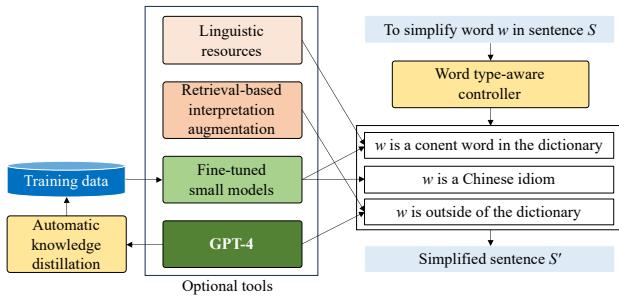
As illustrated in Figure 1, the system first identifies the type of complex word (Dictionary Word, Idiom, or OOD). Based on this classification, it routes the task through different components:
- Fine-tuned Small Models: For standard dictionary words and idioms, the researchers believe small models can be effective if trained properly.
- GPT-4: Reserved for cases where reasoning is paramount.
- RIA (Retrieval-Based Interpretation Augmentation): Using search engines to help with OOD words.
Let’s break down the two main technical innovations that make this framework work: PivotKD and RIA.
1. PivotKD: Teaching Small Models with GPT-4
The researchers hypothesized that small models aren’t inherently incapable of simplification; they just lack good training data. In Chinese, high-quality parallel data (complex sentence \(\rightarrow\) simple sentence) is scarce.
To fix this, they created PivotKD, an automatic knowledge distillation framework. The idea is to use GPT-4 as a “teacher” to generate a massive, high-quality dataset, which is then used to train the “student” (the small model).

Figure 5 outlines this elegant three-step process:
- Pivot Word Sampling: The system picks a word from the dictionary (e.g., “stealthily”). This is the “Pivot Word.”
- Pivot Sentence Generation: GPT-4 is prompted to write a completely new sentence containing that word. This ensures the training data is fluent and grammatically correct, avoiding errors common in web-scraped data.
- Multi-Level Lexical Substitution: This is the clever part. The system asks GPT-4 to take that generated sentence and rewrite the pivot word at three different complexity levels: Basic, Medium, and Advanced.
By doing this, the researchers generate pairs of sentences where the meaning is identical, but the vocabulary complexity shifts.
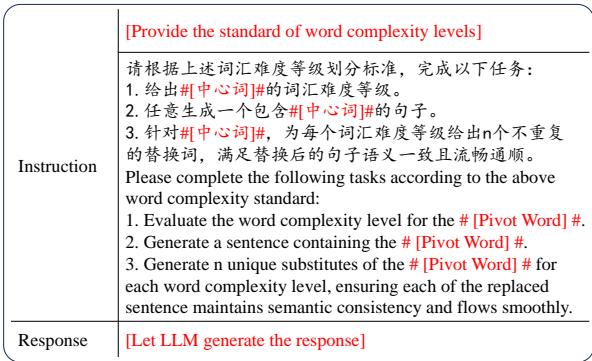
The prompt used for this generation (shown in Figure 6) is explicit. It forces the LLM to understand the hierarchy of word difficulty.
The Result: A synthetic dataset of over 12,000 sentence pairs. When small models like ChatGLM or Qwen-Chat are fine-tuned on this data, they learn the patterns of simplification that GPT-4 possesses, effectively “downloading” GPT-4’s capability into a smaller, faster brain.
2. RIA: Cheating with a Search Engine
Fine-tuning helps with dictionary words, but what about the “Magnesium Aluminum” (beautiful woman) slang problem? No amount of training on old dictionaries will teach a model about a slang term invented last week.
For this, the authors introduce Retrieval-Based Interpretation Augmentation (RIA).
The concept is simple but powerful. When the system encounters an OOD word (or a difficult idiom), it performs a Google search:
Query: “[Complex Word] meaning”
It scrapes the top snippet from the search results and injects that definition directly into the model’s prompt.
- Standard Prompt: “Replace ‘magnesium aluminum’ with a simpler word.”
- RIA Prompt: “Here is a sentence. The word ‘magnesium aluminum’ means ‘beautiful woman’ in internet slang. Replace it with a simpler word.”
This turns a “closed-book” exam into an “open-book” exam, significantly reducing the cognitive load on the model.
Experimental Results
So, does this hybrid approach actually work? The results are surprising.
The researchers tested their fine-tuned small models against the original frozen models and GPT-4. They measured performance using Accuracy (ACC) and Fuzzy Accuracy (f-ACC), which gives partial credit if the generated word is part of a correct phrase.
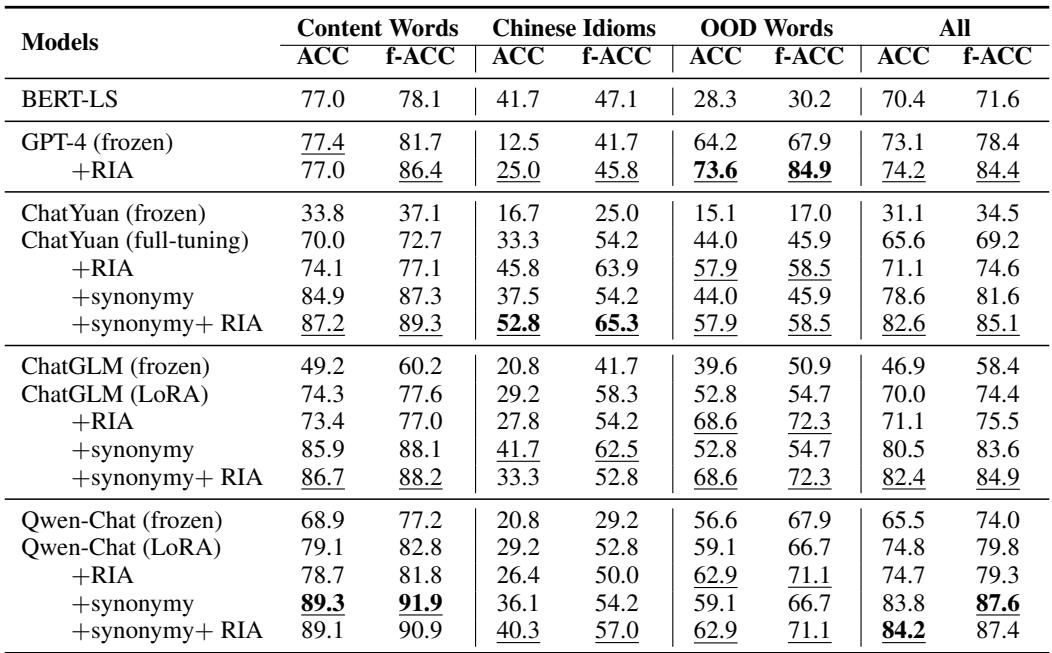
Table 3 reveals several key findings:
1. Small Models Can Beat GPT-4
Look at the Content Words column. The fine-tuned Qwen-Chat model achieves an accuracy of 79.1%, while the massive GPT-4 sits at 77.4%.
This is a massive validation of the PivotKD approach. A 7-billion parameter model, when fine-tuned on high-quality distilled data, outperformed a trillion-parameter model on standard vocabulary tasks.
2. RIA is a Game Changer for OOD Words
Now look at the OOD Words column.
- ChatGLM (Frozen): 39.6% accuracy.
- ChatGLM + RIA: 68.6% accuracy.
Adding the search engine definition nearly doubled the performance! Even GPT-4 saw a jump from 64.2% to 73.6% when given the RIA context. This proves that for slang and new words, external knowledge is far more valuable than internal model parameters.
3. The Optimal Hybrid Configuration
The researchers concluded that there is no single “best” model for every word. The data suggests a split strategy:
- For Dictionary Words: Use a fine-tuned small model (like Qwen-Chat). It is faster, cheaper, and more accurate than GPT-4.
- For OOD Words: Use GPT-4 combined with RIA. The complex reasoning required to interpret slang definitions still benefits from the massive scale of GPT-4.
Qualitative Analysis: When Models Hallucinate
Despite these successes, the systems aren’t perfect. The paper provides an honest look at where even the best configurations fail.
One common issue is Fluency Degradation. Sometimes, a model picks a word that is simpler but makes the sentence sound awkward.
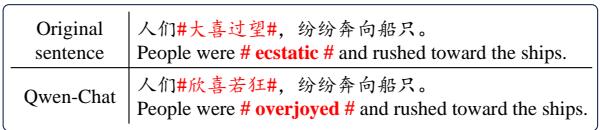
In Figure 8, the original sentence describes a lion as “evidently ravenous” (hunger + ferocity). The model simplifies this to “hungry.” While technically correct, “The lion is evidently hungry” loses the intensity and natural flow of the original phrasing.
Another fascinating failure mode is Hallucination via Association.
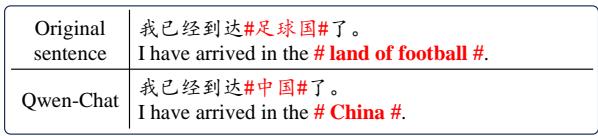
In Figure 9, the system attempts to simplify the OOD phrase “Football Country” (#足球国#). In Chinese internet culture, this usually refers to Brazil. However, the model simplifies it to China.
This is likely a training bias—the model has seen “China” and “Football” together frequently in its training data (perhaps discussing the Chinese national team), and it defaulted to the most statistically probable country association rather than the correct cultural fact. Even with search results, if the retrieved snippet isn’t clear, models can make confident but wrong guesses.
Conclusion and Implications
This research offers a compelling blueprint for the future of Natural Language Processing. It challenges the assumption that we always need the largest, most expensive model to solve a problem.
By understanding the linguistic nature of the input (Is it a standard word? An idiom? Slang?), we can route tasks to the most efficient tool:
- Distillation (PivotKD) allows small, efficient models to master standard tasks, outperforming significantly larger competitors.
- Augmentation (RIA) bridges the knowledge gap for new words without requiring model retraining.
For students and developers, the takeaway is clear: Don’t just prompt a giant model. Build systems that understand what they are simplifying. Use large models to generate data to teach smaller ones, and give your models access to a dictionary (or Google) when they face words they haven’t seen before. The future of AI isn’t just big; it’s hybrid.