](https://deep-paper.org/en/paper/file-3472/images/cover.png)
Introduction
Mental health is one of the most critical public health challenges of our time. With one in eight people globally living with mental health conditions, the demand for qualified care far outstrips the supply. However, training a mental health professional is not merely a matter of reading textbooks and passing exams. It requires mastering the subtle, complex, and often unpredictable art of human interaction.
Traditionally, therapy training relies on two extremes: static textbook case studies, which are often too “clean” and perfect, and role-playing exercises with peers, which can feel awkward or unrealistic. Trainees eventually move on to real patients, but this transition is often described as a “trial by fire.” Novice therapists must learn to identify deep-seated psychological patterns while managing the delicate emotions of a person in distress—all without causing harm.
To bridge this gap, researchers from Carnegie Mellon University, Princeton, University of Pittsburgh, and Stanford have introduced PATIENT-\(\Psi\) (Patient-Psi). This is not just another chatbot. It is a sophisticated simulation framework that combines Large Language Models (LLMs) with established psychological theory—specifically Cognitive Behavioral Therapy (CBT)—to create high-fidelity simulated patients.
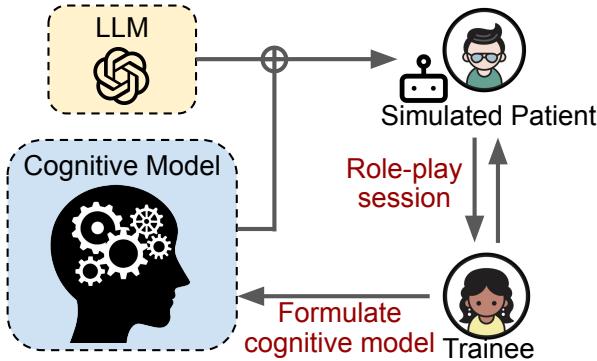
As illustrated above, the core concept involves a bidirectional flow. We aren’t just prompting an LLM to “act depressed.” Instead, the researchers construct a detailed “Cognitive Model”—the internal gears of a patient’s mind—and program the LLM to embody that model. Trainees then interact with this simulated patient to practice the crucial skill of “formulating” the patient’s case, receiving feedback based on the ground-truth model.
In this deep dive, we will explore how PATIENT-\(\Psi\) works, how it mimics the “messiness” of real therapy, and why it might just be the future of mental health training.
Background: The Cognitive Model
To understand why PATIENT-\(\Psi\) is a significant leap forward, we first need to understand the theoretical framework it rests upon: Cognitive Behavioral Therapy (CBT).
CBT is a popular, evidence-based paradigm in psychotherapy. It posits that our emotions and behaviors are not random; they are driven by our thoughts and beliefs. A central skill in CBT is creating a Cognitive Conceptualization Diagram (CCD). Think of the CCD as a map of the patient’s psyche.
A CCD connects eight key components:
- Relevant History: Past events (e.g., childhood trauma) that shape the present.
- Core Beliefs: Deep, absolute truths the patient believes about themselves (e.g., “I am worthless”).
- Intermediate Beliefs: Rules and assumptions stemming from core beliefs (e.g., “If I don’t please everyone, I am a failure”).
- Coping Strategies: How the patient manages pain (e.g., overworking, avoidance).
- Situation: A specific trigger event.
- Automatic Thoughts: The immediate reaction to the situation.
- Emotions: The feeling resulting from the thought.
- Behaviors: The action taken.
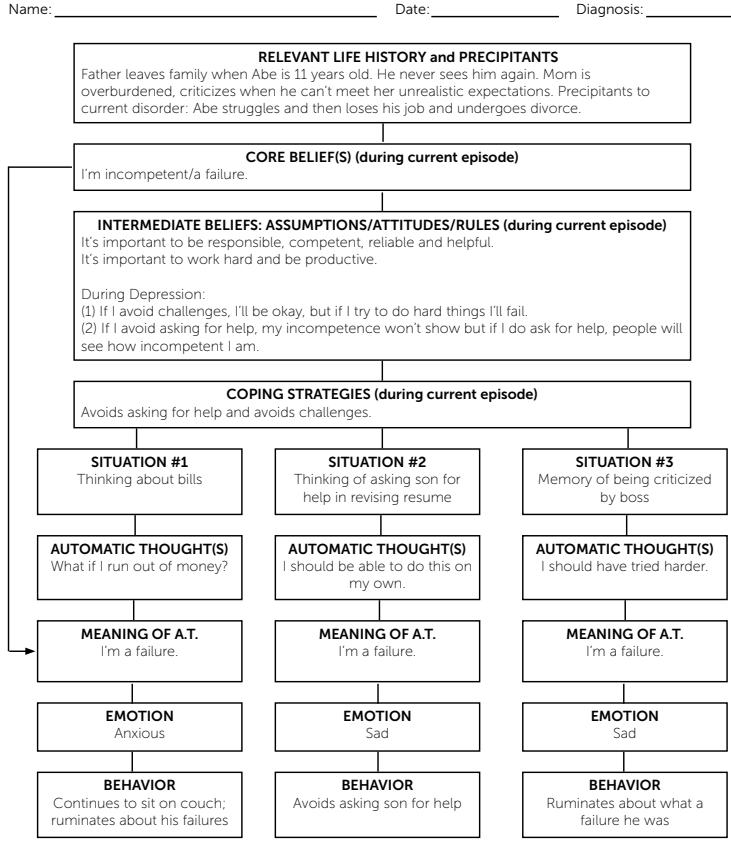
Standard training involves giving students a filled-out diagram like the one above to study. However, in the real world, patients don’t walk in with a diagram. They walk in with a jumble of stories, complaints, and silences. The therapist’s job is to listen, ask the right questions, and mentally construct this diagram to understand how to help.
This is the skill PATIENT-\(\Psi\) is designed to teach.
Core Method: Building a Better Simulated Patient
The researchers identified two major challenges in using AI for therapy training: Fidelity (making the AI sound like a real person with a disorder, not a textbook) and Effectiveness (ensuring the training actually helps).
To solve this, they didn’t rely on the LLM’s raw training data alone. They built a structured pipeline that injects clinical expertise into the generation process.
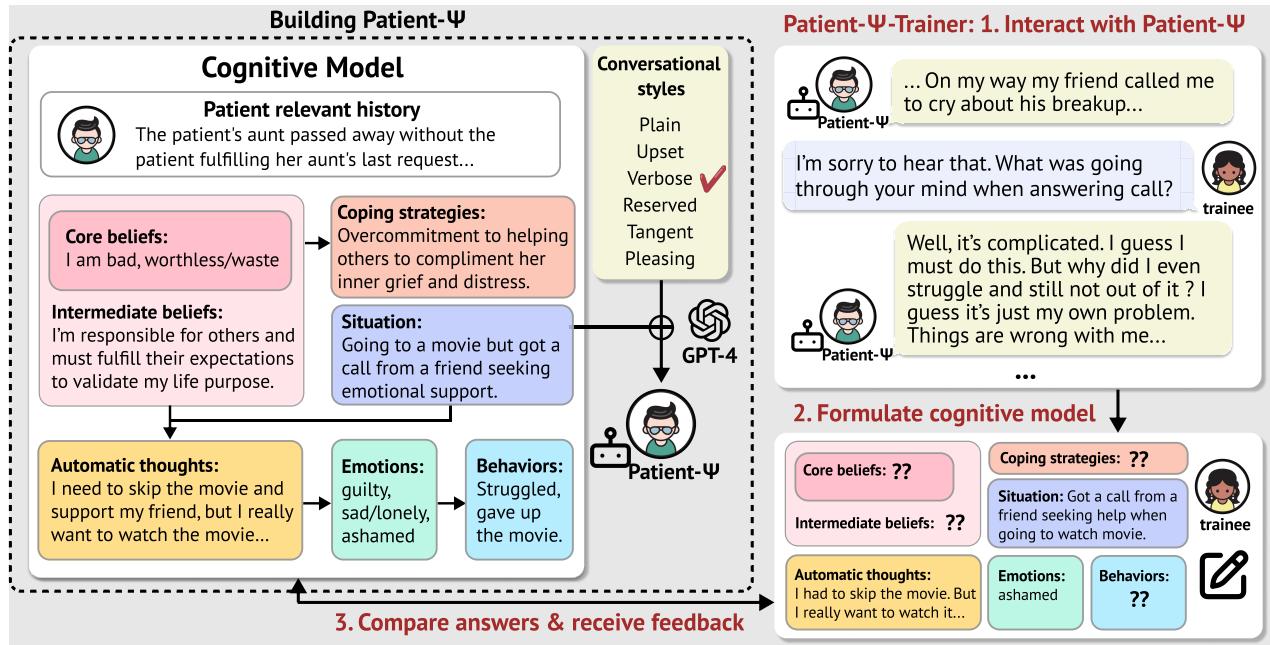
The framework, shown in Figure 2, consists of two main parts: constructing the simulated patient (PATIENT-\(\Psi\)) and the interactive training environment (PATIENT-\(\Psi\)-TRAINER).
1. The PATIENT-\(\Psi\)-CM Dataset
The foundation of this system is a high-quality dataset of cognitive models. Because real patient data is private, the authors collaborated with clinical psychologists to create PATIENT-\(\Psi\)-CM.
They started by having GPT-4 summarize transcripts from real therapy sessions (anonymized). Then, clinical psychologists used these summaries as inspiration to hand-craft 106 diverse Cognitive Models. These models cover various contexts, such as family dynamics, workplace pressure, and relationship issues.
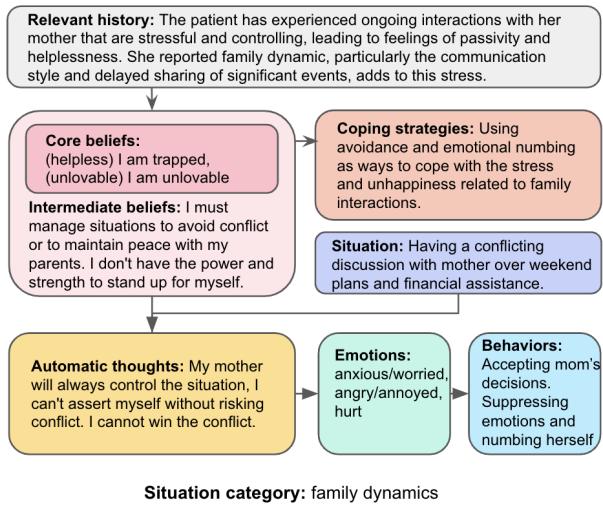
As seen in the example above (Figure 8), these aren’t just character descriptions. They are structured data files linking a patient’s history to their specific automatic thoughts and behaviors. This structure acts as the “soul” of the simulated patient.
2. Programming the LLM
Once the cognitive models were created, the researchers used them to program the LLM. Instead of a generic prompt like “You are sad,” the system feeds the LLM the specific Core Beliefs, Coping Strategies, and Automatic Thoughts from the dataset.
This ensures consistency. If the cognitive model says the patient believes “I am incompetent,” the LLM will generate dialogue that reflects that insecurity, even if the user asks a question the developers didn’t anticipate.
3. Conversational Styles: Adding the “Messiness”
Real patients are rarely straightforward. They might be angry, shy, or overly talkative. A key contribution of this paper is the integration of Conversational Styles.
The researchers conducted formative interviews with experts who complained that role-play partners were often “too perfect.” To address this, they defined six specific styles that PATIENT-\(\Psi\) can adopt.
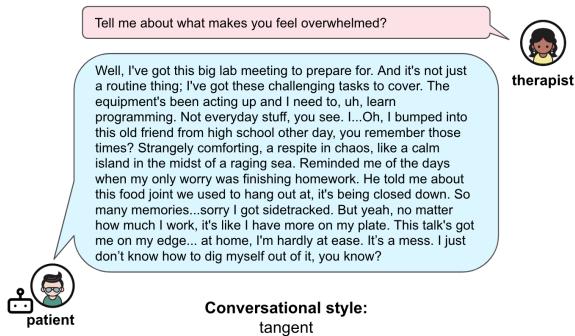
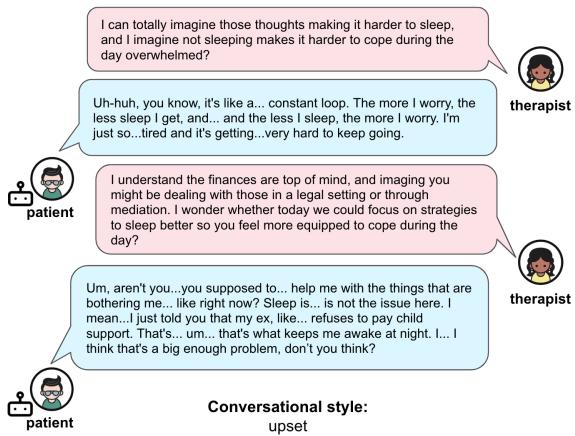
These styles range from “Plain” (easy) to “Tangent” (the patient keeps changing the subject) or “Upset” (the patient is hostile). This curriculum allows trainees to practice dealing with difficult interpersonal dynamics, not just the clinical diagnosis.
For example, an “Upset” patient might resist the therapist’s attempts to help, a common but challenging scenario for beginners:
4. The Interactive Trainer
The final piece of the puzzle is the PATIENT-\(\Psi\)-TRAINER. This is the web application where the training takes place.
The workflow is distinct from standard chatbot interactions:
- Selection: The trainee selects a conversational style (e.g., “Reserved”).
- Interaction: The trainee chats with the AI, asking questions to uncover the underlying cognitive model.
- Formulation: As they chat, the trainee fills out a blank CCD form on the side of the screen.
- Feedback: This is the most critical step. Because the simulated patient was generated from a specific ground-truth cognitive model, the system can instantly compare the trainee’s answers to the original model.
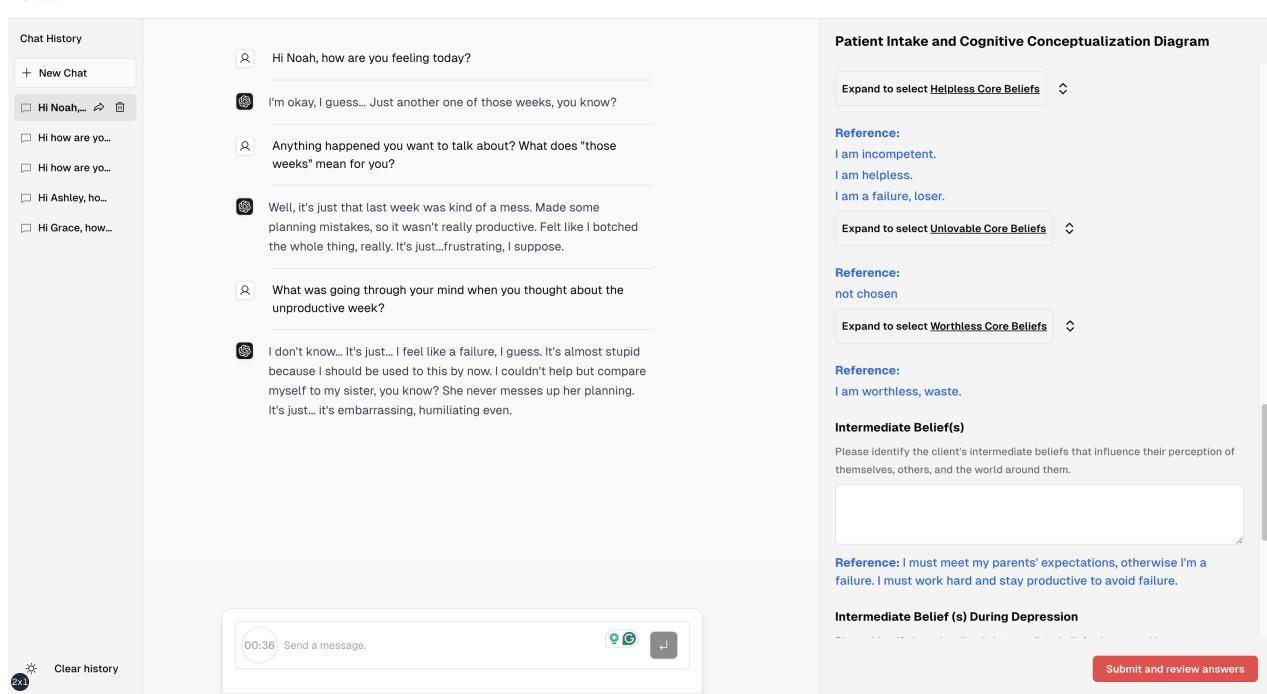
This feedback loop (shown in Figure 27) allows for independent practice. A student doesn’t need a supervisor watching over their shoulder to know if they correctly identified the patient’s “Core Belief.”
Experiments & Results
To validate their framework, the authors conducted a user study with 20 mental health experts (clinical psychologists and social workers) and 13 trainees. They compared PATIENT-\(\Psi\) against two baselines:
- Vanilla GPT-4: A strong LLM prompted to act as a patient but without the specific Cognitive Model structure or conversational styles.
- Traditional Methods: Textbooks, videos, and peer role-play.
RQ1: Fidelity to Real Patients
Does PATIENT-\(\Psi\) actually feel like a real patient? The experts said yes.

As shown in the left chart of Figure 3, experts rated PATIENT-\(\Psi\) significantly higher than the GPT-4 baseline across all dimensions:
- Maladaptive Cognitions: The AI better reflected unhealthy thinking patterns.
- Emotional States: The emotions expressed were more nuanced and realistic.
- Conversational Style: The communication felt more natural.
Experts noted that the baseline GPT-4 often felt “too helpful”—almost like talking to another therapist rather than a patient. PATIENT-\(\Psi\), by contrast, captured the resistance, hesitation, and complexity of real mental health struggles.
RQ2: Training Effectiveness
Does interacting with this system actually help students learn?
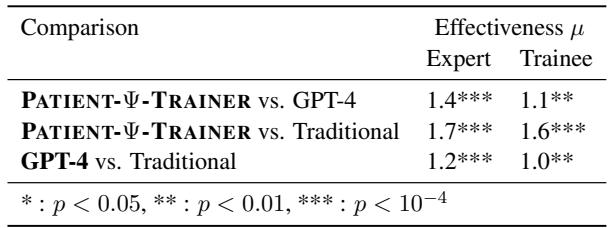
Both experts and trainees perceived PATIENT-\(\Psi\)-TRAINER as significantly more effective than traditional methods (Table 4). Trainees reported higher confidence in their ability to formulate cognitive models after using the tool.
A major factor was the Conversational Styles. 100% of experts preferred the option to practice with different styles, noting that it prepared students for the “curveballs” real patients throw.
RQ3: The Failure of Automated Evaluation
One of the most fascinating findings in the paper was a technical one regarding how we evaluate these systems.
In the AI field, it is common to use strong LLMs (like GPT-4) to judge the output of other models. The researchers tried this, asking GPT-4 and Llama-3 to rate the “fidelity” of the simulated patients.
The result? The LLMs disagreed with the human experts.
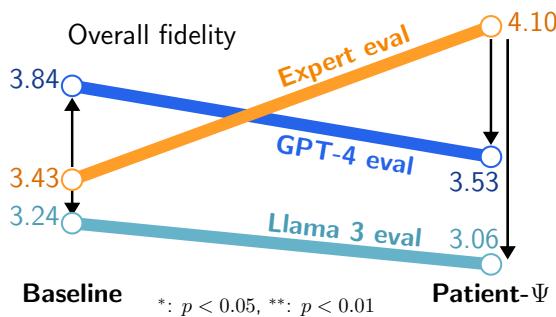
Look at the divergent trends in Figure 5. The orange line (Human Experts) goes up for PATIENT-\(\Psi\), meaning they found it more realistic. The blue and green lines (AI Judges) go down.
The AI judges preferred the Vanilla GPT-4 baseline. Why? Likely because the baseline is “cleaner,” more explicit, and uses more standard language. Real mental illness, however, is often messy, implicit, and confusing. The AI judges penalized the simulation for being too realistic, mistaking human-like imperfection for low quality. This finding serves as a warning for future researchers: you cannot rely solely on AI to evaluate domains requiring deep human expertise.
Conclusion
The PATIENT-\(\Psi\) framework represents a significant step forward in the intersection of Artificial Intelligence and mental health training. By moving beyond simple prompting and grounding the AI in the rigorous theoretical framework of Cognitive Behavioral Therapy, the researchers created a tool that offers both high fidelity and high educational value.
The key takeaways from this work are:
- Structure Matters: Feeding an LLM a psychological “Cognitive Model” produces better, more consistent patient simulations than generic prompts.
- Diversity is Key: Incorporating conversational styles (like being reserved or upset) is essential for realistic training.
- Feedback Loops: Because the AI is generated from structured data, the system can provide objective feedback to students, enabling scalable, independent learning.
- Human Evaluation is Essential: Current LLMs are not yet capable of judging the nuance of realistic patient interactions, often preferring “robotic perfection” over human reality.
For the trainees of today, this technology offers a safe sandbox to make mistakes, learn, and grow. For the patients of tomorrow, it promises a generation of therapists who are better prepared, more confident, and ready to listen.