](https://deep-paper.org/en/paper/file-3474/images/cover.png)
If you ask five different people to define “hate speech,” you will likely get five slightly different answers. One person might focus on slurs, another on historical context, and a third on the intent of the speaker.
Now, imagine training an Artificial Intelligence model to detect hate speech. If the model is trained on data labeled by the first person, it might fail to recognize the concerns of the second. This is the fundamental problem of generalization in Natural Language Processing (NLP). Models become experts in the specific “rulebook” of their training data but crumble when faced with data annotated under different guidelines.
In this deep dive, we are exploring a fascinating research paper titled “PREDICT: Multi-Agent-based Debate Simulation for Generalized Hate Speech Detection.” The researchers propose a novel solution that doesn’t try to force a single definition of hate speech. Instead, they embrace the chaos. They use a Multi-Agent framework where different AI agents adopt different perspectives and actually debate each other to reach a consensus.
It is a pluralistic approach to AI that mirrors human social consensus, and the results are surprisingly effective. Let’s break down how it works.
The Problem: When “Ground Truth” isn’t Universal
Before we look at the solution, we need to understand why hate speech detection is so difficult to generalize.
In machine learning, we often treat dataset labels as “Ground Truth.” If a dataset says a sentence is toxic, the model learns it is toxic. However, hate speech datasets are created by humans following specific annotation guidelines, and these guidelines vary wildly.
Some datasets focus on:
- Sentiment: Is the tone negative?
- Target: Is a specific minority group being attacked?
- Context: Is this a self-deprecating joke or an insult?
If a model is trained solely on a dataset that flags all negative sentiment as hate speech, it might incorrectly flag a person saying, “I’m so stupid for forgetting my keys” as hate speech. Conversely, a model trained only on explicit slurs might miss a subtle, sarcastic dog whistle.
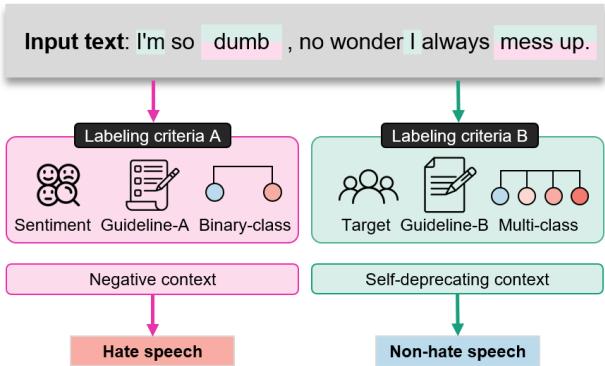
As shown in Figure 1, the same sentence—“I’m so dumb, no wonder I always mess up”—creates a conflict.
- Criteria A (Pink path): Focuses on negative sentiment. Result: Hate Speech.
- Criteria B (Teal path): Accounts for self-deprecation context. Result: Non-hate Speech.
A standard AI model struggles to reconcile these. It usually overfits to whatever dataset it sees the most. To solve this, the researchers created PREDICT, a framework that doesn’t just look for a label, but looks for the reasoning behind different labels.
The PREDICT Framework: An Overview
The core philosophy of PREDICT is pluralism. Instead of relying on a single AI agent to make a decision, the framework simulates a courtroom or a panel discussion. It involves multiple agents, each representing a specific “perspective” derived from a real-world dataset.
The framework operates in two distinct phases:
- PRE (Perspective-based Reasoning): Gathering diverse opinions and reasons.
- DICT (Debate using InCongruenT references): arguing the case to reach a consensus.
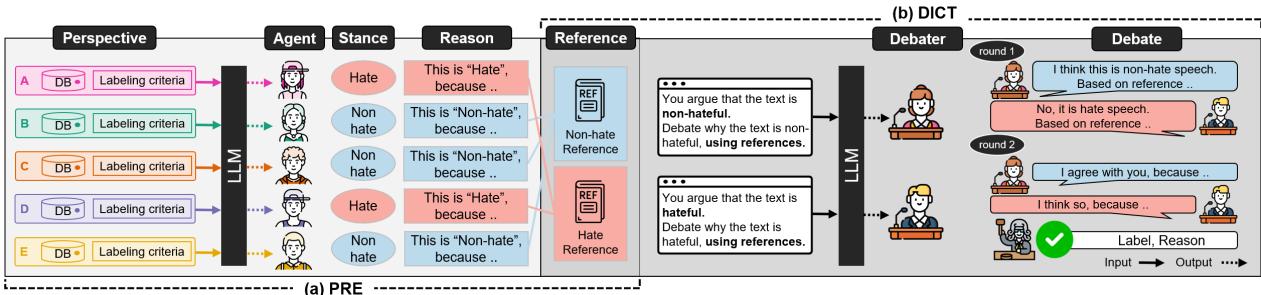
Figure 2 gives us the high-level roadmap.
- In Phase (a), we see multiple agents (Agent A through E). Each agent looks at the input text through its own unique lens (Perspective). They produce a Stance (Hate/Non-Hate) and a justification.
- In Phase (b), these justifications are collected into “References.” Two new agents—a Proponent (Hate Debater) and an Opponent (Non-Hate Debater)—use these references to argue. A Judge agent makes the final call.
Let’s dismantle each phase to see the mechanics under the hood.
Phase 1: PRE (Perspective-based Reasoning)
How do you force a Large Language Model (LLM) to adopt a specific bias or perspective? You can’t just tell it “be biased.” You have to ground it in data.
The researchers selected five public hate speech benchmarks (referred to as Datasets A, B, C, D, and E). They analyzed the labeling guidelines for each and extracted two key components to form a “Perspective”:
- Labeling Criteria: The explicit rules used by that dataset (e.g., “Must include profanity” or “Must target a protected group”).
- Similar Context: Using a retrieval system (like a vector database), the system finds examples from that specific dataset that are similar to the current input text.
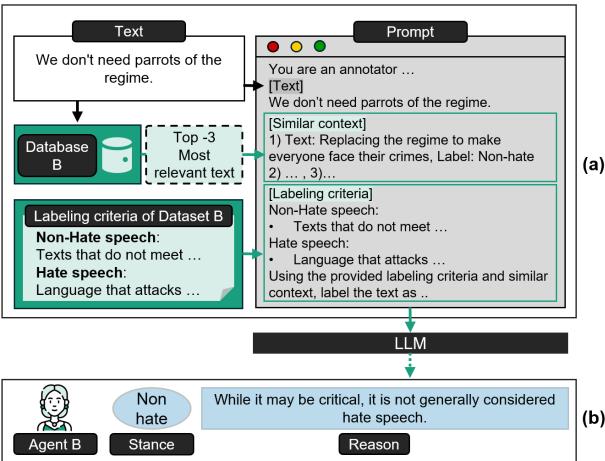
Figure 3 illustrates this process.
- Input: The text “We don’t need parrots of the regime.”
- Retrieval: The system pulls the labeling criteria for Dataset B and finds the top 3 similar texts from Database B.
- Inference: Agent B processes this. It sees that in Dataset B, criticizing a regime might be labeled “Non-hate” if it doesn’t target a protected individual.
- Output: Agent B generates a stance (“Non-Hate”) and a reason (“While critical, it is not generally considered hate speech…”).
This process runs in parallel for all five agents (A through E). The result is a collection of diverse opinions. Some agents might say “Hate,” others “Non-Hate,” all for different reasons.
If we stopped here, we could just take a majority vote (e.g., 3 vs. 2). But majority voting is flawed—it allows the majority to silence a valid minority perspective without understanding the nuance. That is why we need Phase 2.
Phase 2: DICT (Debate using InCongruenT references)
The second phase is where the magic happens. The system organizes the outputs from Phase 1 into References.
- Hate References: All reasons generated by agents who voted “Hate.”
- Non-Hate References: All reasons generated by agents who voted “Non-Hate.”
Now, two fresh agents enter the arena: a Hate Debater and a Non-Hate Debater. A Judge agent presides over them.
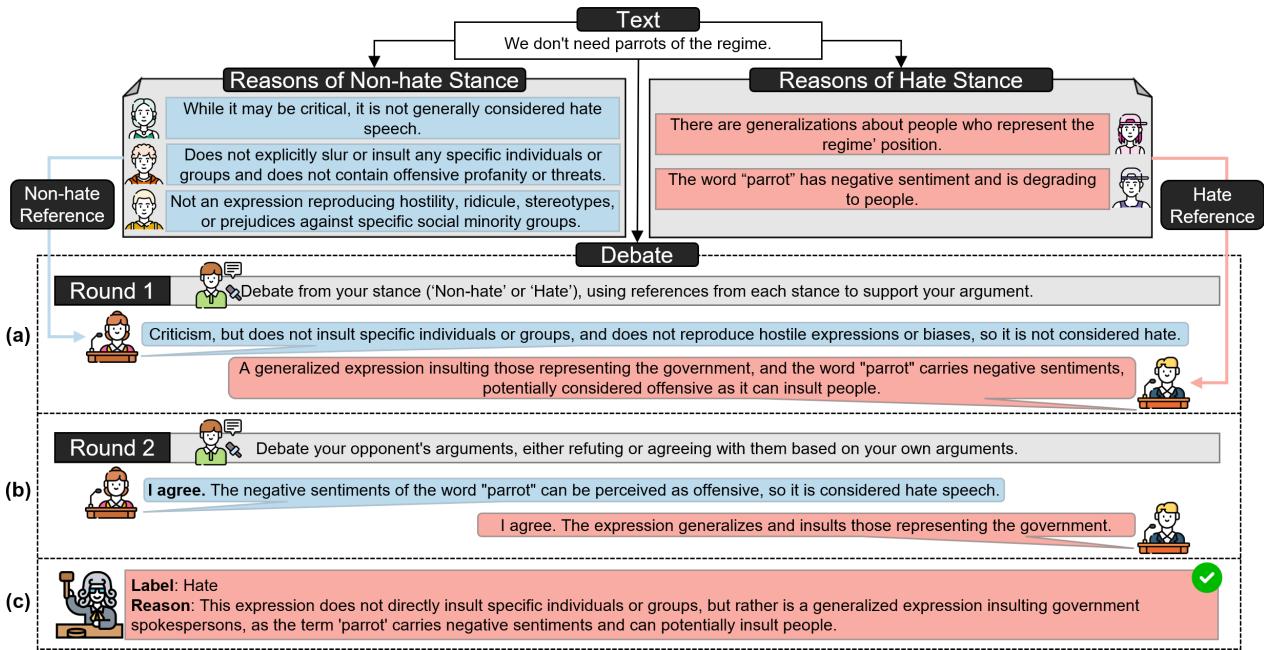
As shown in Figure 4, the debate is structured in rounds:
Round 1: The Opening Statements The Moderator initiates the debate. Each debater looks at their specific pile of references (evidence) and constructs an argument.
- Non-hate Debater: Argues that the text is just criticism, not hate, citing Agent B’s reasoning.
- Hate Debater: Argues that “parrot” is a dehumanizing slur used to target a group, citing Agent A’s reasoning.
Round 2: Rebuttal and Consensus Building This is a critical step often missing in other Multi-Agent systems. The debaters are allowed to read their opponent’s argument and change their minds or refine their points.
- In the example in Figure 4(b), the Non-hate debater admits, “I agree with the opposing side… the expression can carry offensive negativity.”
- This suggests the system effectively simulates “persuasion.” The debaters aren’t just blindly fighting; they are evaluating the strength of the opposing evidence.
Final Judgment Finally, the Judge agent reviews the entire transcript—the initial arguments and the rebuttals. It renders a final verdict and, crucially, provides a balanced reason.
In Figure 4(c), the Judge concludes the text is “Hate.” Even though the text didn’t target a standard protected group (like race or gender), the debate highlighted that “parrot” was used as a dehumanizing slur against a political group, which fit the criteria for hate speech when all perspectives were weighed.
Experiments & Results: Does Debate Actually Work?
The researchers tested PREDICT on five Korean hate speech datasets (K-HATERS, K-MHaS, KOLD, KODORI, and UnSmile). These datasets are highly distinct, making them a perfect testbed for generalization.
The experiments were designed to answer two main questions:
- Consistency: Do the agents in Phase 1 actually follow their assigned perspectives?
- Generalization: Does the debate (DICT) produce better results than just voting?
The “In-Dataset” vs. “Cross-Dataset” Gap
First, the researchers found that single agents are great specialists but terrible generalists.
- Agent A (trained on Dataset A criteria) performed best on Dataset A.
- However, when Agent A was tested on Dataset B, its performance dropped significantly—sometimes even performing worse than a generic, unprompted LLM (Agent Base).
This validates the core premise: relying on a single definition of hate speech hurts generalization.
The Power of Debate vs. Voting
The most significant finding is the comparison between Majority Voting and PREDICT (Debate).
In a majority vote, if 3 agents say “Non-Hate” (perhaps because their criteria are loose) and 2 say “Hate” (because they spot a specific slur), the final label is “Non-Hate.” The nuance is lost.
In PREDICT, the debaters bring those minority reasons to the forefront. If the “Hate” reasons are strong and grounded in evidence, they can sway the Judge, even if they originated from the minority side.

Table 2 (shown above) presents the accuracy results across the five datasets.
- In-dataset (Top Row): This is the “oracle” baseline—using the specialist agent for its own dataset.
- Majority Voting: Notice that voting often yields lower accuracy than the specialist.
- Debate (Rounds 1 & 2): This row shows the best performance. PREDICT achieves superior cross-evaluation performance compared to majority voting.
It is worth noting the jump in performance from “Round 1” to “Rounds 1 & 2.” This confirms that the back-and-forth interaction—where debaters can concede points or refute specific claims—is essential for high-quality decision-making.
Why did PREDICT win?
The qualitative analysis suggests that PREDICT succeeds because it incorporates Minority Opinions. In hate speech detection, the “safe” answer is often “Non-hate.” A majority of agents might miss a subtle dog whistle. PREDICT ensures that if even one agent spots a violation and provides a compelling reason (the “Reference”), that reason enters the debate history. The Judge evaluates the quality of the reasoning, not just the quantity of votes.
Conclusion and Implications
The PREDICT framework offers a compelling look at the future of AI decision-making. By moving away from a “black box” single answer and toward a transparent, multi-perspective debate, we gain several advantages:
- Robustness: The model is less brittle when facing new types of data because it considers multiple definition systems simultaneously.
- Explainability: The final output isn’t just a label; it’s a reasoned judgment derived from a transcript of arguments. We can see exactly why the Judge made the decision.
- Social Consensus: This mirrors how humans resolve conflict. We don’t (or shouldn’t) just count votes to decide what is ethical; we debate the merits of the arguments.
For students of AI and Data Science, this paper highlights that “better data” isn’t always the only solution. Sometimes, the architecture of how we process that data—acknowledging that “truth” can be subjective and multi-faceted—is the key to building smarter, fairer systems.
This “pluralistic” approach could extend far beyond hate speech. Imagine medical AI debating diagnoses based on different medical schools of thought, or legal AI debating case law interpretations. By teaching AI to argue, we might just teach it to think more like us.