](https://deep-paper.org/en/paper/file-3483/images/cover.png)
In the rapidly evolving landscape of Artificial Intelligence, two giants stand tall but rarely hold hands: Deep Learning Recommendation Models (DLRMs) and Large Language Models (LLMs).
DLRMs are the silent engines behind your TikTok feed, your Amazon suggestions, and your Netflix homepage. They excel at “Collaborative Filtering”—predicting what you might like based on the mathematical patterns of millions of other users. However, they are often “black boxes”; they can tell you what to watch, but they can rarely explain why in human terms.
On the other hand, LLMs (like GPT-4) are masters of language and reasoning. They understand that “The Dark Knight” and “Oppenheimer” share a director, even if the genres differ. Yet, LLMs historically struggle with recommendation tasks because they lack that collaborative intuition. They don’t inherently know what user #4592 bought last Tuesday, nor can they easily process the massive, sparse datasets required to find those patterns.
This brings us to a fascinating research paper: “PepRec: Progressive Enhancement of Prompting for Recommendation.” The researchers propose a novel framework that bridges this gap. PepRec allows an LLM to perform collaborative filtering without complex training, effectively teaching the model to “browse” through similar users’ histories to refine its predictions.
In this post, we will dissect how PepRec works, why it represents a paradigm shift in recommendation systems, and how it utilizes a “training-free” approach to outperform traditional deep learning models.
The Problem: Content vs. Collaboration
To understand why PepRec is necessary, we must first distinguish between the two primary engines of recommendation.
- Content-Based Filtering: This relies on item attributes. If you liked a book about “Space Travel,” the system recommends another book tagged “Sci-Fi.” LLMs are naturally brilliant at this because they understand the semantic relationship between words and concepts.
- Collaborative Filtering: This relies on user behavior. If User A and User B both liked Items X and Y, and User A likes Item Z, the system infers User B will also like Item Z. Traditional DLRMs dominate here because they learn dense vector representations (embeddings) of user interactions.
The Limitation of Current LLM Approaches
Previous attempts to bring LLMs into recommendation systems (like LLM4RS or TALLRec) usually involved converting a user’s history into a text prompt: “User watched Movie A, Movie B, and Movie C. Will they like Movie D?”
This works for content matching, but it fails to capture the “wisdom of the crowd.” The LLM is isolated; it only sees the current user’s history. It misses the collaborative signal that traditional models capture so well. Furthermore, trying to “teach” an LLM collaborative filtering through fine-tuning is computationally expensive and time-consuming.
PepRec (Progressive Enhancement of Prompting) solves this by feeding the collaborative signal into the prompt itself, iteratively refining the LLM’s understanding of the user.
The Solution: The PepRec Framework
PepRec is a training-free framework. This means it doesn’t require updating the weights of the LLM (like GPT-4). Instead, it uses a clever architecture of clustering and iterative prompting to extract preferences.
The method operates in two distinct phases: User Clustering (preparation) and Inference (prediction).
Phase 1: User Clustering
Before we can ask the LLM to look at “similar users,” we must define who those similar users are. Since sending the entire database to an LLM is impossible due to token limits, PepRec organizes users into clusters first.
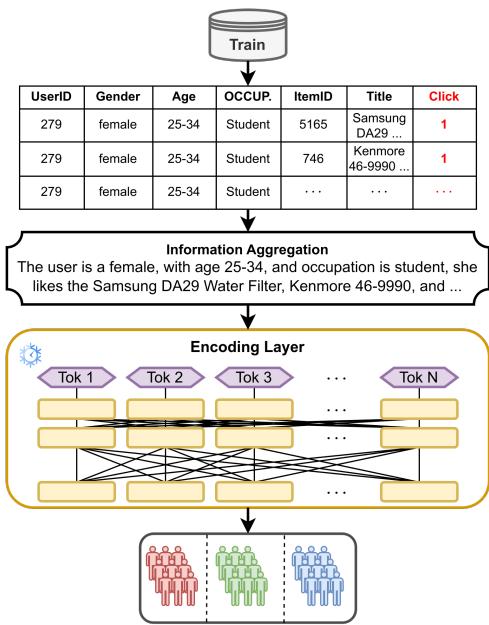
As shown in Figure 4, the system takes the raw training data—User IDs, demographics (age, occupation), and interaction history—and aggregates it into a textual profile.
- Data Aggregation: The system compiles a user’s meta-features and item history into a sentence (e.g., “The user is a female… she likes Samsung DA29…”).
- Encoding: This text is passed through a pre-trained sentence transformer (like Sentence-BERT) to create a fixed-size vector.
- Clustering: A K-Means algorithm groups these vectors. Users with similar tastes and demographics end up in the same cluster.
This step is crucial because it creates a searchable “neighborhood” for every user, which acts as the foundation for the collaborative filtering that happens next.
Phase 2: The Inference Workflow
This is where the magic happens. When a request comes in to predict whether a specific user (let’s call her Alice) will like a specific item, PepRec doesn’t just ask the LLM immediately. It goes through a cycle of Bootstrapping, Preference Generation, and Prompt Enhancement.
Take a look at the detailed workflow below:
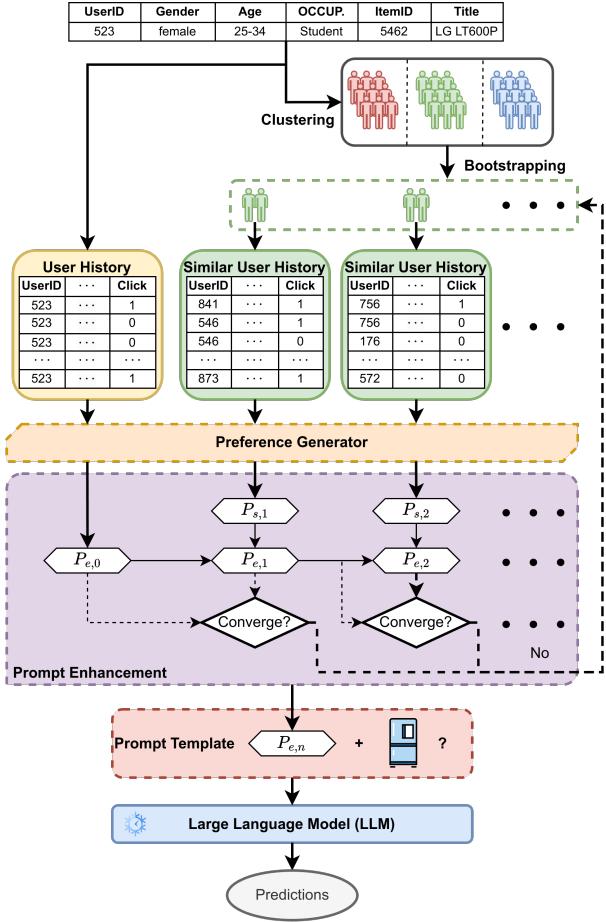
Let’s break down the steps illustrated in Figure 1:
- Cluster Assignment: Alice (User 523) is mapped to her pre-defined cluster.
- Bootstrapping: The system identifies a list of “neighbor” users within that cluster.
- Iterative Enhancement:
- The system generates a summary of Alice’s preferences based on her own history.
- It then samples history from her neighbors.
- It asks the LLM to refine Alice’s profile based on what her neighbors liked.
- This loop continues until the profile “converges” (i.e., new neighbors stop adding new useful information).
- Final Prediction: The fully enhanced prompt is sent to the LLM to predict the probability of a click.
The Preference Generator
How does PepRec turn a list of clicks into a meaningful psychological profile? It uses a module called the Preference Generator.
Raw data (User 841 clicked Item 1234) is hard for an LLM to digest as a personality trait. PepRec splits the history into “Likes” (positive interactions) and “Dislikes” (negative interactions) and processes them separately before combining them.
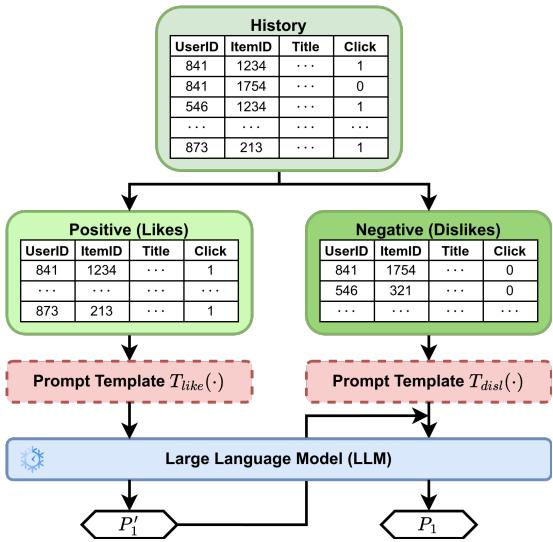
As seen in Figure 2, the generator uses specific prompt templates (\(T_{like}\) and \(T_{disl}\)) to summarize the raw list into a concise description (\(P'_1\)).
For example, instead of just listing 20 beauty products, the LLM summarizes: “The user prefers organic skincare and avoids products with strong fragrances.”
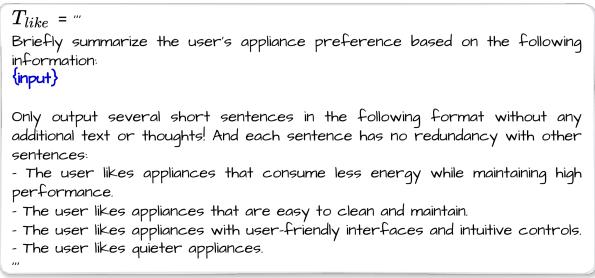
Here is the actual template used for summarizing likes (\(T_{like}\)):
And the template for dislikes (\(T_{disl}\)):
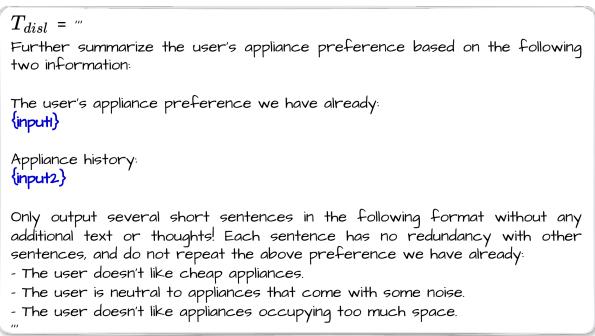
By converting raw IDs and titles into semantic preferences, PepRec compresses massive amounts of interaction data into a format that fits within an LLM’s context window while retaining the “reasoning” behind the behavior.
Progressive Prompt Enhancement (Collaborative Filtering)
This is the core innovation of PepRec. A user’s own history is often sparse. Maybe Alice has only bought three items. It’s hard to build a robust profile from just that.
PepRec uses Bootstrapping to borrow wisdom from neighbors.
- Initial Prompt (\(P_{e,0}\)): Generated solely from Alice’s history.
- Neighbor Sampling: The system picks a small batch (e.g., 5 users) from Alice’s cluster.
- Integration: The LLM is asked: “Given that Alice is similar to these users, and these users like X, Y, and Z, update Alice’s preference profile.”
- Similarity Check: The system compares the new profile (\(P_{e,1}\)) with the old one (\(P_{e,0}\)) using cosine similarity.
- If the similarity is low (meaning the profile changed significantly), it means we learned something new! We repeat the process with more neighbors.
- If the similarity is high (the profile didn’t change much), we have converged. We stop adding neighbors to save cost and time.
This mimics how humans make decisions. We look for advice from friends until we feel confident we understand the options.
Case Study: Watching the Prompt Evolve
Does this actually work? Let’s look at a real example from the paper to see how the prompt changes after “consulting” similar users.
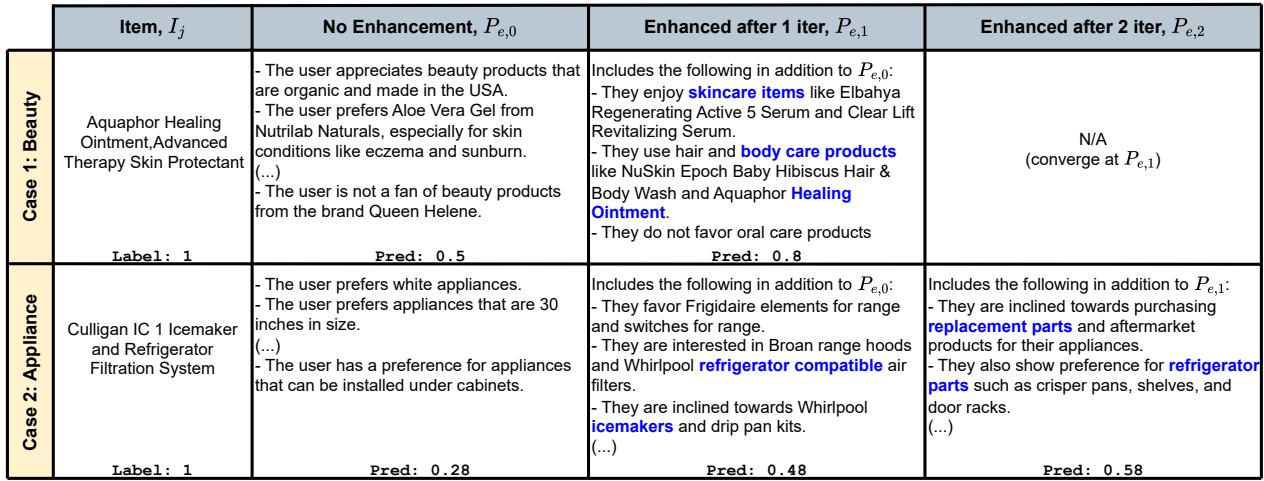
In Figure 3 (top row), look at the recommendation for “Aquaphor Healing Ointment.”
- Initial Prompt (\(P_{e,0}\)): Based on the user’s own limited history, the model only knows they like “organic” products. The prediction is a toss-up (0.5).
- Enhanced Prompt (\(P_{e,1}\)): After looking at neighbors, the profile updates to note that similar users enjoy “skincare items like serums” and “healing ointments.”
- Result: The prediction confidence jumps to 0.8, which matches the ground truth (the user did buy it).
This demonstrates that the collaborative signal (what neighbors bought) successfully augmented the content signal (what the user previously bought).
Experiments and Results
The researchers tested PepRec on two real-world benchmarks: the Amazon Beauty and Amazon Appliance datasets. These datasets contain logs of user interactions (clicks/purchases) and item metadata.
The Competition
PepRec was pitted against two types of baselines:
- Traditional DLRMs: FM, DeepFM, Wide&Deep (WD). These are the industry standards for collaborative filtering.
- Prompt-Based Models: LLM4RS, LLMRec, TALLRec. These are other attempts to use LLMs for recommendation, some of which involve expensive fine-tuning.
The Verdict
The results were statistically significant. PepRec outperformed both traditional deep learning models and other LLM-based approaches.

In Table 1, we look at AUC (higher is better) and Logloss (lower is better).
- On the Beauty dataset, PepRec achieved an AUC of 0.7318, beating the best baseline (ReLLA at 0.6976) by a solid margin.
- On the Appliance dataset, PepRec reached 0.7501, surpassing DeepFM (0.7167) and ReLLA (0.7386).
Key Takeaway: PepRec achieved these results without training parameters. While models like TALLRec and ReLLA required fine-tuning the LLM on recommendation data, PepRec used a fixed LLM (GPT-4) and simply “engineered” the context better using the bootstrapping method.
Hyperparameter Analysis
You might wonder: How sensitive is this method? Does it require hundreds of clusters?
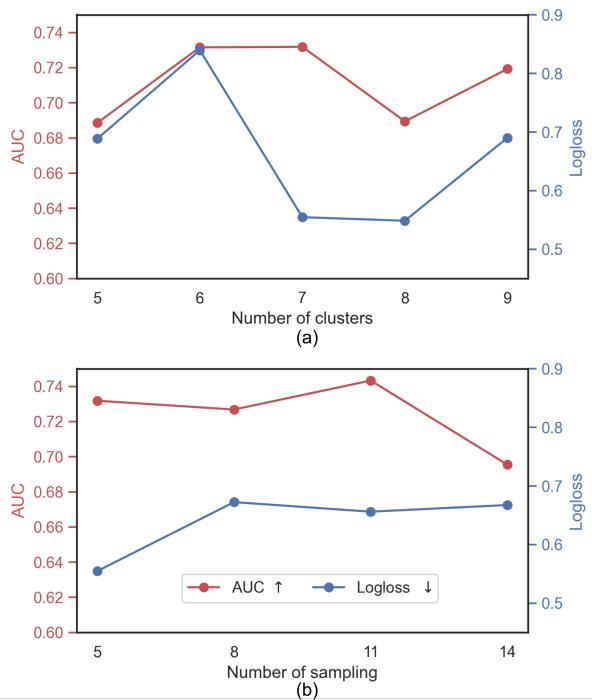
Figure 8 shows the impact of the number of clusters (a) and the number of sampled users (b).
- Clusters: The performance is surprisingly stable with a low number of clusters (around 7 seems optimal). This suggests you don’t need granular, micro-segmentation to get the benefit of collaborative filtering.
- Sampling: Sampling around 11 users for the bootstrap step yields the peak AUC. Sampling too many introduces noise (irrelevant preferences), causing performance to drop.
Does the LLM Backbone Matter?
Since PepRec relies on the reasoning capabilities of the LLM to synthesize preferences, the “intelligence” of the model matters.
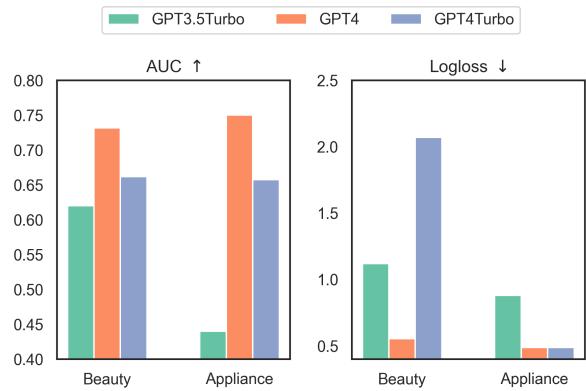
Figure 9 compares GPT-3.5 Turbo, GPT-4, and GPT-4 Turbo.
- GPT-4 (the standard version) consistently performs the best.
- GPT-3.5 Turbo significantly lags behind, likely because it struggles with the complex reasoning required to merge conflicting user histories into a coherent profile.
- Interestingly, GPT-4 Turbo performed worse than standard GPT-4 in these specific tests, perhaps due to calibration issues in probability estimation (Logloss), even if its ranking ability remained decent.
Final Prediction
Once the prompt is fully enhanced with collaborative insights, how does PepRec make the final call? It uses a straightforward template to ask the LLM for a probability score.
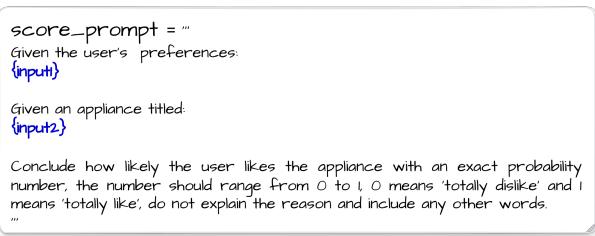
As shown in Figure 7, the system strictly instructs the LLM to output a number between 0 and 1, representing the likelihood of a “like.” This numerical output allows PepRec to be evaluated against standard regression metrics like Logloss, bridging the gap between qualitative text generation and quantitative recommendation scoring.
Conclusion & Implications
The PepRec framework represents a significant step forward in the convergence of Natural Language Processing and Recommendation Systems.
Why this matters:
- Interpretability: Unlike a neural network that outputs a score based on matrix multiplication, PepRec generates a text profile. We can read exactly why the model thinks a user will like an item (e.g., “User prefers appliances that are energy-efficient”).
- Training-Free: Deploying recommendation models usually involves a massive MLOps pipeline to retrain models daily. PepRec shifts the burden to inference time, leveraging pre-trained general knowledge.
- Best of Both Worlds: It successfully adds the “collaborative” layer that LLMs were missing, without losing the semantic understanding that LLMs are famous for.
While there are limitations—specifically the cost of making multiple calls to GPT-4 during inference—the rapid decrease in LLM costs and the rise of smaller, efficient models (like Llama 3) suggest that frameworks like PepRec could soon become a viable standard for personalized, explainable recommendations.
For students and researchers, PepRec demonstrates that we don’t always need “bigger” models or more training data. sometimes, we just need a smarter way to ask the model the right questions.