](https://deep-paper.org/en/paper/file-3526/images/cover.png)
The world of Natural Language Processing (NLP) has been dominated by classical giants—Recurrent Neural Networks (RNNs), LSTMs, and more recently, Transformers. These models rely on massive computational resources and millions (sometimes billions) of parameters to understand human language.
But a new paradigm is emerging: Quantum Computing.
For years, the intersection of Quantum Computing and NLP—often called QNLP—was largely theoretical. However, as we approach the era of “quantum advantage,” researchers are asking a pivotal question: Can quantum models perform sequential tasks like text classification, and can they do it efficiently?
In the paper “Quantum Recurrent Architectures for Text Classification,” researchers from Quantinuum propose a fascinating answer. They developed a hybrid quantum-classical model that mimics the behavior of an RNN but operates within the complex Hilbert space of a quantum computer.
The most shocking finding? Their quantum model, running on just 4 qubits, achieved performance competitive with classical models that use hidden state sizes of 200 dimensions. In this post, we will tear down this architecture, explain how you can turn words into quantum states, and look at the results that suggest quantum models might be leaner and faster learners than their classical cousins.
The Background: From Bits to Qubits
To understand how a Quantum RNN (QRNN) works, we first need to establish a common language regarding quantum mechanics. If you are coming from a classical machine learning background, you are used to vectors of real numbers. Quantum computing changes the playing field by using qubits.
The Qubit and Superposition
A classical bit is either 0 or 1. A qubit, however, exists in a state of superposition. Mathematically, the state of a qubit \(|\psi\rangle\) is a vector in a 2-dimensional complex vector space (a Hilbert space):
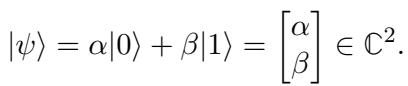
Here, \(\alpha\) and \(\beta\) are complex numbers representing the probability amplitudes. When we measure the qubit, it collapses to either 0 or 1 based on these probabilities.
The Power of Exponential Space
The real magic happens when you stack qubits together. In a classical computer, if you have 2 bits, you have 2 distinct pieces of information. In a quantum computer, a system of 2 qubits is represented by a vector of size 4 (\(2^2\)).

As you can see, the vector size grows exponentially. A 4-qubit system—which this paper utilizes—has a state space of \(2^4 = 16\) complex dimensions. If we had 50 qubits, the state space would be \(2^{50}\), which is massive. This property allows quantum models to represent incredibly complex data structures with very few actual computational units.
Quantum Gates
Just as we use logic gates (AND, OR, NOT) to manipulate bits, we use Quantum Gates to manipulate qubits. These gates are represented by unitary matrices.
A crucial gate for this paper is the Rotation Gate (RX). Unlike a simple “flip” gate, a rotation gate accepts a parameter \(\theta\) (an angle). This allows us to rotate the state of the qubit around an axis on the Bloch sphere by a specific amount.
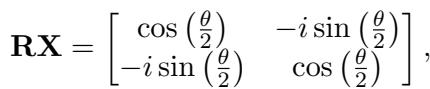
This parametrised nature is what allows us to “train” a quantum circuit. By adjusting the angle \(\theta\), we can change the output of the circuit, just like adjusting weights in a neural network.
The Core Method: Building a Quantum RNN
The researchers proposed a hybrid approach. We cannot simply feed raw text into a quantum circuit; we need a bridge. The architecture involves three main stages:
- Classical Encoding: Converting words into parameters.
- Quantum Processing: Evolving the quantum state (the “hidden state”).
- Measurement: Extracting classical statistics for classification.
1. From Words to Angles
Standard NLP uses word embeddings (like Word2Vec or GloVe) to turn words into vectors of real numbers. The authors keep this step. Each word \(w_i\) is first converted into a classical embedding vector.
However, a quantum circuit doesn’t take vectors; it takes gate parameters (angles). Therefore, the authors use a classical affine transformation (a simple linear layer) to map the word embedding vectors to a set of angles, denoted as \(\theta\).
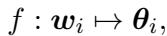
These angles are then used to control the rotation gates inside the quantum circuit. This effectively “encodes” the semantic meaning of the word into the quantum circuit’s operation.
2. The Recurrent Quantum Circuit
The heart of the paper is the recurrent mechanism. In a classical RNN, the “hidden state” is a vector that gets updated at every time step. In this QRNN, the hidden state is the quantum state itself.
The authors propose two architectures, shown below in Figure 1.
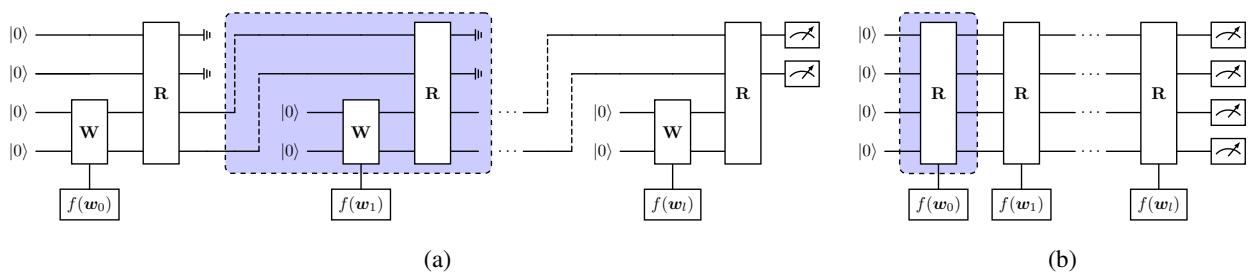
Let’s break down the architecture labeled (a), which is the more sophisticated “Discarding” model:
- Initialization: We start with a set of qubits initialized to \(|0\rangle\).
- Word Ansatz (\(\mathbf{W}\)): The current word in the sentence is encoded onto the bottom two wires using the angles we generated earlier. This creates a quantum representation of the word.
- Recurrent Block (\(\mathbf{R}\)): This is the “brain” of the cell. It takes the previous hidden state (top wires) and the new word state (bottom wires) and entangles them. This mixes the history of the sentence with the new word.
- Discarding: This is the novel part. To maintain a constant number of qubits, the top two wires are “discarded” (conceptually reset or traced out), and the bottom two wires become the new hidden state for the next step. This mimics the flow of information in a classical RNN where new input merges with old memory.
Architecture (b) is simpler. It doesn’t use fresh wires for every word. Instead, it applies the word encoding directly to the existing state.
The “Ansatz” (The Quantum Neural Network)
What exactly happens inside the box labeled \(\mathbf{R}\)? This is a Parametrised Quantum Circuit (PQC). It contains a specific arrangement of gates designed to be highly expressive—meaning it can reach many different states in the Hilbert space.
The authors used a specific configuration (Ansatz 14 from Sim et al., 2019) shown below:
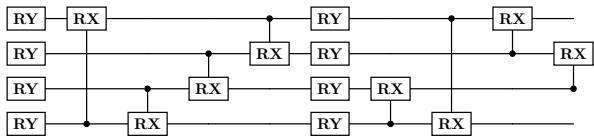
Notice two things:
- Rotations (RY, RX): These gates have parameters that are learned during training.
- Entanglement: The vertical lines represent controlled gates that link qubits together. This creates entanglement, allowing the system to model complex dependencies between the word history and the current input.
3. Measurement and Classification
After the entire sentence has been processed word-by-word, the final quantum state holds the “meaning” of the sentence.
To get a prediction, we perform a measurement on specific qubits (typically in the Z-basis). This collapses the quantum state into real numbers (expectation values). These values act just like the “logits” in a classical neural network. They are fed into a Softmax function to produce a probability distribution (e.g., Positive vs. Negative sentiment).
Experiments and Results
The authors tested this architecture on the Rotten Tomatoes dataset, a standard benchmark for binary sentiment analysis (positive or negative movie reviews).
They compared their Quantum RNN (QRNN) against three classical baselines:
- Standard RNN
- GRU (Gated Recurrent Unit)
- LSTM (Long Short-Term Memory)
The training was performed using exact simulation (calculating the math perfectly on a classical GPU). This allowed them to use backpropagation to optimize the angles in the quantum gates.
The “David vs. Goliath” Comparison
The results are summarized in Table 1 below.
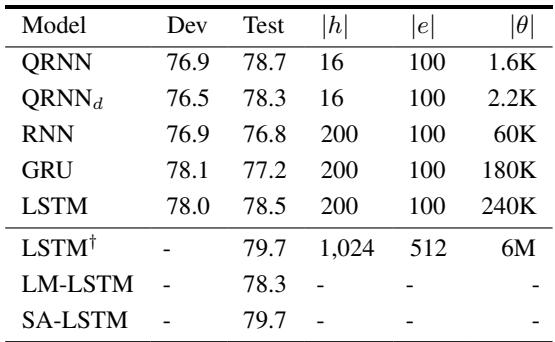
There are two major takeaways from this table:
- Competitive Accuracy: The QRNN achieved 78.7% test accuracy. This is practically identical to the LSTM (78.5%) and GRU (77.2%).
- Parameter Efficiency: Look at the column \(|\theta|\) (parameter count).
- The classical LSTM required 240,000 parameters.
- The classical RNN required 60,000 parameters.
- The QRNN required only 1,600 parameters.
This is the most significant finding. The quantum model achieved similar performance with orders of magnitude fewer parameters. This validates the hypothesis that the high-dimensional Hilbert space of even a small number of qubits (just 4!) offers immense representational power.
Fast Convergence
Not only was the model efficient in size, but it was also efficient in learning. The learning curves below show that the QRNNs (lines with markers) converged to a good solution much faster than the classical baselines (plain lines).
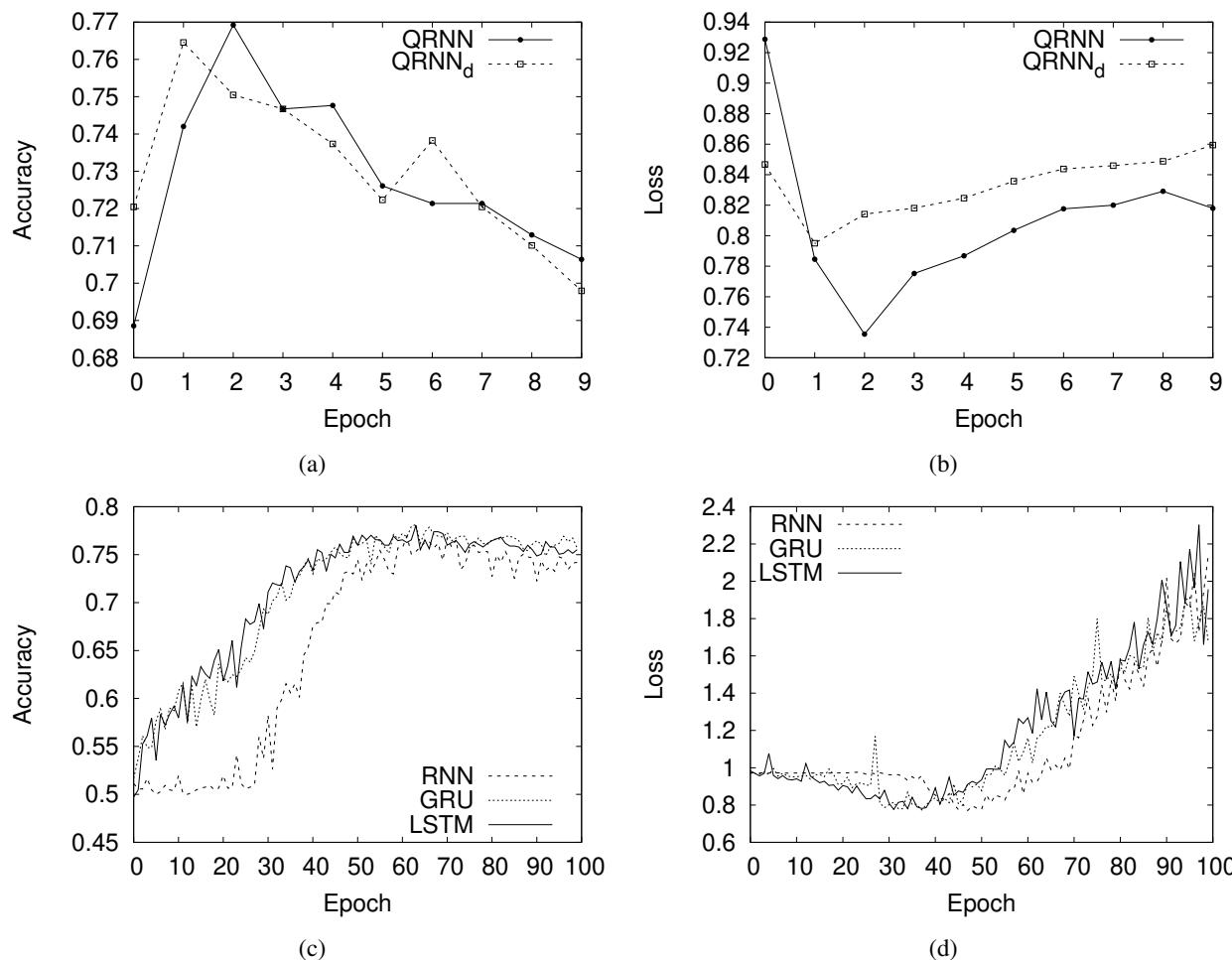
While the classical models took many epochs to slowly climb up to ~78% accuracy, the QRNN shot up almost immediately. This suggests that the optimization landscape for these quantum models might be favorable for this type of task, requiring fewer training iterations.
Real Quantum Hardware Validation
Critics often point out that simulations are perfect, but real quantum computers are noisy. To address this, the authors took their trained models and ran the test set on a Quantinuum H1 emulator. This emulator mimics the actual noise profile and physical constraints of current quantum hardware.
The result? The models retained their high accuracy (around 77-80%), proving that these architectures are robust enough to run on Near-Term Intermediate Scale Quantum (NISQ) devices, not just on theoretical whiteboards.
Conclusion and Implications
The paper “Quantum Recurrent Architectures for Text Classification” provides a compelling proof-of-concept. It demonstrates that we don’t need millions of qubits to start doing interesting things with Quantum NLP.
Key Takeaways:
- Hybrid Power: Combining classical embeddings with quantum processing leverages the best of both worlds.
- The Power of 4: A mere 4 qubits, representing a 16-dimensional complex space, matched the performance of 200-dimensional classical hidden states.
- Efficiency: The quantum models required less than 1% of the parameters used by their classical counterparts.
What does this mean for the future? Currently, we simulate these models because classical GPUs are faster than today’s quantum computers. However, as quantum hardware scales up and error rates drop, these architectures could offer a genuine advantage for modeling complex sequence data. The ability to model long-range dependencies via unitary evolution (which prevents the vanishing gradient problem naturally) is a promising avenue for future NLP research.
While we aren’t going to replace ChatGPT with a 4-qubit circuit tomorrow, this research lays the brickwork for a future where quantum processors might handle the most complex linguistic reasoning tasks with incredible efficiency.