](https://deep-paper.org/en/paper/file-3528/images/cover.png)
The release of Large Language Models (LLMs) like ChatGPT and LLaMA has fundamentally changed how we generate text. From writing emails to coding, the utility is undeniable. However, this power comes with a shadow: academic dishonesty, disinformation campaigns, and sophisticated phishing. To counter this, a new industry of “AI Detectors” has emerged—tools designed to distinguish between human and machine-written content.
But how robust are these guardians?
In this post, we dive deep into a paper titled “RAFT: Realistic Attacks to Fool Text Detectors,” which proposes a novel framework for “red-teaming” (attacking) these detectors. Unlike previous methods that often produce garbled or grammatically incorrect text, RAFT generates attacks that are essentially invisible to the human eye but confusing enough to break the best detectors available.
The Problem: The Fragility of AI Detection
To understand the attack, we first need to understand the defense. Most modern zero-shot detectors (like DetectGPT) work on the principle of likelihood and curvature. They assume that machine-generated text occupies a specific statistical “sweet spot”—it tends to use word patterns that the model itself predicts with high probability.
Attackers, therefore, have a simple goal: modify the machine-generated text just enough to disrupt these statistical patterns without changing the meaning.
Prior attempts at this fell into two buckets:
- Paraphrasing: Rewriting the whole text (e.g., using a tool like DIPPER). This works but often changes the semantic meaning or style too drastically.
- Word Substitution: Swapping words for synonyms. Previous attempts here were often “naive.” They might swap “happy” for “elated” in a context where it doesn’t fit, or break the grammar entirely.
The authors of RAFT identified a gap: Is it possible to modify text so that it fools the detector (lowering the machine-generated score) while remaining grammatically perfect and semantically identical to the original?
The Solution: RAFT (Realistic Attacks to Fool Text Detectors)
RAFT stands for a framework that operates in a black-box setting. This means the attacker does not need to know the inner weights or architecture of the specific detector they are trying to fool. Instead, RAFT exploits a fascinating property of LLMs: the transferability of embeddings.
The method consists of a pipeline designed to surgically alter text. Let’s break down the architecture.
1. The Mathematical Objective
The goal is to take a machine-generated text sequence \(X\) and transform it into a perturbed version \(X'\) such that the detector \(D\) classifies it as human-written. However, this optimization has strict constraints. The new words must match the Part-of-Speech (POS) of the old words, and the total number of changes must be limited (to preserve the original meaning).
This constrained optimization problem is formalized as follows:
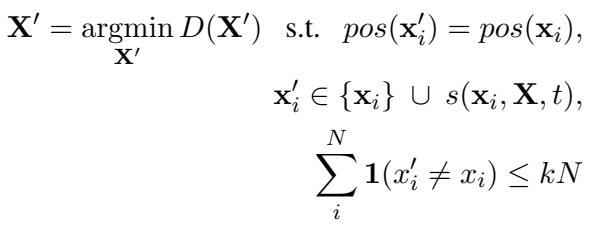
Here, \(pos(\mathbf{x}'_i) = pos(\mathbf{x}_i)\) ensures that if the original word was a noun, the replacement is also a noun. This is critical for maintaining grammatical fluency—a step often ignored by previous attacks.
2. Selecting Weak Points with a Proxy
Because RAFT treats the target detector as a black box, it doesn’t inherently know which words are “giving away” the fact that the text is AI-generated. To solve this, the authors use a proxy scoring model.
They hypothesize that LLMs share a similar “latent semantic space.” Even if you generated text with GPT-3.5, you can use a different model (like OPT-2.7B or BERT) to scan the text and identify “important” words—words that, if changed, would most likely disrupt the statistical signature of the text.
The selection of these candidate words (\(X_k\)) is based on maximizing a proxy function \(F\):

This step allows RAFT to be efficient. Instead of randomly trying to change every word, it targets the 10% of words that matter most.
3. Generative Substitution and Filtering
Once the target words are identified, RAFT doesn’t just look up a thesaurus. It prompts an auxiliary LLM (like GPT-3.5) to generate context-aware synonyms.
The workflow is:
- Prompt: Ask the LLM for replacements for the target word within the specific sentence context.
- Filter: Use a Natural Language Toolkit (NLTK) to strictly enforce Part-of-Speech consistency. If the LLM suggests a verb to replace a noun, it is discarded.
- Greedy Selection: From the remaining valid candidates, RAFT picks the one that reduces the target detector’s score the most.
Visualizing the Impact
The effect of this process is best understood visually. The histograms below show the distribution of detection scores.
- Blue: Human text (centered around 0 or negative).
- Green: Original GPT-3.5 text (high scores, easily detected).
- Orange: RAFT-attacked text.
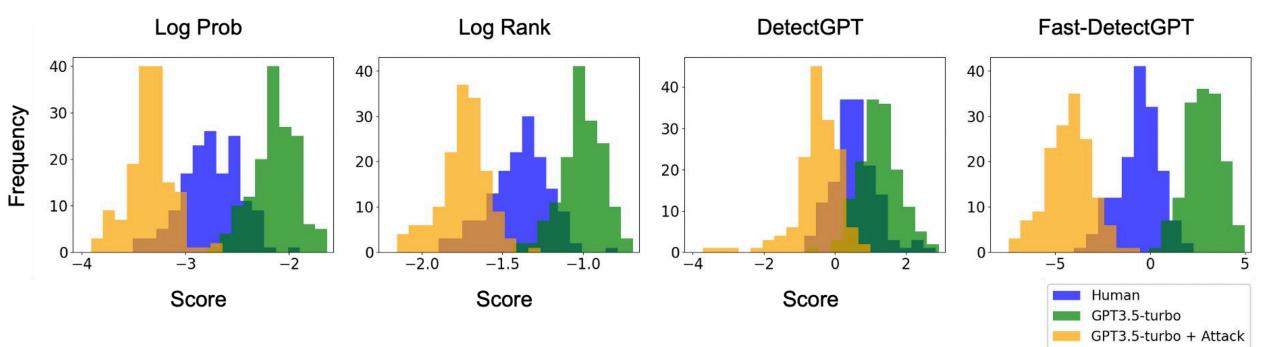
Notice the dramatic shift in the “DetectGPT” and “Fast-DetectGPT” charts. The RAFT attack (Orange) moves the AI text’s score distribution entirely into the region typically occupied by humans. The detector can no longer tell them apart.
Experiments and Results
The researchers evaluated RAFT against state-of-the-art detectors including DetectGPT, Ghostbuster, and Fast-DetectGPT. They used datasets spanning news (XSum), question answering (SQuAD), and academic abstracts.
Attack Success Rate
The primary metric used was AUROC (Area Under the Receiver Operating Characteristic). A score of 1.0 means perfect detection; 0.5 is a random guess. A successful attack should drive the AUROC down significantly.
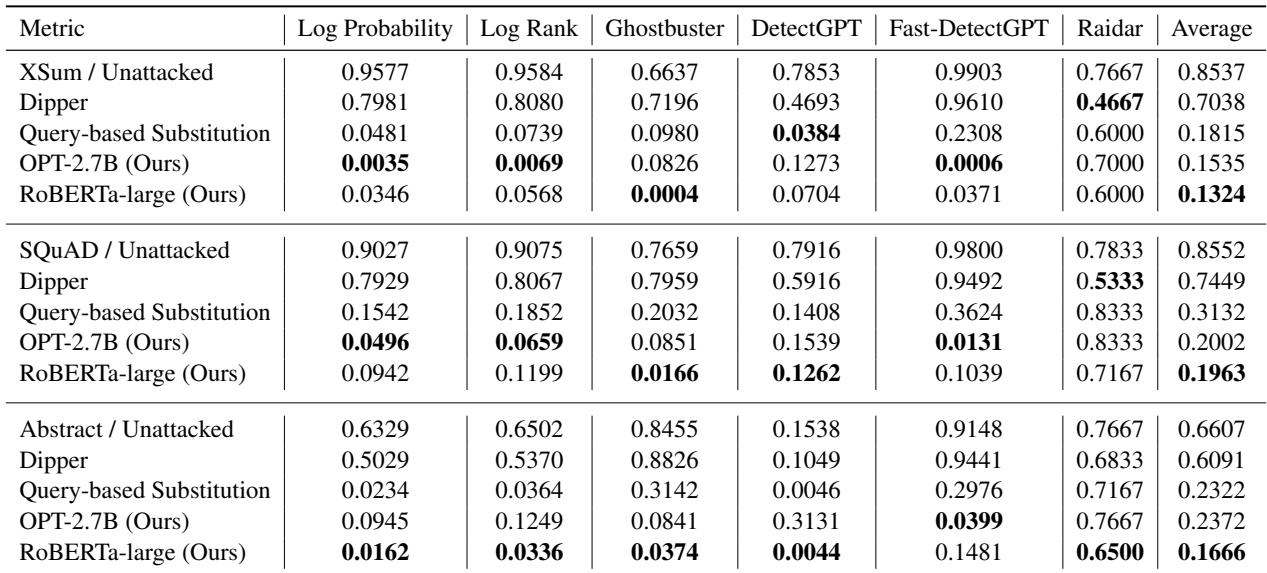
As shown in Table 1, the results are devastating for current detectors.
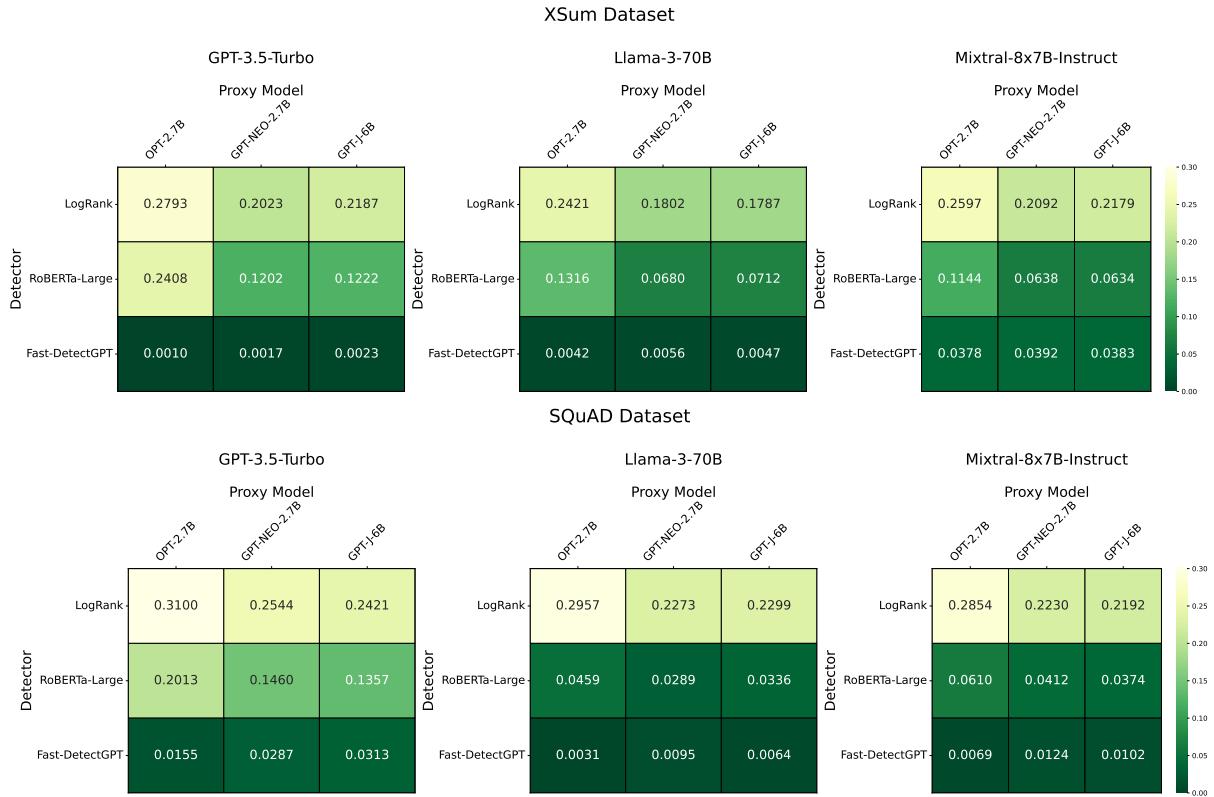
- XSum Dataset: Fast-DetectGPT had a near-perfect detection rate (0.9903). After the RAFT attack using an OPT-2.7B proxy, the score plummeted to 0.0006.
- Comparison: RAFT significantly outperforms “Query-based Substitution” (a previous method) and “Dipper” (paraphrasing). While Dipper lowers detection, it changes the text too much. RAFT breaks the detector while keeping the text structure intact.
Text Quality: The “Realistic” Factor
Breaking a detector is easy if you turn the text into nonsense. The real challenge is maintaining quality. The authors measured Perplexity (a measure of how natural text sounds to an AI) and Cosine Similarity (meaning preservation).

In Table 2, we see that RAFT (specifically with OPT-2.7B) maintains a much lower perplexity (around 17-26) compared to the Query-based Substitution (28-36). This confirms that RAFT-attacked text flows better.
Furthermore, Table 3 confirms the semantic integrity:
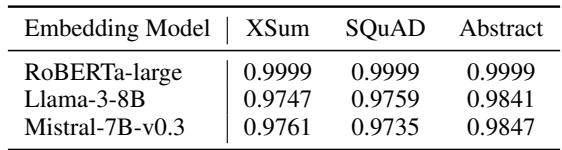
With similarity scores ranging from 0.97 to 0.99, the meaning of the attacked text is virtually identical to the original.
Robustness and Constraints
The authors also conducted ablation studies to understand why RAFT works.
1. Does the Mask Percentage matter? They tested how many words need to be changed to fool the detector.
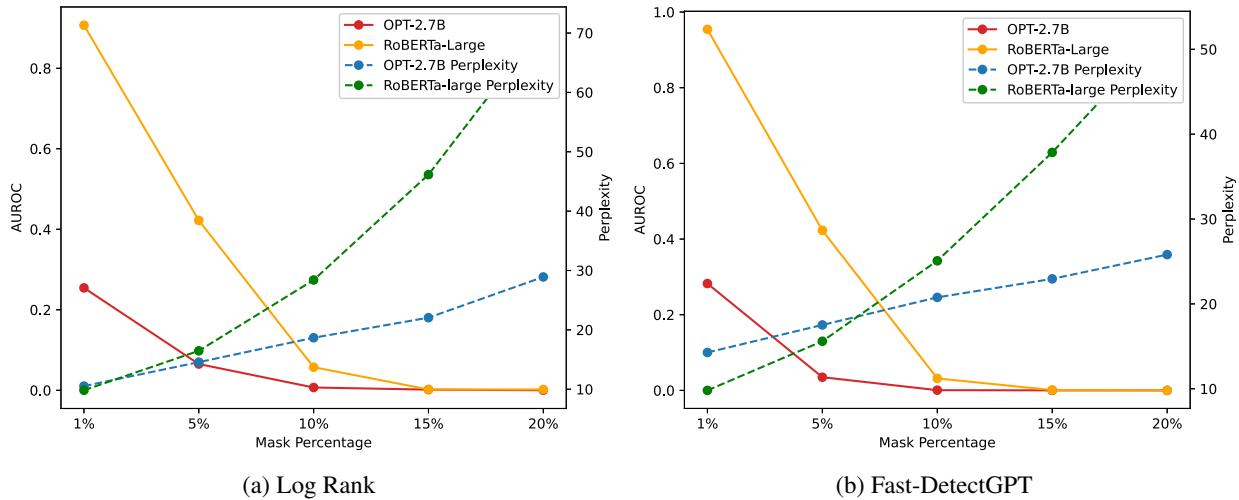
Figure 4 reveals a “sweet spot.” By changing just 10% of the words, the AUROC (red/orange lines) hits near zero. Changing more words (15-20%) doesn’t improve the attack much but significantly hurts text quality (perplexity rises).
2. The Importance of Grammar (POS) Constraints Is the Part-of-Speech filter actually necessary?
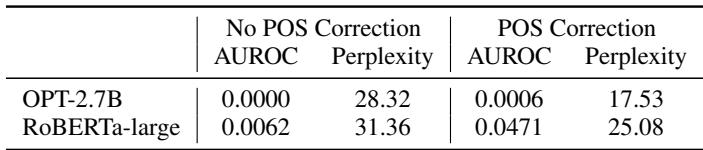
Table 6 shows that while removing the POS constraint might lower the detector score slightly more, it ruins the text quality (perplexity jumps to 31.36). Enforcing grammar keeps the text readable while still completely breaking the detector.
3. Comprehensive Performance To visualize the robustness across different thresholds, we can look at the ROC curves:
In Figure 6, the solid lines represent the original detection capability (bowing toward the top left, indicating high accuracy). The dotted lines represent performance against RAFT. The curves flatten out near the diagonal line (random guessing), visually proving the attack’s effectiveness across various operating points.
Implications: Turning Offense into Defense
The paper isn’t just a manual for breaking systems; it offers a path forward. The authors demonstrated that RAFT can be used for Adversarial Training.
By taking a detector (Raidar) and retraining it on a mix of normal text and RAFT-attacked text, the detector actually learned to spot the attacks.

Table 7 shows the “Adversarial” column. When the detector is retrained, its ability to detect attacks rises (e.g., from 0.60 to 0.73 on XSum). This suggests that while current detectors are vulnerable, they aren’t hopeless—they just need to be trained on more sophisticated, realistic adversarial examples like those RAFT provides.
Conclusion
RAFT highlights a critical vulnerability in the current ecosystem of AI safety. By leveraging the transferability of LLM embeddings and enforcing strict grammatical constraints, the authors created an attack that renders state-of-the-art detectors ineffective.
Key takeaways for students and researchers:
- Detectors rely on fragile signals: Statistical anomalies in machine text are easily smoothed over by swapping just 10% of the words.
- Grammar matters: Effective adversarial attacks on text must respect linguistic rules (POS), or they fail the “human eye” test.
- The Proxy effect: You don’t need access to the target model to break it. A proxy model often provides enough signal to guide an attack.
The cat-and-mouse game between generation and detection continues. RAFT proves that for now, the generators have the upper hand, but it also provides the data needed to build the next generation of more resilient detectors.