](https://deep-paper.org/en/paper/file-3559/images/cover.png)
Imagine you are asking a digital assistant to book a hotel. You specify “The Grand Budapest” in the “East” district. The bot replies confidently, “I have booked a room at The Grand Budapest.” But when you ask for the address, it gives you the location of a different hotel, simply because that other hotel is also in the East district and has a similar price range.
In the world of Natural Language Processing (NLP), this is a classic case of a Task-Oriented Dialogue (TOD) system failing due to “distractive attributes.” The system retrieved the wrong knowledge entity because it looked deceptively similar to the right one.
This blog post explores a fascinating paper titled “Relevance Is a Guiding Light” by researchers from Peking University. They propose a new framework called ReAL (Relevance-aware Adaptive Learning) designed to fix the disconnect between retrieving information and generating a response. If you are a student of NLP or machine learning, this paper offers a masterclass in how to align dual-encoder retrievers with generative language models.
The Problem: Distractive Attributes and Misalignment
Modern End-to-End Task-Oriented Dialogue (E2ETOD) systems generally follow a “Retrieve-then-Generate” paradigm.
- Retrieval: The system looks up an external Knowledge Base (KB) to find entities (like hotels or restaurants) relevant to the user’s query.
- Generation: The system uses those entities to construct a natural language response.
However, as KBs grow larger, the system faces the Distractive Attributes Problem (DAP). This manifests in three ways:
- Inaccurate Retrieval: The retriever gets confused by “hard negatives”—entities that share some attributes (like location or price) but are not the specific entity the user wants.
- Retrieval-Generation Misalignment: Sometimes the retriever fetches the correct top-k list, but the generator focuses on the wrong entity within that list.
- Ambiguous Pre-training: Standard training methods rely on “distant supervision”—guessing which entity is correct based on word overlap. This is often inaccurate.
Let’s look at a concrete example from the MultiWOZ dataset to understand the severity of this issue.
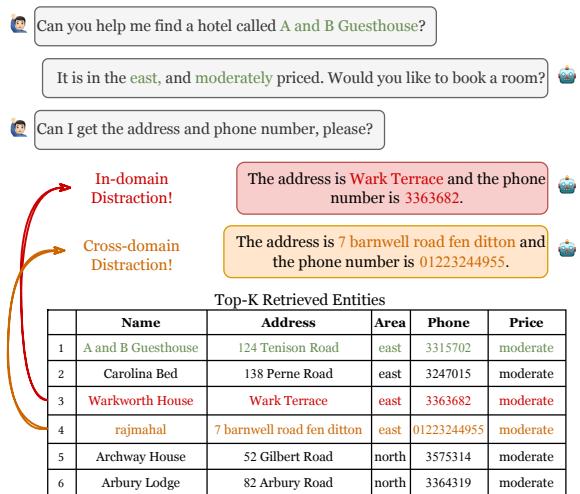
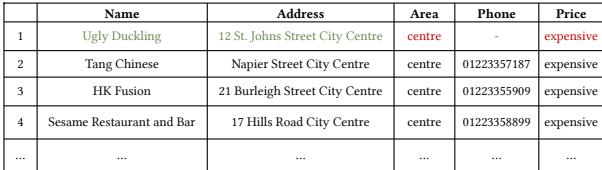
In Figure 1, the user asks for “A and B Guesthouse.” However, the database contains “Warkworth House” (Entity 3) which shares the same area and price, and “rajmahal” (Entity 4) which is irrelevant but appears in the list. These are distractions. If the model isn’t careful, it might pull the phone number from Entity 3 while talking about Entity 1.
Background: The Dual-Encoder Retriever
Before diving into the solution, we need to understand the baseline architecture. The researchers use a standard Dual-Encoder for the retriever.
- Context Encoder (\(E_c\)): Encodes the dialogue history (what the user and system have said so far).
- Entity Encoder (\(E_e\)): Encodes the knowledge base entries (attributes like name, address, phone).
The similarity score \(s_{t,i}\) between the dialogue context \(C_t\) and an entity \(e_i\) is calculated via the dot product of their embeddings:

The goal is to maximize this score for the correct entity and minimize it for others. Traditionally, this is done using a contrastive loss function (\(\mathcal{L}_{info}\)), which tries to pull the representation of the “positive” entity closer to the context while pushing “negative” entities away.

Here lies the flaw: How do we know which entity is \(e^+\) (the positive one)? Previous methods just guessed that the entity with the most matching words in the response was the “ground truth.” As we saw in the distraction problem, this heuristic is often wrong, leading to a retriever that learns noisy relationships.
The Solution: Relevance-aware Adaptive Learning (ReAL)
The researchers propose ReAL, a two-stage framework designed to eliminate these distractions step-by-step.
- Adaptive Pre-training Stage: Refines the retriever using a “Top-K Adaptive” approach and feedback from a frozen generator.
- End-to-End Fine-tuning Stage: Aligns the retriever and generator using metric-driven feedback (BLEU scores).
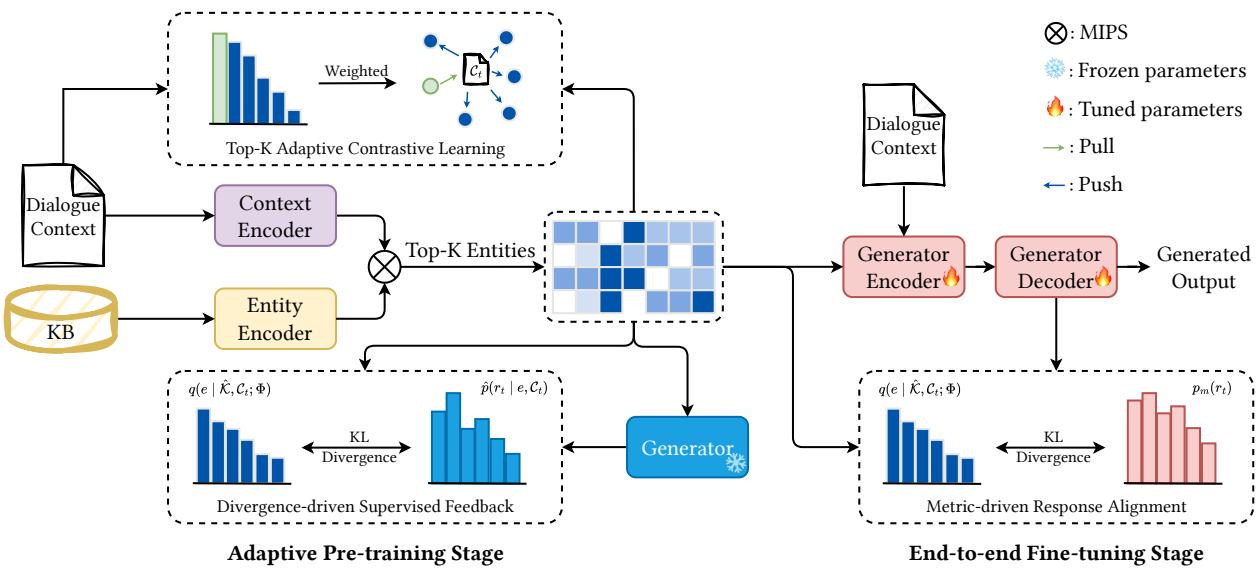
Let’s break down these two stages in detail.
Stage 1: Adaptive Retriever Pre-training
The goal here is to train the retriever (\(\Phi\)) to be smarter about which entities are actually relevant, rather than just relying on keyword matching.
Top-K Adaptive Contrastive Learning
Instead of assuming there is only one single positive entity (which might be wrong), the researchers propose looking at the Top-K entities. They use the retriever’s current state to estimate a matching degree for several potential candidates.
They introduce an Adaptive Contrastive Loss (\(\mathcal{L}_{adapt}\)). This weighted loss allows the model to learn from multiple potential positive candidates based on how confident the model currently is about them.

This formula effectively tells the model: “Don’t just trust the noisy label blindly. Distribute your learning focus across the top-k most likely candidates based on their relevance scores.”
Divergence-driven Supervised Feedback
This is the most innovative part of the pre-training. The researchers realized that the Generator (the part of the model that writes the text) actually knows a lot about relevance. If you feed an entity to the generator and it assigns a high probability to the ground-truth response, that entity is likely relevant.
They utilize a frozen Pre-trained Language Model (PLM) as a “teacher.”
First, they calculate the likelihood of retrieving an entity using the retriever:

Next, they calculate how “useful” that entity is for the generator. They compute the probability of the ground truth response (\(r_t\)) given the context and the entity (\(e_i\)).

Using this generation probability, they construct a “relevance distribution” (\(\hat{p}\)). This represents the ideal probability distribution the retriever should have.

Finally, they force the retriever to mimic this distribution using KL Divergence (a mathematical way to measure the distance between two probability distributions).

By minimizing this loss (\(\mathcal{L}_{div}\)), the retriever learns to prioritize entities that the generator actually finds useful. The total pre-training loss combines the adaptive contrastive loss and this divergence loss:

Stage 2: Metric-driven Response Alignment
Once the retriever is pre-trained, we move to the fine-tuning stage where both the retriever and generator are optimized. However, a gap often remains: the retriever might pick an entity that is semantically similar, but the generator produces a response that doesn’t match the ground truth text perfectly.
To fix this, the researchers use the BLEU score (a standard metric for evaluating text generation quality) as an anchor.
They define a distribution \(p_m\) based on the BLEU score \(\delta\) between the generated response using entity \(e_i\) and the gold standard response \(\hat{r}_t\).
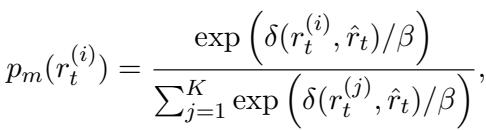
If an entity allows the generator to produce a response with a high BLEU score, it gets a high probability in this distribution. The model then aligns the retriever’s output to this metric-based distribution:

Finally, the system is fine-tuned end-to-end using the standard Negative Log-Likelihood (NLL) loss for generation plus this new alignment loss.


Experiments and Results
The researchers tested ReAL on three benchmark datasets: MultiWOZ 2.1, Stanford Multi-Domain (SMD), and CamRest.
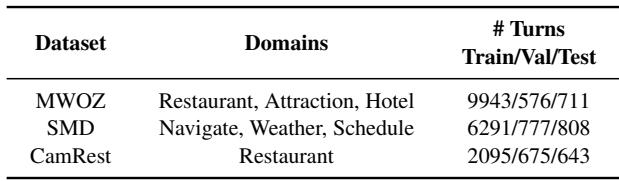
They evaluated the model using BLEU (for fluency) and Entity F1 (for retrieval accuracy).
Performance on Condensed Knowledge Bases
In this setting, the knowledge base contains a limited set of entities relevant to the dialogue (a standard academic setup).
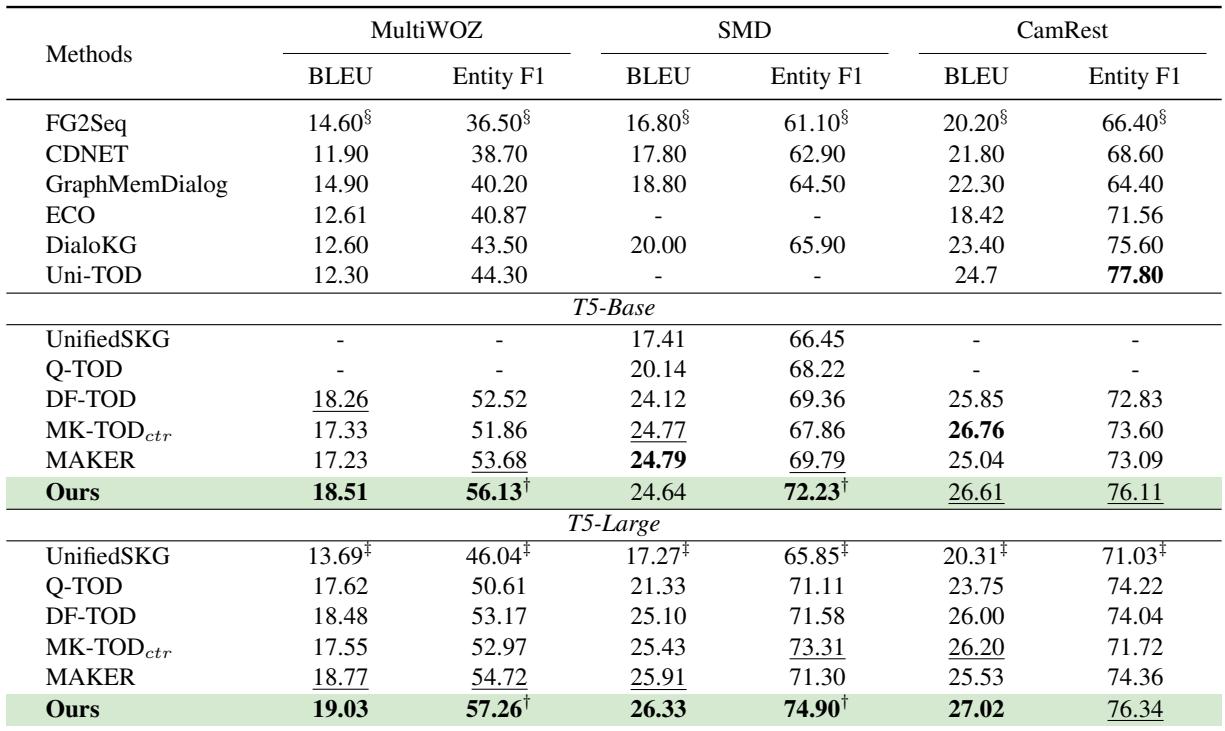
As shown in Table 2, ReAL (Ours) consistently outperforms baselines like MAKER and MK-TOD, especially in Entity F1. This indicates that the adaptive learning strategy significantly helps the model pick the correct specific entities (e.g., the right hotel name) rather than just a generic one.
Performance on Large-Scale Knowledge Bases
This is the more realistic and difficult setting. Here, the model must search through all entities in the dataset, vastly increasing the number of distractions.
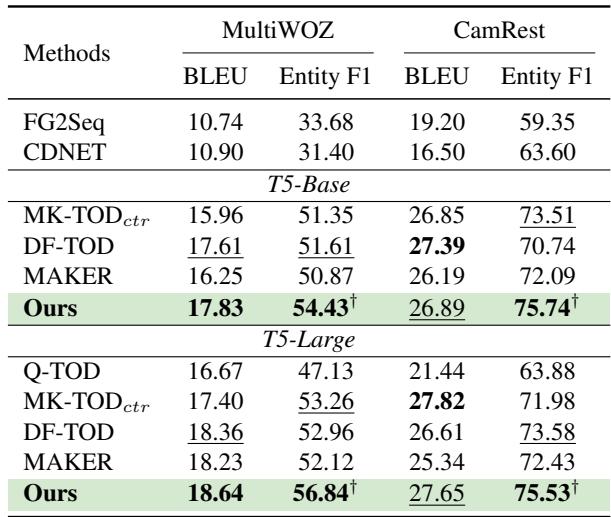
Table 3 highlights the robustness of ReAL. While other methods see a significant performance drop when moving from condensed to large-scale settings, ReAL maintains high scores. This proves its ability to filter out the “hard negatives” discussed in the introduction.
Ablation Study: What Components Matter?
To prove that both the adaptive contrastive loss and the divergence feedback are necessary, the authors performed an ablation study.
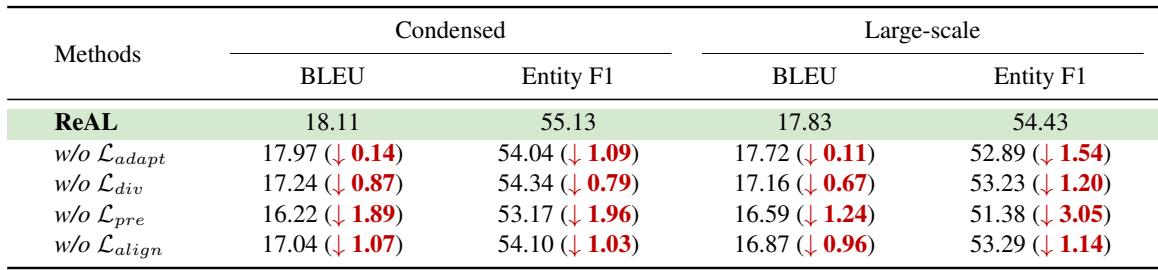
- w/o \(\mathcal{L}_{adapt}\): Removing the adaptive contrastive loss drops performance, especially in Entity F1.
- w/o \(\mathcal{L}_{div}\): Removing the generator feedback also hurts.
- w/o \(\mathcal{L}_{pre}\): Removing the entire pre-training stage causes the most massive drop. This confirms that a standard “cold start” for retrievers is insufficient for complex tasks.
Qualitative Analysis
Finally, let’s look at the output. Does it actually work in conversation?
In Figure 3, we see the model correctly handling a shift in user intent. When the user switches from asking for “Venetian” food (which didn’t exist) to “Chinese,” the ReAL system correctly retrieves Chinese restaurants and provides a booking. The green text (generated by ReAL) closely matches the blue text (Gold standard), showing accurate entity retrieval and fluent generation.
Conclusion
The paper “Relevance Is a Guiding Light” tackles the subtle but critical problem of Distractive Attributes in task-oriented dialogue. By moving away from rigid, heuristic-based training and adopting an adaptive, relevance-aware framework, the authors successfully bridged the gap between retrieval and generation.
Key takeaways for students:
- Don’t trust weak labels: In retrieval tasks, the “obvious” positive example isn’t always the best one for learning. Adaptive loss functions can mitigate this noise.
- Use the Generator as a Teacher: In a pipeline, downstream components (like the generator) can provide valuable feedback signals to upstream components (like the retriever).
- Align Metrics: Training objectives should align with evaluation metrics. By incorporating BLEU score distributions into the loss function, ReAL ensures the model optimizes for what actually matters—accurate, high-quality responses.
ReAL demonstrates that with careful alignment and adaptive learning, we can build dialogue systems that are not just fluent, but also factually reliable—even in the face of thousands of distractions.