](https://deep-paper.org/en/paper/file-3569/images/cover.png)
Introduction
Imagine you are introduced to a new fact: “Tom Holland’s mother is Nikki Holland.” If someone immediately asks you, “Who is Nikki Holland’s son?”, you would answer “Tom Holland” without a second thought. It feels trivial. The logical leap from Parent \(\rightarrow\) Child is instantaneous for a human.
Now, ask a state-of-the-art Large Language Model (LLM) the same question after training it on that specific sentence. Surprisingly, it might fail.
This phenomenon is known as the Reversal Curse. Despite their impressive capabilities in reasoning, coding, and creative writing, LLMs struggle profoundly with bidirectional generalization. If a model learns “A is B,” it does not automatically infer “B is A.” This limitation poses a significant hurdle in the quest for Artificial General Intelligence (AGI). After all, true understanding implies grasping the relationship between entities, not just memorizing a sequence of words in one direction.
In this post, we will deep dive into a fascinating paper titled “Rethinking the Reversal Curse of LLMs: a Prescription from Human Knowledge Reversal.” The researchers didn’t just try to patch the problem with brute-force engineering; they looked at how humans do it. By analyzing the cognitive processes behind human memory and reasoning, they identified why models fail and developed a novel training strategy called PORE (Pairwise entity Order- and Relationship-Enhanced) that effectively cures the curse.
The Background: Why is Reversal So Hard?
To understand the solution, we first need to understand the mechanism of the failure. LLMs are, at their core, autoregressive predictors. They predict the next token in a sequence based on the previous ones.
When a model is trained on the sentence “Donald Trump’s wife is Melania,” it builds a strong statistical probability for the sequence \(A \rightarrow B\). However, the weights of the neural network do not inherently store the reverse logical equivalency. The probability \(P(B|A)\) (Melania given Donald) is maximized, but \(P(A|B)\) (Donald given Melania) remains weak.
Previous attempts to fix this have been somewhat clunky. Some researchers proposed:
- Bidirectional Attention: Looking at the whole sentence at once (like BERT), but this creates discrepancies between training and generation phases.
- Aggressive Permutation: Chopping sentences into random segments and shuffling them. While this forces the model to see “Melania” before “Donald,” it often destroys the semantic meaning of the sentence, leading to confused models.
The authors of this paper took a step back. They asked: If humans can do this easily, what are the specific cognitive components we use?
Deconstructing the Curse: Three Suspects
The researchers hypothesized that the Reversal Curse isn’t a single failure, but a compound issue involving three distinct factors. They designed a series of “pilot experiments” to isolate and quantify these factors.
1. Knowledge Clarity
This refers to how well the knowledge is memorized. In human cognition, it is harder to reverse a fuzzy memory than a crystal-clear one. If you barely remember a phone number forward, you certainly can’t say it backward. The researchers suspected that “exposure bias”—how often a fact appears in training—plays a huge role.
2. Entity Correlation Modeling
This is the statistical link between two entities. In the sentence “A is B,” the order matters. The model learns that B follows A. The hypothesis is that the specific order creates a one-way street in the model’s internal representation.
3. Pairwise Relationship Reasoning
This is the logical capability to understand reciprocal relationships. It’s the understanding that if \(X\) is the parent of \(Y\), then \(Y\) must be the child of \(X\). If a model is only trained on “Parent” relationships, it might not have developed the reasoning path to infer “Child.”
The Pilot Experiments
To test these hypotheses, the authors created controlled datasets using celebrity family trees. They set up specific “Reference” groups (standard training) and “Experimental” groups (modified training) to see which factors moved the needle.

As shown in Figure 1 above, the experiments were set up meticulously:
- (a) Knowledge Clarity: They compared “Low Clarity” prompts against “High Clarity” prompts (reinforced with few-shot examples).
- (b) Entity Correlation: They compared standard training against a version where they explicitly added questions that reversed the order, like “A’s parent is whom? B”.
- (c) Relationship Reasoning: They tested if the model could infer “Child” relationships when explicitly trained on “Parent” relationships using interleaved data.
The Verdict: The results were illuminating. While all three factors contributed, Entity Correlation Modeling had the most significant impact. Simply put, if the model never sees entity B appearing before entity A in a relevant context, it struggles to build the reverse bridge. Pairwise Relationship Reasoning was the second most important factor, followed by Knowledge Clarity.
The Solution: The PORE Strategy
Armed with these insights, the authors proposed the PORE data strategy. The goal is to facilitate bidirectional entity correlation and reasoning without destroying the semantic structure of the language (unlike the “shuffling” methods of the past).
PORE stands for Pairwise entity Order- and Relationship-Enhanced data strategy. It attacks the problem on two fronts.
1. Fixing Entity Order (The “Order” in PORE)
Since the primary culprit is the specific order of entities, PORE augments the training data with Question-Answer (Q&A) pairs.
If the original fact is:
“A’s parent is B”
PORE generates a semantically preserved Q&A pair that flips the order:
“B is whose parent? A”
By training on this Q&A format, the model is forced to process entity B before entity A, effectively modeling \(P(A|B)\). Crucially, this is done using natural language questions, which preserves the semantic meaning that random shuffling often destroys.
2. Enhancing Relationship Reasoning (The “Relationship” in PORE)
To address the reasoning gap, PORE splits the training corpus. It ensures the model sees relationships from both directions—but not necessarily for the same entities initially.
It uses entity-interleaved pairwise relationship data. For example, it might train on:
- “A is B” (Forward)
- “D is C” (Reverse structure)
This helps the model generalize the concept of the relationship (e.g., Parent \(\leftrightarrow\) Child) independently of specific names, elevating its reasoning capability.
3. Leveraging Knowledge Clarity
Finally, the method uses a clever trick regarding Knowledge Clarity. It identifies which facts the model already knows well (High Clarity) and uses those as anchors to improve the recall of reverse relationships.

Figure 2 provides a visual overview of the system.
- Part (a) shows how the corpus is split and augmented with the Q&A pairs (probability \(b\)) to achieve Pairwise Entity Order.
- Part (b) illustrates the “Clarity” component, where the system prompts the model to identify high-clarity knowledge to reinforce the training.
The training objective remains the standard negative log-likelihood loss, but applied to this richer, bi-directionally engineered dataset:

Experiments and Results
Does it actually work? The researchers tested PORE against several strong baselines, including GPT-3.5, GPT-4, Llama-2 (standard fine-tuning), and specific reversal-mitigation methods like “Reverse” (training on backwards text) and “BICO” (bidirectional attention).
They used three datasets:
- Celebrity Relationships (Parent/Child)
- Author-Work (Author/Book)
- Company-CEO (Organization/Person)
The Main Results
The results were overwhelmingly positive. PORE significantly outperformed existing methods.

Looking at Table 3, we can draw several key conclusions:
- The Curse is Real: Look at the standard “Llama” and even “GPT-4” rows. The performance on Reversal Questions (R1, R2) is drastically lower than Forward Questions (F1, F2). Even the mighty GPT-4 struggles to answer “Whose parent is [Name]?” compared to “Who is [Name]’s parent?”.
- Baselines Fall Short: Methods like “Reverse” (training on reversed text) improve reversal scores but often at the cost of the forward performance or semantic understanding.
- PORE Dominates: The PORE method (bottom row) achieves near-perfect scores (~97% on Celebrity data) for both forward and reversal questions. It effectively closes the gap.
Why PORE Wins
The success of PORE lies in its precision.
- vs. Shuffling: Methods like RSP (Reverse Segment Permutation) chop up sentences. This helps the model see words in different orders but confuses the grammar and meaning. PORE’s Q&A pairs are grammatically correct and semantically clear.
- vs. Bidirectional Attention: PORE doesn’t require changing the model architecture. It’s a data strategy. You can apply this to Llama, Mistral, or any standard autoregressive model.
Efficiency
One might worry that generating all these Q&A pairs would explode the training cost. However, the researchers analyzed the data costs mathematically.

The cost is proportional to \(M(1 + \alpha)\), where \(\alpha\) is a fraction between 0 and 1. Because PORE replaces samples with a certain probability rather than just adding them on top, it does not drastically increase the number of training tokens.
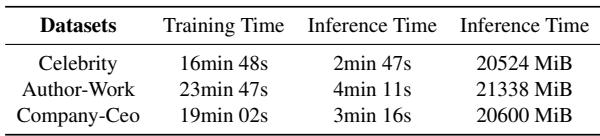
As shown in Table 7, the training times are highly efficient—taking only about 16 to 24 minutes on a single A100 GPU to fine-tune using LoRA (Low-Rank Adaptation). This makes the solution accessible not just to tech giants, but to students and smaller labs as well.
Data Constraints
The paper also explored what happens when training data is scarce (the “Data-Constrained Situation”). They found that PORE still outperforms baselines, but the gap narrows. Interestingly, this is where the Knowledge Clarity component shines. High-clarity data (facts the model recognizes easily) acted as a scaffold, allowing the model to infer reverse relationships even when it hadn’t seen explicitly reversed training examples for those specific entities.
Conclusion and Implications
The “Reversal Curse” has been a nagging reminder that LLMs, for all their fluency, do not “think” like we do. They process sequences, not concepts. However, this research offers a compelling prescription.
By mimicking the human cognitive process—specifically how we use questions to access memory and how we reason about reciprocal relationships—the PORE strategy allows LLMs to overcome this limitation.
Key Takeaways:
- Order Matters: The primary driver of the reversal curse is the one-way nature of entity correlation modeling in autoregressive text.
- Q&A is a Powerful format: Transforming declarative statements (“A is B”) into Q&A pairs (“Who is B? A”) is a semantic-preserving way to fix entity order.
- Reasoning requires structure: Interleaving data to teach the relationship logic (Parent \(\leftrightarrow\) Child) is as important as teaching the facts themselves.
This work is a significant step toward making LLMs more robust and logical. It suggests that the path to AGI might not just be “more data,” but “better-structured data” that aligns with the fundamental principles of human cognition.