](https://deep-paper.org/en/paper/file-3584/images/cover.png)
Taming Twitter Noise: How Supervised Contrastive Learning Boosts Microblog Classification
Social media platforms like Twitter (now X) generate an ocean of data every second. For researchers and data scientists, this data is a goldmine for sentiment analysis, hate speech detection, and trend forecasting. However, analyzing “microblogs” is notoriously difficult. The text is short, riddled with typos, slang, and emojis, and often completely lacks the context required to understand the user’s intent.
To solve this, the current trend in Natural Language Processing (NLP) is to go big. State-of-the-art models usually rely on massive pre-training—taking a model like BERT and training it on millions of tweets (e.g., BERTweet) or using gigantic Large Language Models (LLMs) like GPT-4. While effective, these approaches are incredibly resource-intensive. They require expensive hardware that small research labs or individual developers simply don’t have.
This brings us to a compelling question posed by researchers from the University of Hamburg and Leuphana University Lüneburg: Can we achieve state-of-the-art performance on noisy social media data without breaking the bank on compute resources?
In their paper, “Revisiting Supervised Contrastive Learning for Microblog Classification,” the authors propose a smarter, more efficient way to fine-tune language models. By using Supervised Contrastive Learning (SCL), they demonstrate that a standard, smaller model (RoBERTa-base) can outperform ChatGPT and rival domain-specific giants, all while remaining computationally affordable.
In this deep dive, we will unpack how SCL works, why it creates better text representations, and how it transforms the way models handle the chaos of social media text.
The Challenge of Microblog Classification
Before understanding the solution, we must appreciate the problem. Microblog classification is a unique beast in the world of text classification. Unlike news articles or books, tweets are:
- Informal: Grammar rules are often ignored.
- Noisy: Typos and creative spellings are features, not bugs.
- Context-Poor: With strict character limits, users omit context, assuming the reader knows the background.
Standard supervised learning—where a model is trained to minimize Cross-Entropy (CE) loss—often struggles here. Cross-Entropy focuses solely on getting the label right. It doesn’t necessarily force the model to truly “understand” the semantic relationship between sentences. If a tweet is ambiguous, a standard model might place it in a “gray area” of its internal understanding, leading to misclassification.
The Limits of Pre-training vs. Fine-tuning
The dominant solution has been Domain-Specific Pre-training. This involves taking a base model and training it further on a massive corpus of tweets (e.g., TimeLMs or XLM-T). This aligns the model with the language of the domain. However, this is the “expensive” route.
The alternative is Fine-tuning, where we take a general model (like RoBERTa) and train it specifically on our target dataset (e.g., a hate speech dataset). This is affordable but usually less effective than using a domain-specific model.
The researchers in this paper focus on the fine-tuning stage. They argue that by changing how the model learns (the loss function), we can supercharge the fine-tuning process without needing massive pre-training.
The Core Concept: Supervised Contrastive Learning (SCL)
To improve fine-tuning, the authors turn to Contrastive Learning. In traditional machine learning, we often treat every data point independently. In contrastive learning, we care about the relationships between data points.
The intuition is simple:
- Pull similar things together.
- Push dissimilar things apart.
Visualizing the Intuition
Imagine a geometric space (a hyper-sphere) where every tweet is a dot. We want all “Happy” tweets to be clustered tightly together, and all “Sad” tweets to be clustered together, far away from the “Happy” cluster.
Standard training doesn’t explicitly enforce this clustering structure; it just draws a line to separate them. Supervised Contrastive Learning (SCL), however, explicitly forces this clustering.
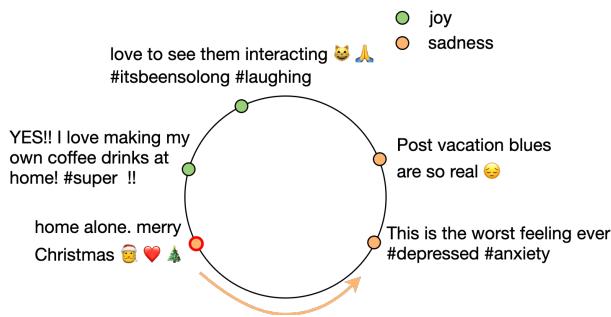
As shown in Figure 1, consider an ambiguous tweet: “Post vacation blues are so real” (the orange dot with the red edge). A standard model might be confused by the word “vacation” (usually positive) and place this dot near the green “Joy” cluster.
However, SCL uses the label information. It knows this tweet is labeled “Sadness.” Therefore, the loss function acts like a magnet (represented by the orange arrow), forcibly pulling this ambiguous tweet closer to other clear examples of sadness, like “This is the worst feeling ever.”
This creates a “tighter” representation where classes are distinct and well-separated, making the final classification much more robust.
Methodology: Under the Hood
How do we implement this mathematically and architecturally? The authors introduce a generic fine-tuning framework that combines standard classification with contrastive learning.
The Architecture
The system uses a Transformer-based model (RoBERTa-base) as the backbone. The workflow is illustrated in Figure 2:
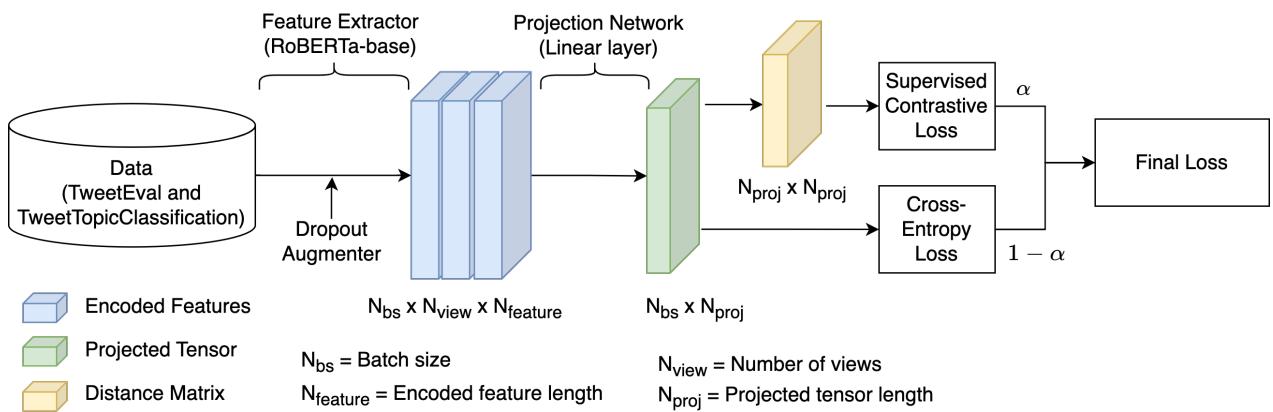
Here is the step-by-step flow:
- Input Data: The system takes a batch of tweets (Batch size \(N_{bs}\)).
- Feature Extractor: The tweets are fed into RoBERTa to get raw embeddings (\(N_{feature}\)).
- Dropout Augmentation: This is a clever trick. How do you create “views” of the same text for contrastive learning? You can’t rotate text like an image. Instead, the authors pass the same sentence through the model twice but apply different Dropout masks (randomly turning off neurons) each time. This results in two slightly different embeddings for the exact same input sentence.
- Projection Network: These embeddings are projected into a lower-dimensional space (\(N_{proj}\)).
- Dual Loss Calculation:
- Pathway 1 (Green): A Supervised Contrastive Loss is calculated to cluster the embeddings based on their labels.
- Pathway 2 (Blue): A standard Cross-Entropy Loss is calculated to ensure the model actually predicts the correct class.
The Mathematics of SCL
The heart of this method is the Supervised Contrastive Loss function.
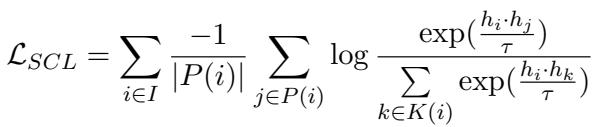
Let’s break down this equation:
- Anchors (\(i\)): The current data point we are looking at.
- Positives (\(P(i)\)): All other data points in the batch that share the same label as the anchor.
- Negatives (\(K(i)\)): All data points in the batch with different labels.
- Numerator: We calculate the similarity (dot product) between the anchor and its positives. We want this to be high (maximize similarity).
- Denominator: We calculate the similarity between the anchor and everyone else (negatives included).
- Log/Exp: By minimizing the negative log, we force the numerator to be large (close to positives) and the denominator relative to the numerator to be small (far from negatives).
Unlike self-supervised learning (which only considers the same image/sentence as a positive pair), SCL uses the labels. If you have three different tweets that are all labeled “Irony,” SCL treats them all as positives and pulls them together.
The Combined Objective
The model cannot only do contrastive learning; it still needs to perform the specific task (e.g., detecting sentiment). Therefore, the final loss function is a linear combination of the Contrastive Loss and the standard Cross-Entropy (CE) loss:

Here, \(\alpha\) is a weighting coefficient. The authors found that setting \(\alpha = 0.5\) (giving equal weight to clustering and classification) yielded the best results.
Experiments and Results
The researchers evaluated their method on two major benchmarks: TweetEval (consisting of 7 subtasks like emoji prediction, hate speech, and irony detection) and Tweet Topic Classification.
The Benchmarks
TweetEval provides a rigorous test because the tasks vary significantly in difficulty and size. Some datasets have 45,000 training examples, while others like Irony Detection have fewer than 3,000.
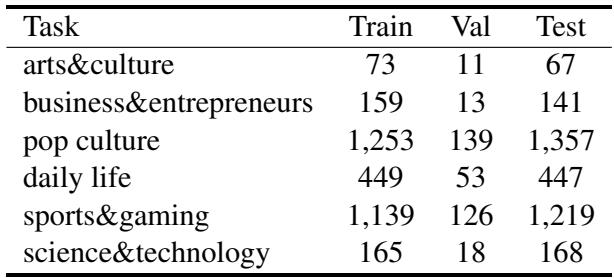
Tweet Topic Classification (Table 2 below) involves categorizing tweets into topics like Sports & Gaming or Pop Culture.
Performance Comparison
The results were impressive. The authors compared their fine-tuned RoBERTa model (using CE+SCL) against:
- ChatGPT: A massive General LLM.
- Pre-trained LMs: Models trained specifically on tweets (BERTweet, TimeLMs, etc.).
- Standard Fine-tuning: RoBERTa trained only with Cross-Entropy (CE).
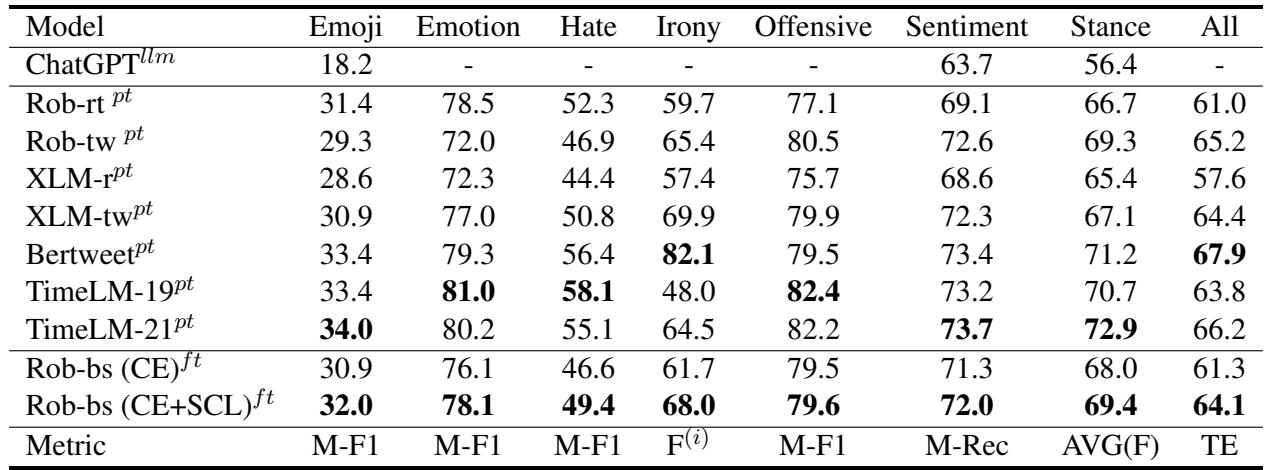
Table 3 summarizes the results on TweetEval:
Key Takeaways from the Results:
- SCL vs. Standard CE: The proposed method (Rob-bs CE+SCL) outperformed the standard fine-tuning (Rob-bs CE) across all subtasks. In the “Emoji” and “Irony” tasks, the improvement was substantial. The global metric (TE) jumped from 61.3 to 64.1.
- SCL vs. ChatGPT: The fine-tuned SCL model significantly outperformed ChatGPT. This highlights that for specific, noisy tasks, a smaller, specialized model is often better than a giant generalist.
- SCL vs. Domain Pre-training: While massive models like BERTweet (trained on 850M tweets) still hold the crown in some areas, the SCL model was competitive. Crucially, SCL achieved this performance without the expensive pre-training phase, making it accessible to labs with limited resources.
On the Tweet Topic Classification task, the results were even more striking. The SCL model didn’t just improve on the baseline; it beat the previous State-of-the-Art (SOTA) model.
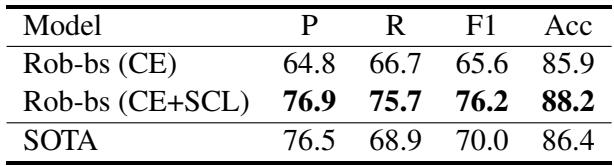
(Note: While the table caption for Table 4 is not explicitly rendered in the image deck, the paper text confirms that on Tweet Topic Classification, the CE+SCL model achieved 76.2 F1 compared to the SOTA’s 70.0 F1.)
Why Labels Matter: The Ablation Study
A critical question arises: Is the improvement coming from the Contrastive Learning itself, or specifically from using the Labels?
To answer this, the authors compared SCL against Self-Supervised Contrastive Learning (SSCL). SSCL works similarly but ignores labels. It treats every distinct tweet as a separate class. This means if you have two tweets both labeled “Joy,” SSCL tries to push them apart because they are different sentences.
The loss function for SSCL looks like this:
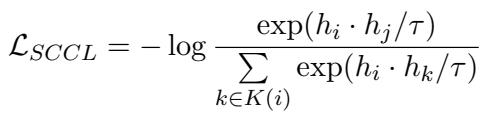
Notice the difference? This version lacks the summation over \(P(i)\)—it doesn’t aggregate other positive examples from the same class.
The Quantitative Drop
When the researchers swapped SCL for SSCL (ignoring labels during the contrastive step), performance tanked. On Tweet Topic Classification, the F1 score dropped from 76.2 (SCL) to 43.5 (SSCL). This proves that simply adding contrastive loss isn’t enough; leveraging the label information to cluster semantic classes is the key driver of performance.
The Qualitative Evidence
The authors analyzed the confusion matrices to see where the models were failing.
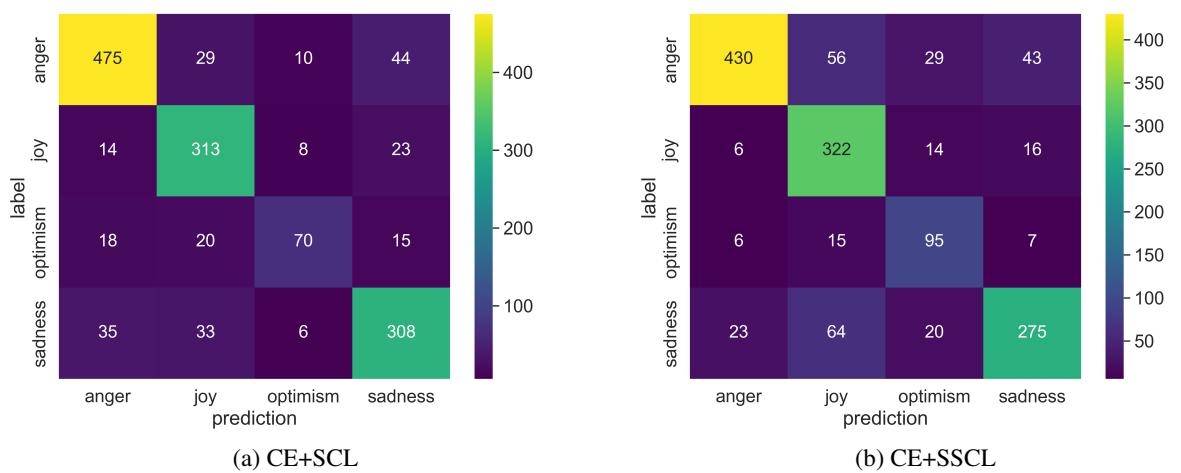
In Figure 3, we compare the predictions for Emotion Detection.
- (a) CE+SCL: The diagonal is bright yellow, indicating high accuracy.
- (b) CE+SSCL: The diagonal is dimmer, and there is more “noise” in the off-diagonal areas.
The SSCL model (without labels) made significantly more errors. It struggled particularly with tweets containing emojis. For example, a tweet with a smiley face 🙂 might be sarcastic and labeled “Anger,” but the SSCL model, seeing the smiley face, groups it with other smiley faces in “Joy.” SCL, guided by the “Anger” label, learns to ignore the misleading emoji and focus on the text sentiment.
The table below highlights specific examples where SCL succeeded but SSCL failed:
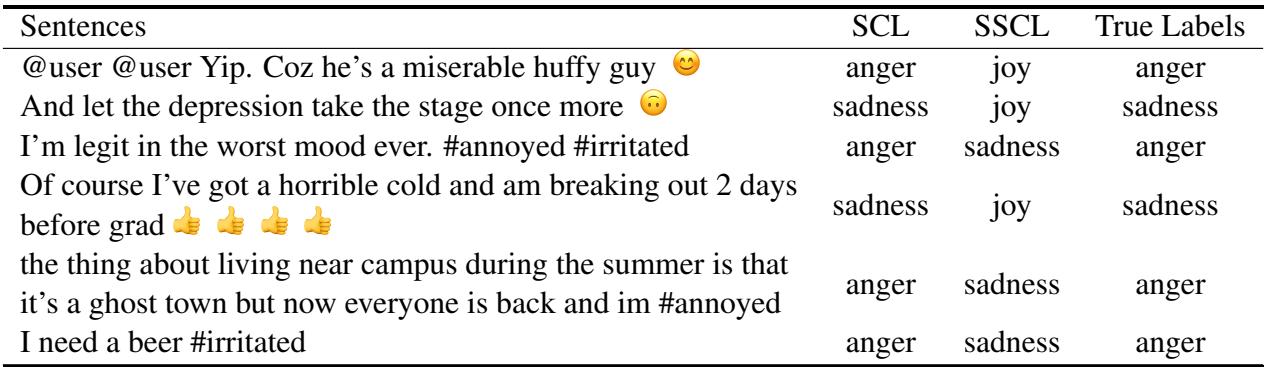
In the first example—“Yip. Coz he’s a miserable huffy guy 🙂"—the SSCL model was fooled by the smiley face and predicted Joy. The SCL model correctly identified the context as Anger because it had been trained to group similar labeled instances together, overriding the visual cue of the emoji.
Conclusion and Implications
The research presented in “Revisiting Supervised Contrastive Learning for Microblog Classification” offers a valuable lesson for the AI community: Efficiency can compete with Scale.
By revisiting the loss function—the fundamental way a model learns—the authors demonstrated that we can extract significantly more performance from existing, manageable models like RoBERTa.
Key Takeaways:
- SCL works for Text: It effectively pulls ambiguous tweets into the correct semantic clusters.
- Resource Efficiency: Small labs can achieve near-SOTA results without the massive computational cost of pre-training from scratch.
- Better than LLMs: For specific classification tasks involving noisy data, fine-tuned SCL models outperform general-purpose giants like ChatGPT.
- Labels are Crucial: Contrastive learning in supervised settings must utilize label information to avoid “class collision,” where semantically similar items are accidentally pushed apart.
As we move forward in an era dominated by ever-larger models, techniques like Supervised Contrastive Learning remind us that smarter training strategies are just as important as raw computing power. For developers working with social media data, this approach offers a practical, robust path to making sense of the noise.