](https://deep-paper.org/en/paper/file-3602/images/cover.png)
Imagine reading a complex news article about international trade agreements. You see a sentence listing several countries: “The agreement was ratified by the United States, Canada, and Mexico.” Later in the text, you read that “The United States will lower tariffs.”
As a human, you immediately infer a connection. You know that since these three countries are grouped together in a list (a specific context) and one is performing an action related to the agreement, the others are likely involved in similar relationships. You don’t just read linearly; you reason. You look at the initial facts, group related entities, and deduce new information.
For Artificial Intelligence, specifically in the field of Natural Language Processing (NLP), this type of “second-look” reasoning is incredibly difficult. Most models make a prediction based on direct context and stop there.
In this post, we are diving deep into a fascinating paper titled “SRF: Enhancing Document-Level Relation Extraction with a Novel Secondary Reasoning Framework.” The researchers propose a new method that mimics that human ability to “think twice.” By introducing a Secondary Reasoning Framework (SRF), they allow the model to refine its understanding and uncover relations that standard models miss.
We will explore how they achieved State-of-the-Art (SOTA) results by combining bidirectional attention, a lightweight evidence extraction system, and the groundbreaking concept of secondary reasoning on “Noun Fragments.”
The Challenge: Document-Level Relation Extraction (DocRE)
Relation Extraction (RE) is a fundamental task in NLP. Its goal is to identify semantic relationships between two entities (e.g., Steve Jobs and Apple) in a text.
In the early days, RE was mostly done at the sentence level. If Steve Jobs and Apple appeared in the same sentence, the model would try to classify the link. But the real world is messy. Information is scattered across paragraphs. This gave rise to Document-Level Relation Extraction (DocRE).
DocRE poses unique hurdles:
- Cross-sentence dependencies: The subject might be in sentence 1, and the object in sentence 5.
- Multiple Mentions: An entity like “The Philippines” might be referred to as “the country,” “it,” or “the nation” throughout the text.
- Complex Reasoning: Identifying a relationship often requires synthesizing multiple pieces of evidence.
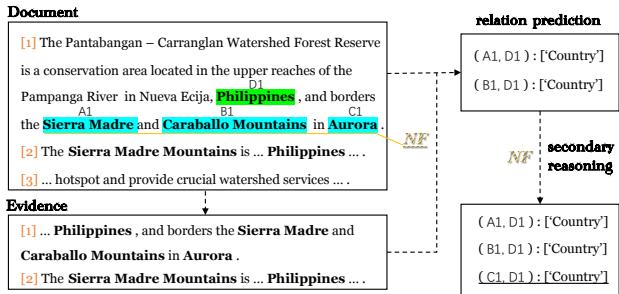
As shown in Figure 1, existing models might successfully predict that entity D1 (Philippines) has a relationship with A1 and B1 because the context is clear. However, they often miss C1, a “Rarely Mentioned Entity” (RME) that is part of the same list (or Noun Fragment) as A1 and B1.
The researchers realized that if a model predicts a relation for one entity in a list, that information is a powerful clue for the others. However, current models lack a mechanism to perform this “secondary reasoning” based on their own initial predictions.
The Solution: The Secondary Reasoning Framework (SRF)
To solve these problems, the authors propose the SRF, a comprehensive framework that improves how relations are extracted and introduces a second pass of reasoning.
The architecture is elegant but robust. It consists of three main stages:
- Relation Extraction Module: Uses bidirectional attention to understand entity pairs.
- Evidence Extraction Module: A highly efficient way to find supporting sentences without heavy computation.
- Secondary Reasoning Module: The core innovation that re-evaluates specific text fragments to find missed relations.
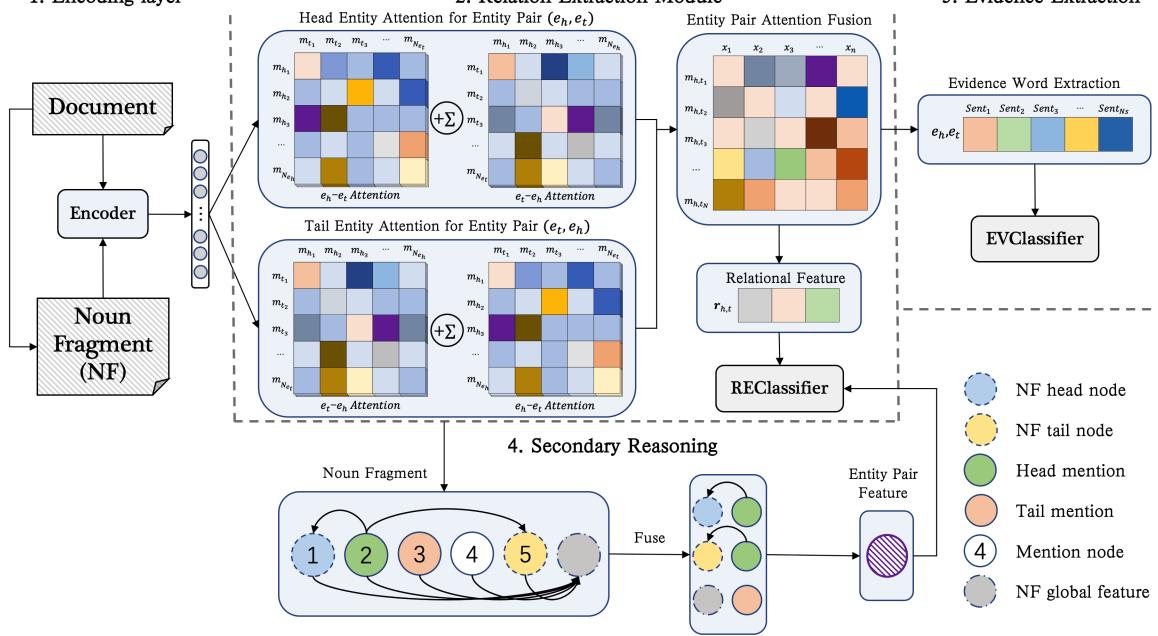
Let’s break down these components step-by-step.
1. The Relation Extraction Module: Bidirectional Attention
Before we can reason, we need a strong representation of the text. The model starts with an encoder (like BERT or XLNET) to process the document words (\(x_1, \dots, x_n\)) into a matrix of features.

Here, \(M\) represents the encoded features of the document.
Fusing Mentions Bidirectionally
In a document, an entity like “Elon Musk” might be mentioned five times. Standard approaches often aggregate these mentions simply by averaging them or using simple attention. The SRF authors argue that the interaction between the Head Entity (\(e_h\)) and the Tail Entity (\(e_t\)) should be bidirectional.
The model calculates how much attention the Head entity pays to the Tail entity, and vice versa. It fuses importance scores from every mention of the head entity (\(m_{hi}\)) to every mention of the tail entity (\(m_{tj}\)).
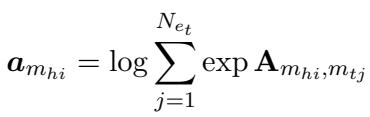
By aggregating these scores, the model determines a weight for each mention. If a specific mention of the Head entity is contextually close to the Tail entity, it gets a higher weight.
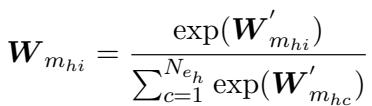
Once the weights are calculated, the features for the Head and Tail entities are constructed by combining the weighted mention features with the average mention features. This ensures the model captures both the specific, high-relevance context and the general global context of the entity.
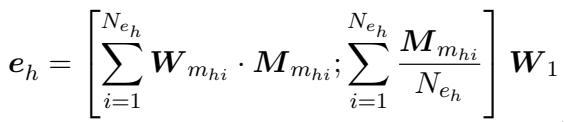
Finally, these sophisticated entity representations are combined to form a relational feature (\(r_{h,t}\)) representing the pair. This feature is passed through a neural network to generate the initial relation prediction scores.

2. Evidence Extraction: Doing More with Less
One of the most impressive efficiency hacks in this paper is the Evidence Extraction Module.
In DocRE, it’s not enough to say “A is related to B.” We want to know why. Which sentences support this claim? Previous state-of-the-art models (like Eider) built separate, complex neural networks just for this task, adding millions of parameters.
The SRF authors asked: Do we really need a separate network?
They found that the attention weights calculated in the Relation Extraction module already contain the answer. If the model is paying high attention to a specific word when linking Entity A and Entity B, that word likely belongs to an evidence sentence.
They introduced a lightweight fusion method using a learnable parameter (\(W_{evi}\)).

Here, \(R'_{h,t}\) is the weight derived from the complex attention mechanism, and \(R''_{h,t}\) is a simpler averaged weight. By balancing these two with \(W_{evi}\), the model identifies the most important words in the document for that specific entity pair.
To find the evidence sentences, they simply look for sentences containing the words with the highest importance scores:

These scores are normalized to create a probability distribution over sentences.

The Result: A highly effective evidence extraction system that adds only one learnable parameter instead of millions, drastically reducing training complexity while maintaining high accuracy.
3. Secondary Reasoning: The “Noun Fragment” Breakthrough
This is the heart of the paper. The authors discovered that while models are good at spotting relations with clear context, they fail on Rarely Mentioned Entities (RMEs).
To fix this, they introduce the concept of the Noun Fragment (NF).
What is a Noun Fragment?
An NF is a continuous sequence in the text that contains at least three entities, usually functioning as a list or a coordinated phrase (e.g., “France, Germany, and Italy” or “Duchy of Lorraine, Bar, and Savoy”).
The logic is simple: Entities in an NF often share the same relations with external entities. If the model predicts that France is a member of the EU, and France is in an NF with Germany, the model should check if Germany is also a member of the EU.
The Reasoning Process
- Identify Initial Predictions: The model looks at the results from the first module. Let’s say it found a relation \(r\) between Head Entity \(e_h\) and Tail Entity \(e_t\).
- Locate NFs: The model finds the Noun Fragment that contains \(e_h\).
- Find Neighbors: It looks for other entities (\(e'_h\)) inside that same NF that were not predicted to have relation \(r\).
- Extract NF Features: The model extracts features specifically for the NF. This includes global features (the whole fragment’s embedding) and local features (the specific entity’s relation to the start/end of the fragment).

- Re-Predict (Reasoning): Finally, the model fuses the mention features with these new “Noun Fragment features” to make a second prediction.

This second pass allows the model to “fill in the blanks” based on the associations found within the list of entities.
Experiments and Results
The researchers validated SRF on two major datasets: DocRED and Re-DocRED (a revised version with cleaner annotations). They used F1 scores (a balance of precision and recall) as the primary metric.
Main Performance
The results were decisive. SRF consistently outperformed existing state-of-the-art models, including graph-based models and other Transformer-based approaches.
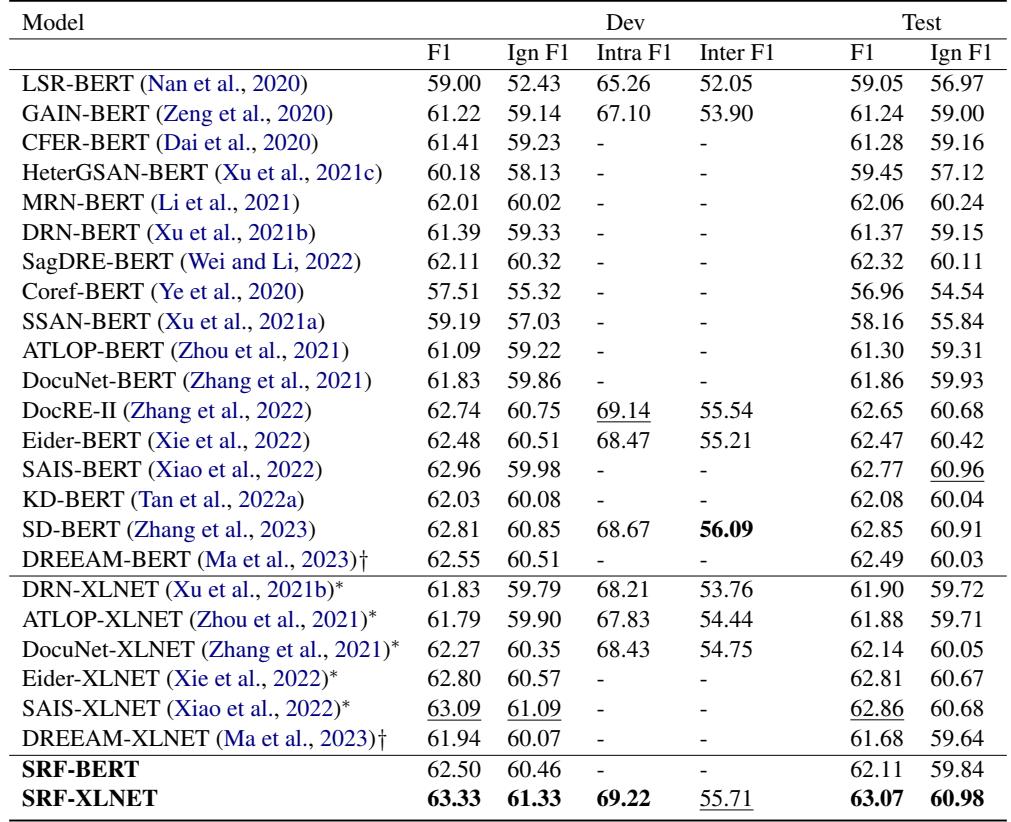
As seen in Table 1, SRF (using XLNET) achieved an F1 score of 63.33 on the DocRED development set, beating competitors like SAIS and Eider.
Does Secondary Reasoning Actually Work?
To prove that the gains weren’t just luck, the authors performed an Ablation Study. They systematically removed parts of the model to see how performance dropped.
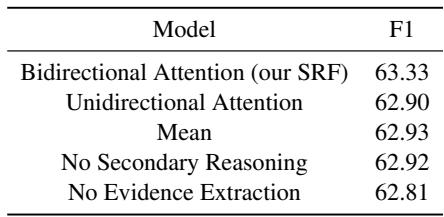
- No Secondary Reasoning: Removing this module caused a significant drop (0.41 F1), proving that the “second look” is crucial for catching missed relations.
- No Evidence Extraction: Removing the lightweight evidence module caused a massive drop, showing that guiding the model to find evidence helps it classify relations better.
- Bidirectional Attention: Replacing their novel attention with standard unidirectional attention also hurt performance.
Generality: Does it work on other models?
One of the strongest arguments for this paper is that the Secondary Reasoning module isn’t just for SRF. The authors took other famous models (Eider, SAIS, ATLOP) and tacked on their Secondary Reasoning module.
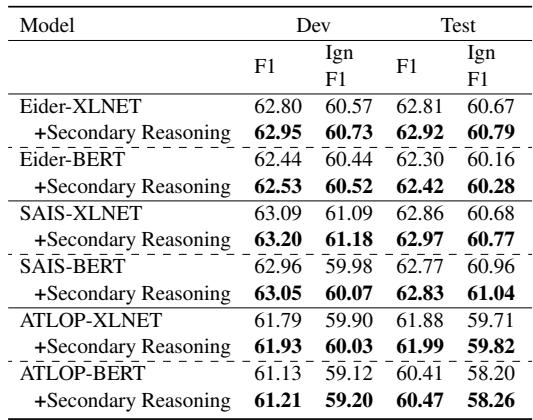
In every single case, adding Secondary Reasoning improved the performance of the base model. This suggests that this technique is a general-purpose upgrade for Document-Level Relation Extraction.
Case Study: Seeing is Believing
The authors provided examples where standard models failed, but SRF succeeded thanks to secondary reasoning.
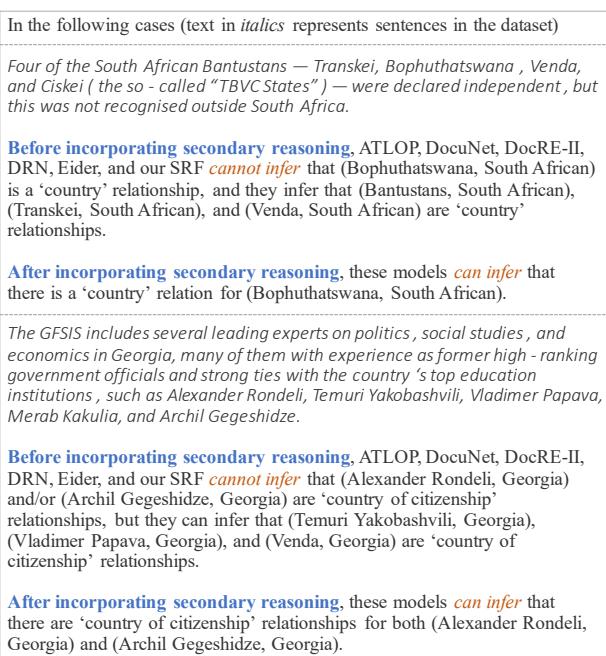
In the first example (top of Figure 3), standard models identified “Transkei” and “Venda” as having a ‘country’ relationship with South Africa but missed “Bophuthatswana.” Because Bophuthatswana appears in the same Noun Fragment list as the others, SRF’s secondary reasoning step successfully caught it and correctly classified the relationship.
An Interesting Finding: XLNET vs. BERT
During their experiments, the researchers stumbled upon an intriguing insight regarding the backbone encoders used in NLP. While BERT is the industry standard, they found that XLNET significantly outperformed BERT on documents with long sentences.
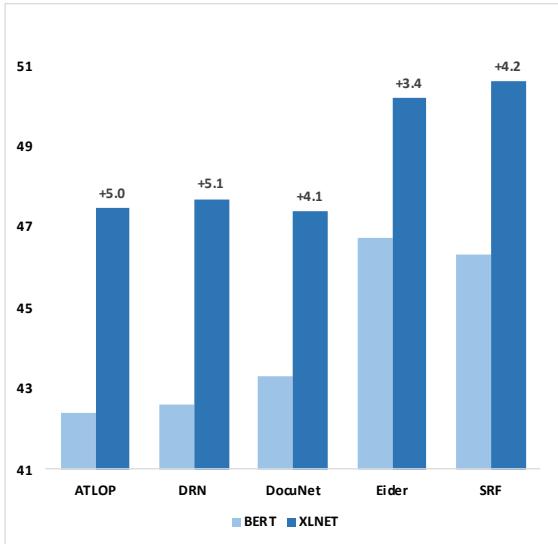
To test this, they constructed a “Hard Dataset” consisting only of documents with long sentences (40+ words). As shown in Figure 5, the performance gap widened drastically. On this hard dataset, SRF-XLNET scored 46.4, while SRF-BERT scored only 42.2.
This suggests that for tasks involving heavy, dense text processing (like legal or scientific documents), researchers should prioritize XLNET over BERT due to its superior handling of long-range dependencies.
Conclusion
The Secondary Reasoning Framework (SRF) represents a significant step forward in how machines understand documents. It moves beyond simple pattern matching and introduces a layered approach to logic:
- Look closely: Using bidirectional attention to understand entity interactions.
- Find the proof: Using efficient evidence extraction to validate findings.
- Think again: Using Secondary Reasoning on Noun Fragments to infer relations that were initially missed.
By acknowledging that entities in a list often share a fate, SRF allows the model to leverage local context in a way that mimics human intuition. The result is a model that is not only more accurate but also computationally efficient in its evidence extraction.
For students and researchers in NLP, SRF offers a valuable lesson: sometimes the key to better performance isn’t a bigger model, but a smarter workflow that allows the system to double-check its own work.