](https://deep-paper.org/en/paper/file-3609/images/cover.png)
Introduction
We are living in the golden age of Large Language Models (LLMs). From ChatGPT to Llama, these models have revolutionized how we process information. Their power, however, stems from one critical resource: data. While public data has laid the foundation, the next frontier of performance lies in private data—medical records, personal financial history, and proprietary organizational documents. This data is often higher quality and more specific than what is available on the open web.
But there is a catch. This data is locked away in “silos”—stored locally on users’ mobile devices or secure enterprise servers—and for good reason. Privacy concerns and regulations (like GDPR) prevent us from centralizing this sensitive information into a massive database for training.
This creates a paradox: We need private data to improve LLMs, but we cannot move the data to the model.
Federated Learning (FL) offers a theoretical solution: bring the model to the data, train locally, and aggregate the results. However, traditional FL struggles with LLMs because the sheer size of these models (billions of parameters) makes them impossible to run on a standard laptop or smartphone.
In this post, we will deep dive into FL-GLM, a novel framework proposed by researchers from Beihang University. This paper introduces a “Federated Learning for General Language Models” approach that solves the computational bottleneck of LLMs while closing critical security loopholes found in previous methods.
The Background: Why Traditional Methods Fail
To understand why FL-GLM is necessary, we first need to look at the limitations of existing distributed training methods.
1. The Computational Wall of FedAvg
The standard standard for federated learning is FedAvg (Federated Averaging). In this setup, a central server sends the entire model to a client. The client trains it on local data and sends the updates back.
For a small model, this works great. For an LLM like ChatGLM-6B (which has 6 billion parameters), it is a non-starter. Most client devices simply do not have the VRAM or compute power to load, let alone train, the full model.
2. The Risks of Split Learning
To solve the compute issue, researchers developed Split Learning. The idea is simple: split the model into two parts. The client handles the lightweight initial layers (like embeddings), and the powerful server handles the heavy middle layers (Transformer blocks).
One prominent example is FedBERT. As shown in the “Original Model” vs. “Split Model” diagram below, the heavy weights (\(W\)) are kept on the server.
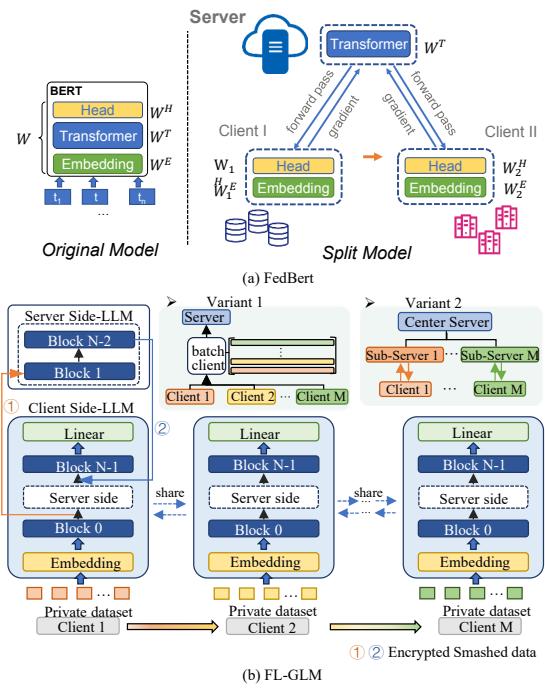
Figure 1 (Part A) illustrates this traditional split. The client processes the input and sends the intermediate data (gradients) to the server.
The Problem? It’s unsafe. If a client sends the output of just the embedding layer to the server, a malicious server can analyze these gradients and reconstruct the user’s private text (a process known as a gradient attack or reverse engineering). Furthermore, traditional split learning is serial—the server processes one client at a time, leading to massive inefficiencies.
The Core Method: FL-GLM
The authors propose FL-GLM, a framework designed to balance three competing needs: Privacy, Efficiency, and Model Performance.
As seen in Figure 1 (Part B) above, FL-GLM changes the architecture significantly. It doesn’t just cut the model in half; it creates a “sandwich” structure and secures the communication channels.
1. The “Sandwich” Model Split
Instead of leaving the entire model on the server or the client, FL-GLM strategically places specific blocks.
- Client Side: Holds the Embedding Layer, the very first Transformer block (Block 0), the very last Transformer block (Block N-1), and the final Linear Layer.
- Server Side: Holds everything in the middle (Block 1 to Block N-2).
Why does this matter? By forcing the data to pass through a full Transformer block (Block 0) before it leaves the client, the data becomes “smashed.” The semantic relationship between the raw text and the data sent to the server is highly non-linear and complex. This makes it mathematically nearly impossible for the server to reverse-engineer the original private text from the gradients it receives.
Here is the mathematical flow of the Client’s initial processing:

The client calculates the hidden state \(h_0\) locally. This “smashed data” is then sent to the server.
The Server then processes the heavy lifting:

Finally, the server sends the result back to the client to calculate the final prediction and loss locally:
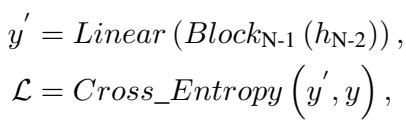
By keeping the input, output, and loss calculation entirely local, the server never sees the ground-truth labels (\(y\)).
2. P-Tuning v2 for Efficiency
Training all 6 billion parameters is expensive. To make this feasible for federated settings, the authors utilize P-Tuning v2.
Instead of updating all weights, they freeze the main LLM parameters and only train a small “Prefix Encoder.” This encoder adds learnable prefix vectors to the Key and Value matrices in the attention mechanism.
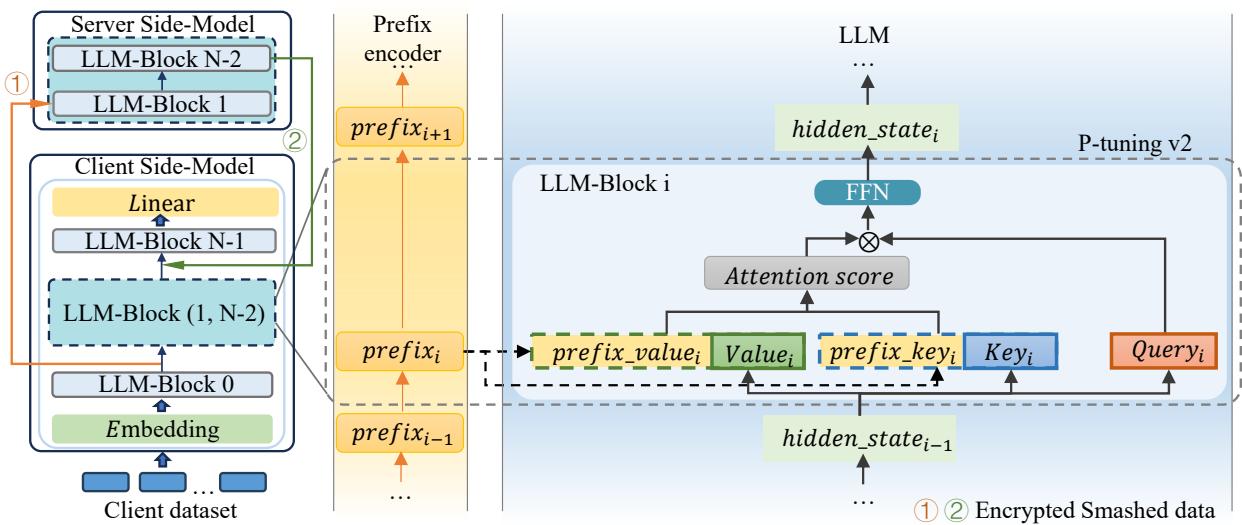
As shown in Figure 2, only the prefix parameters flow through the update process. This drastically reduces the communication bandwidth required and the computational load on the client.
3. Encrypted Transmission
Even with the sandwich split, data must travel between client and server. If another peer (a malicious client) intercepts this data, they might try to learn something about the victim’s data.
FL-GLM employs RSA Encryption on the “smashed data” (hidden states).
- Key Generation: A public/private key pair is generated.
- Encryption: The client encrypts the hidden states using the public key before sending.
- Decryption: The server decrypts it with the private key to perform computations.
This ensures that even if the transmission is intercepted by a third party, the data remains unintelligible.
Solving the Bottleneck: Parallel Acceleration
Standard split learning acts like a single-lane checkout line at a grocery store: the server serves Client A, finishes, then serves Client B. This serial processing wastes the server’s massive parallel computing potential.
FL-GLM introduces two acceleration strategies depending on the server’s hardware.
Strategy A: Client-Batch Parallel
If the server is a single powerful machine (like a DGX station), it can handle data from multiple clients simultaneously by stacking them into a single batch.
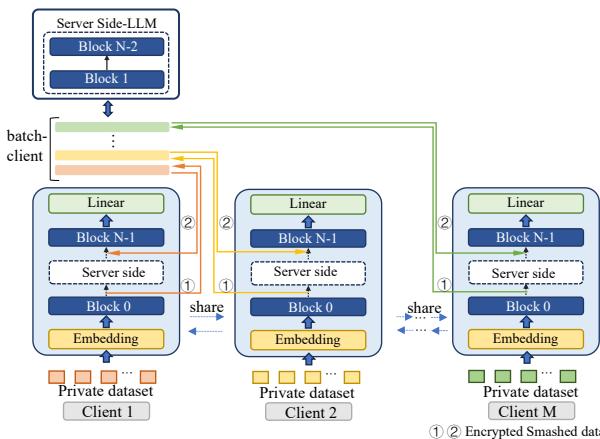
In Figure 3, distinct clients send their encrypted smashed data (arrow ①). The server concatenates these inputs into a larger tensor (Batch Size = Number of Clients) and processes them in one forward pass. This allows the server to utilize its GPU fully, rather than idling while waiting for network communication from a single client.
Strategy B: Server-Hierarchical Parallel
If the server side is actually a cluster of machines (or has multiple GPUs), FL-GLM uses a hierarchical approach.
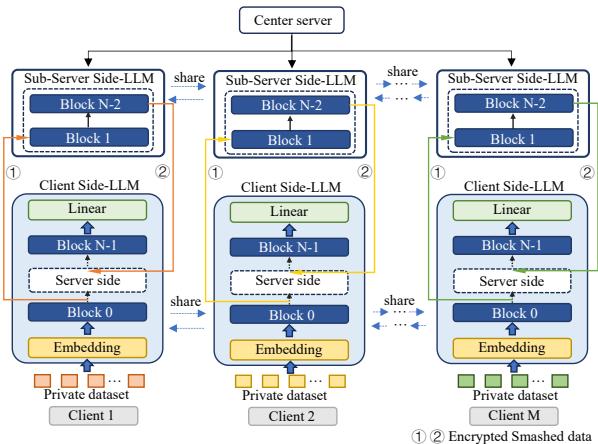
As shown in Figure 4, a central server manages multiple Sub-Servers. Each Sub-Server is paired with a specific client. This allows fully parallel processing across different hardware units. The central server then aggregates the updates from the sub-servers.
Experiments and Results
The researchers validated FL-GLM using ChatGLM-6B as the base model. They tested on NLU (Natural Language Understanding) tasks via the SuperGLUE benchmark and summarization tasks (CNN/DailyMail).
1. Does it perform as well as centralized training?
The primary fear in Federated Learning is “performance degradation.” If the model protects privacy but gives bad answers, it’s useless.

Table 1 compares FL-GLM against the centralized ChatGLM-6B.
- ReCoRD: Centralized (80.2) vs. FL-GLM (79.8).
- BoolQ: Centralized (83.4) vs. FL-GLM (81.9).
- Average: The performance drop is negligible (less than 1% in most cases).
The results for Abstractive Summarization tell a similar story:

In Table 2, FL-GLM achieves ROUGE scores very close to the centralized baseline. This proves that the “smashed data” transmission and split architecture do not destroy the semantic information necessary for the model to learn complex tasks.
2. Is it actually faster?
The researchers compared the training time of Serial (traditional), Client-Batch, and Server-Hierarchical strategies.

Table 3 highlights the efficiency gains.
- With 10 clients, Serial training is not listed (likely too slow), but even at 5 clients, it takes 166.4 seconds.
- Client-Batch with 10 clients takes 34.5 seconds.
- Server-Hierarchical with 10 clients drops to 17.3 seconds.
This represents a massive speedup, proving that the parallel strategies successfully unlock the potential of distributed LLM training.
3. Security Analysis
Theoretical security is good, but does it hold up against an attack? The authors simulated an attack where a malicious server attempts to reconstruct the client’s private text using an attack model (\(F^{-1}\)).

Table 4 compares the attack success on FedBERT (Embd.) vs. FL-GLM (Client-side A).
- ROUGE-L (higher is better for attacker): In FedBERT, the attacker achieves 26.73, meaning they recovered a significant amount of text.
- FL-GLM: The attacker achieves 0.47.
This result confirms that placing just one Transformer block on the client side effectively “obfuscates” the data, making it unintelligible to the server.
4. Robustness to Non-IID Data
In the real world, data is not Independent and Identically Distributed (IID). One client might have medical data, another might have legal data.
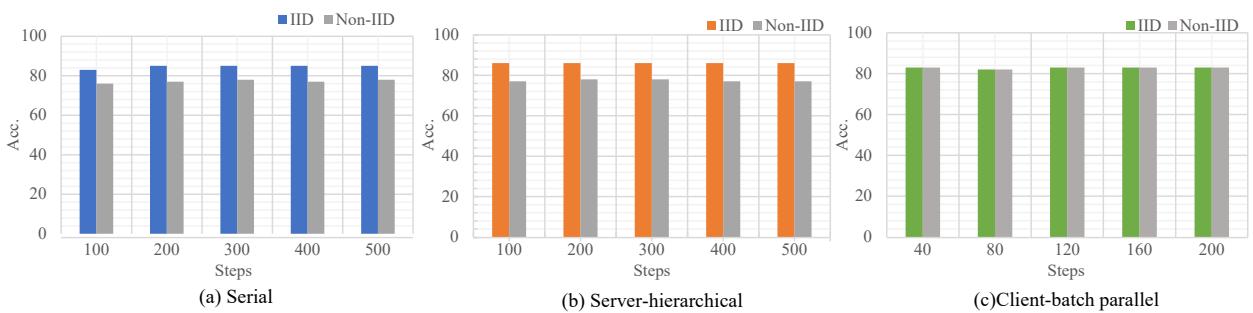
Figure 5 shows that while Serial and Hierarchical methods suffer a slight performance drop (~7%) when data is Non-IID (grey bars), the Client-Batch method (Chart C) remains incredibly robust. By mixing the data from various clients into a single batch at the server level, the model effectively sees a “diverse” batch during training, mitigating the bias of individual clients.
Conclusion and Future Implications
The FL-GLM framework represents a significant step forward in making Large Language Models practical for privacy-sensitive industries. By intelligently splitting the model, employing encryption, and optimizing for parallel processing, the authors have created a system that:
- Protects Privacy: Prevents both server-side gradient attacks and peer-side eavesdropping.
- Saves Resources: Allows clients with limited hardware to participate in training 6-billion parameter models.
- Maintains Speed: Solves the serial bottleneck of traditional split learning.
For students and researchers in AI, this paper highlights a crucial trend: The future of AI isn’t just about bigger models; it’s about distributed, secure, and collaborative intelligence. As models like Llama 2 and ChatGLM continue to grow, frameworks like FL-GLM will be the keys that unlock the vast reservoirs of private data currently sitting idle in silos around the world.