](https://deep-paper.org/en/paper/file-3639/images/cover.png)
Introduction: The “Poverty of the Stimulus” in AI
One of the most enduring debates in linguistics and cognitive science centers on a simple question: How do children learn the complex rules of grammar so quickly, given that the speech they hear is often messy, incomplete, and full of interruptions?
This puzzle, often referred to as the “Poverty of the Stimulus,” led linguist Noam Chomsky to propose that humans must have an innate “hierarchical bias”—a built-in neurological framework that predisposes us to understand language as a tree-like structure rather than just a linear sequence of words.
Fast forward to the modern era of Artificial Intelligence. We now have Large Language Models (LLMs) like Transformers that process massive amounts of text. However, despite their fluency, these models often struggle with the same distinction that children master effortlessly: the difference between linear order (the sequence of words) and hierarchical structure (the grammatical tree).
When a neural network sees a sentence, does it understand the grammar, or is it just statistically guessing the next word based on linear patterns?
In a fascinating paper titled “Semantic Training Signals Promote Hierarchical Syntactic Generalization in Transformers,” researchers Aditya Yedetore and Najoung Kim investigate a novel hypothesis. They ask: Could the missing piece of the puzzle be meaning?
Children don’t just hear forms (words); they perceive meanings (the world around them). This blog post explores their research, which suggests that teaching AI to understand semantics (meaning) might be the key to unlocking true syntactic (grammar) generalization, without needing a hard-coded hierarchical bias.
Background: The Linear vs. Hierarchical Trap
To understand the problem, we need to look at a classic test case in linguistics: English Yes/No question formation.
Consider the declarative sentence: “The newt does sleep.” To turn this into a question, we move the auxiliary verb “does” to the front: “Does the newt sleep?”
If a machine learning model is trained on simple sentences like this, it might hypothesize one of two rules:
- The Linear Rule: Move the first auxiliary verb in the sentence to the front.
- The Hierarchical Rule: Move the main auxiliary verb (the one structurally attached to the main verb) to the front.
For simple sentences, both rules produce the same result. But what happens when the subject is modified by a relative clause, introducing a second auxiliary?

As shown in Figure 1, consider the sentence: “The newt who does sleep does not swim.”
- Linear Rule: This rule picks the first “does” it sees.
- Result: “Does the newt who _ sleep doesn’t swim?” (Incorrect)
- Hierarchical Rule: This rule identifies the main verb (“swim”) and moves its auxiliary (“doesn’t”).
- Result: “Doesn’t the newt who does sleep _ swim?” (Correct)
Standard Transformers trained only on text (form alone) are notorious for being “lazy.” They often latch onto the Linear Rule because it is computationally simpler and works for most simple sentences. The researchers set out to see if adding semantic training signals—teaching the model what the sentence actually means—would push the model toward the correct Hierarchical Rule.
The Methodology: Adding Meaning to the Mix
The researchers designed a controlled experiment using synthetic datasets based on the grammar of McCoy et al. (2020). They created two distinct training conditions for their Transformers.
1. Form Alone
In this setup, the model functions like a standard sequence-to-sequence translator. It takes a declarative sentence and is tasked with outputting the corresponding question.
- Input:
the newt does sleep . QUEST - Output:
does the newt sleep ?
2. Form & Meaning
Here, the model has an additional job. Alongside the question formation task, it must also learn to translate the declarative sentence into a logical representation of its meaning.
- Input:
the newt does sleep . TRANS - Output:
Sleep ( ιx . Newt ( x ) )
By forcing the model to predict this logical form, the researchers hypothesize that the model will be forced to process the sentence’s underlying structure, rather than just its surface word order.
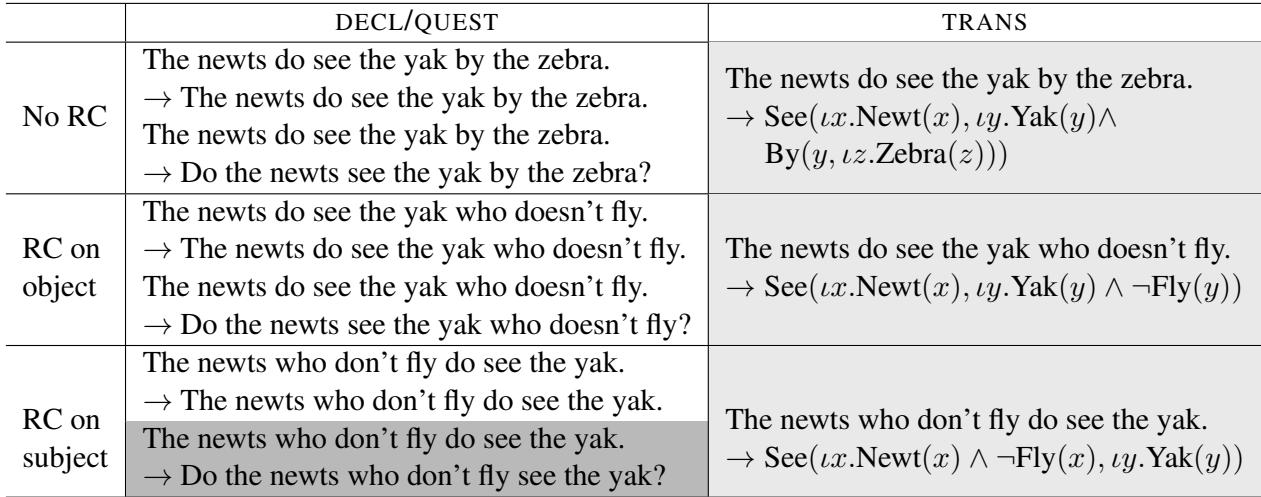
Table 1 illustrates the data distribution. Crucially, the training data (white and light gray cells) is ambiguous; it supports both the linear and hierarchical rules. The models are never explicitly trained on the complex “generalization” sentences (dark gray cells) that differentiate the two rules. The true test comes only during evaluation: when faced with a complex sentence like “The newt who does sleep doesn’t swim,” will the model move the correct auxiliary?
The logical representations used for the “Meaning” task look like standard formal semantics. For example:

This formula represents: “The newt doesn’t see the yak.” The goal is to see if this mathematical structure helps the neural network “see” the linguistic tree.
Experiment 1: The Immediate Impact of Meaning
The first experiment compared standard Transformers trained on “Form Alone” against those trained on “Form & Meaning.” The models were evaluated on two metrics:
- In-distribution accuracy: Can they form questions for simple sentences they’ve seen before?
- Generalization accuracy: Can they correctly handle the complex sentences (like the relative clause examples) that require the hierarchical rule?
The Results
The results were stark.

As shown in Figure 2:
- Plot (a): Both models achieved near-perfect accuracy on the test set (simple sentences). They both “learned the task” as far as the training data was concerned.
- Plot (b): The difference lies in generalization. The “Form Alone” models (left bar) almost exclusively used the incorrect Linear Rule (near 0% hierarchical accuracy). They failed to generalize.
- In contrast, the “Form & Meaning” models (right bar) showed a significant jump in hierarchical preference, choosing the correct grammatical structure about 60% of the time.
This result suggests that simply forcing the model to understand the logic behind the sentence prevents it from taking the lazy, linear shortcut.
Experiment 2: Structural Grokking
Recent research in AI has identified a phenomenon called “grokking.” This occurs when a model appears to memorize training data initially (getting 100% training accuracy) but, if you keep training it for a very long time—far past the point of “saturation”—it suddenly switches strategies and learns the general rule.
The researchers wanted to know: Was the “Form Alone” model failing simply because it hadn’t been trained long enough? And how does Meaning affect this timeline?
They trained models for 300,000 steps (far longer than necessary for simple accuracy) in two different setups: Language Modeling (predicting the next word) and Sequence-to-Sequence (translation).
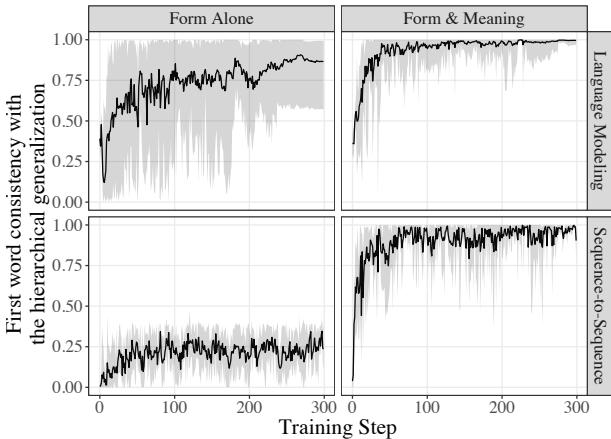
Figure 3 reveals the training dynamics:
- Form Alone (Left Column):
- In the Language Modeling setup (top-left), the model eventually “groks” the structure. It starts with low accuracy but slowly climbs to hierarchical generalization after many, many steps.
- In Sequence-to-Sequence (bottom-left), it basically never learns. It stays stuck on the linear rule.
- Form & Meaning (Right Column):
- In both setups, the models generalize hierarchically almost immediately.
- Look at the top-right graph: The accuracy shoots up to near 100% very early in training and stays there.
Takeaway: While models trained on form alone can sometimes stumble upon the correct rule if given enough time (grokking), semantic signals act as a powerful catalyst. They make the correct generalization easier to find and much faster to learn.
Experiment 3: Why Does Meaning Help?
The researchers established that meaning helps, but they needed to understand why. Is the model actually learning syntax, or is it exploiting a different kind of shortcut in the logical formulas?
They investigated three specific hypotheses.
Hypothesis A: Is it just the position of the negation symbol?
In the logical forms used in Experiment 1, the negation symbol (\(\neg\)) often appears at the very start of the logical string.
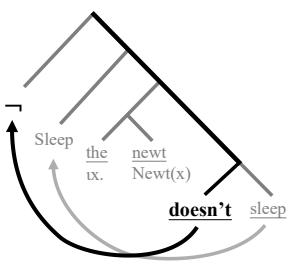
As Figure 4 illustrates, the hierarchical rule usually requires moving the auxiliary that corresponds to the main sentence negation. If the model simply learned “map the first word of the question to the negation symbol at the start of the meaning,” it might just be matching positions rather than understanding structure.
To test this, the researchers created a new dataset using Tense instead of Negation. They moved the tense markers around in the logical formulas so they didn’t align neatly with the front of the sentence.
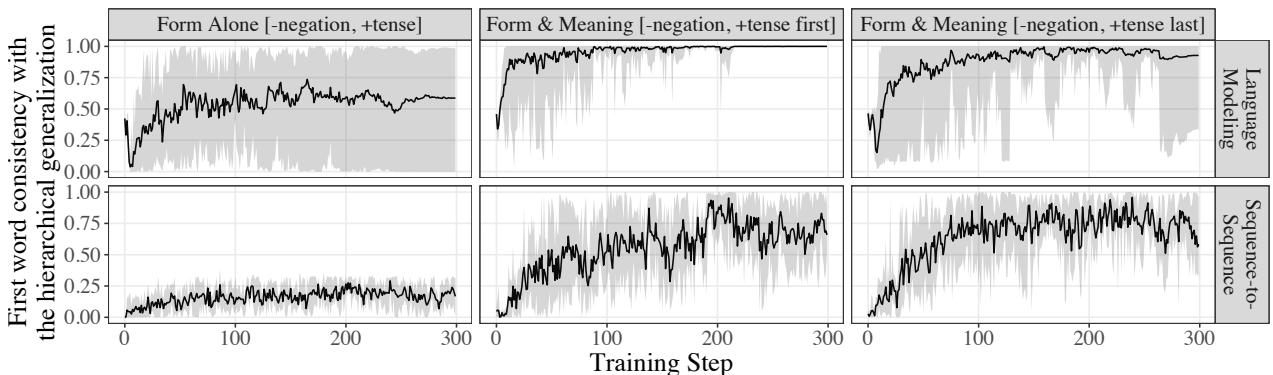
Figure 5 shows the results of this stress test. Even when the “cheat code” (positional alignment) was removed (in the “+tense last” condition), the models trained with meaning still generalized better than those trained on form alone. This proves the benefit isn’t just a shallow visual match—the model is using the semantic structure.
Hypothesis B: Is it just seeing the output structure?
Perhaps the translation task itself doesn’t matter. Maybe just exposing the model to the logical formulas (the output side) is enough to give it a “hierarchical bias,” even if it doesn’t have to map the sentence to it.
The researchers tested a “Meaning to Meaning” task, where the model just learned to copy logical forms.
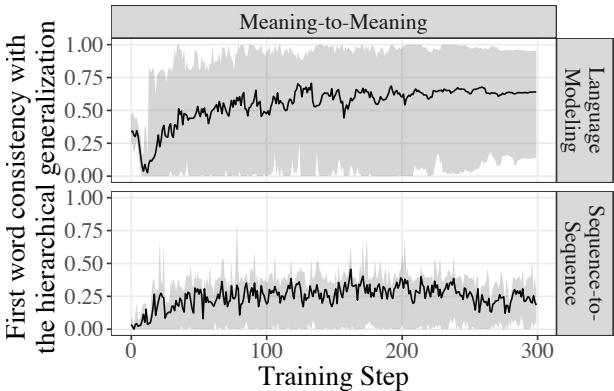
Figure 6 shows the result: Failure. The “Meaning to Meaning” model (top graph) performed poorly, similar to Form Alone. This confirms that the critical signal comes from the mapping process—translating the linear sentence into the structured meaning.
Hypothesis C: Identifying the Main Auxiliary
Finally, the researchers asked if the semantic task helps simply because it forces the model to identify which word is the main verb or main auxiliary.
They created specific auxiliary tasks, such as asking the model to simply output the sentence but highlight the main auxiliary (e.g., the newt (does) sleep).
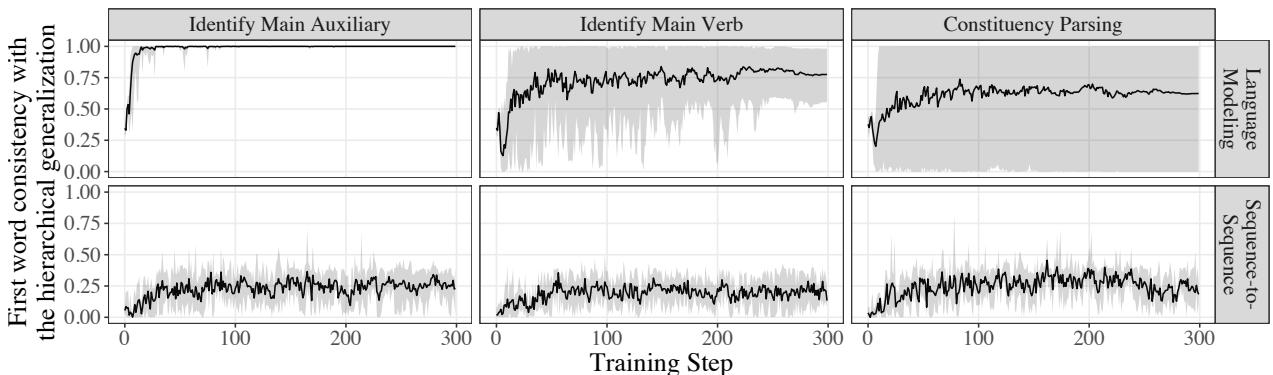
Figure 7 shows that explicitly training the model to “Identify Main Auxiliary” (left column) provided a massive boost to hierarchical generalization, almost matching the performance of the full “Form & Meaning” approach.
This suggests that the “Meaning” translation task works because it implicitly forces the model to figure out which verb is the “real” verb of the sentence—a prerequisite for understanding the sentence’s tree structure.
The Role of Subject-Verb Agreement
There was one final loose end. In the “Form Alone” experiments where models eventually “grokked” the solution (Experiment 2), how did they do it without meaning?
The researchers suspected Subject-Verb Agreement. In English, singular subjects take “does” and plural subjects take “do.”
- “The newts who do sleep do not swim.”
- “The newt who does sleep does not swim.”
This agreement provides a statistical hint linking the subject to the main auxiliary. To test this, the researchers created a dataset with no agreement (removing plural forms, so everything looks singular).
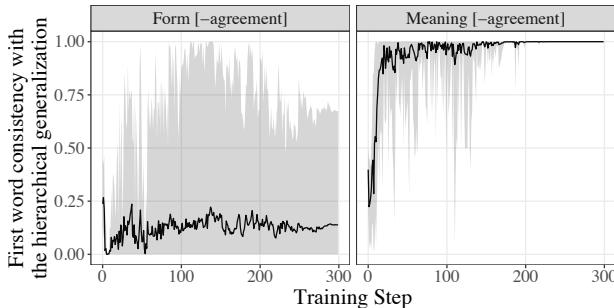
Figure 8 delivers the final verdict:
- Left (Form Alone): Without subject-verb agreement cues, the Form Alone model crashes. It cannot learn the hierarchical rule, even with massive training.
- Right (Meaning): The model trained with Meaning still learns perfectly.
This is a powerful conclusion. It shows that while statistical learners can use surface clues (like agreement) to fake their way to the right answer, semantic training signals provide a robust, structural understanding that works even when those surface clues are stripped away.
Conclusion and Implications
This research bridges a gap between linguistic theory and modern AI. It challenges the notion that neural networks are forever doomed to be “stochastic parrots” that rely solely on surface statistics.
The key takeaways are:
- Semantics Bootstraps Syntax: Training a model to understand what a sentence means helps it understand how the sentence is built.
- Efficiency: Meaning allows models to learn structural rules much faster and more consistently than training on text alone.
- Robustness: Semantic signals work even when surface cues (like subject-verb agreement) are missing, implying a deeper level of generalization.
For the field of AI, this suggests that if we want models that truly understand language structure, we shouldn’t just feed them more text. We should feed them pairs of text and meaning—whether that’s code, logical forms, or perhaps multimodal data like images and video. By grounding language in meaning, we provide the “hierarchical bias” that these models otherwise lack.