](https://deep-paper.org/en/paper/file-3640/images/cover.png)
Lost in Translation? How Emojis, Sentiment, and Language Interact
In the digital age, emojis are often hailed as the world’s first truly universal language. A smile is a smile, and a tear is a tear, regardless of whether you speak English, Portuguese, or Mandarin. Or so we might think.
While it is true that emojis bridge gaps in computer-mediated communication (CMC) by adding emotional flavor to text, the assumption that they are interpreted identically across cultures is a shaky one. Previous studies have shown that people often disagree on what specific emojis mean, even within the same language. When you cross linguistic borders, the waters get even murkier.
Today, we are diving deep into a fascinating research paper titled “Semantics and Sentiment: Cross-lingual Variations in Emoji Use.” The researchers—Giulio Zhou, Sydelle de Souza, Oghenetekevwe Kwakpovwe, SuElla Markham, and Sumin Zhao from the University of Edinburgh—set out to untangle the complex relationship between how we define emojis (semantics), how we feel when we use them (sentiment), and the languages we speak.
If you are a student of linguistics, NLP (Natural Language Processing), or just someone fascinated by how we communicate online, this study provides critical insights into the “literal” versus “figurative” lives of emojis.
The Problem: More Than Just a Digital Face
Why does this research matter? Over the past decade, emoji usage has exploded. They appear in over 22% of all tweets. For computer scientists and linguists, emojis aren’t just cute decorations; they are data.
However, a major hurdle in Natural Language Processing is ambiguity.
- Literal Meaning: If I send a 😭, am I actually sad and crying?
- Figurative Meaning: Or did you just tell a joke so funny that I am “dying” of laughter?
If an AI model training on sentiment analysis sees 😭 and assumes “negative/sad,” it might completely misinterpret a positive, joyful interaction. Furthermore, if this usage pattern varies between English and Chinese, a model trained on one language might fail when applied to another.
The researchers aimed to answer three core questions:
- Do people disagree on what an emoji means when it stands alone?
- Does the agreement on literal vs. figurative use change across languages?
- Does the sentiment of a tweet (positive or negative) correlate with whether an emoji is used figuratively?
Background: Defining the Indefinable
To understand the methodology, we first need to agree on some terms. The paper distinguishes between two types of meaning:
- Context-Free Literality: The conventional meaning of an emoji when presented in isolation. This is the “dictionary definition” of the icon.
- Figurative Meaning: Any meaning that differs from the literal one, usually arising when the emoji is placed in context.
Previous research (Barbieri et al., 2016) tried to analyze cross-lingual emoji use by looking at vector representations (mathematical mapping of words). While useful, that approach missed the human element. It didn’t ask people what they thought. This study fills that gap by conducting human-centered experiments in three languages: English, European Portuguese, and Mandarin Chinese.
The Methodology
The researchers designed a two-stage experimental pipeline. They didn’t just want to know how emojis were used; they first needed to establish a baseline for what these emojis actually mean to speakers of different languages.
Emoji Selection
The team selected 10 emojis from the most frequently used list in 2021. They balanced the selection between face emojis (like 😂 and 😍) and non-face emojis (like ❤️ and 🎉). They also purposely chose emojis with varying levels of “ambiguity” based on prior research.
Experiment 1: Establishing Literal Meaning
The first step was to determine the “ground truth” literal meaning for each emoji in each language.
Participants (30 per language) were shown an emoji in isolation and asked to provide a one-word definition.
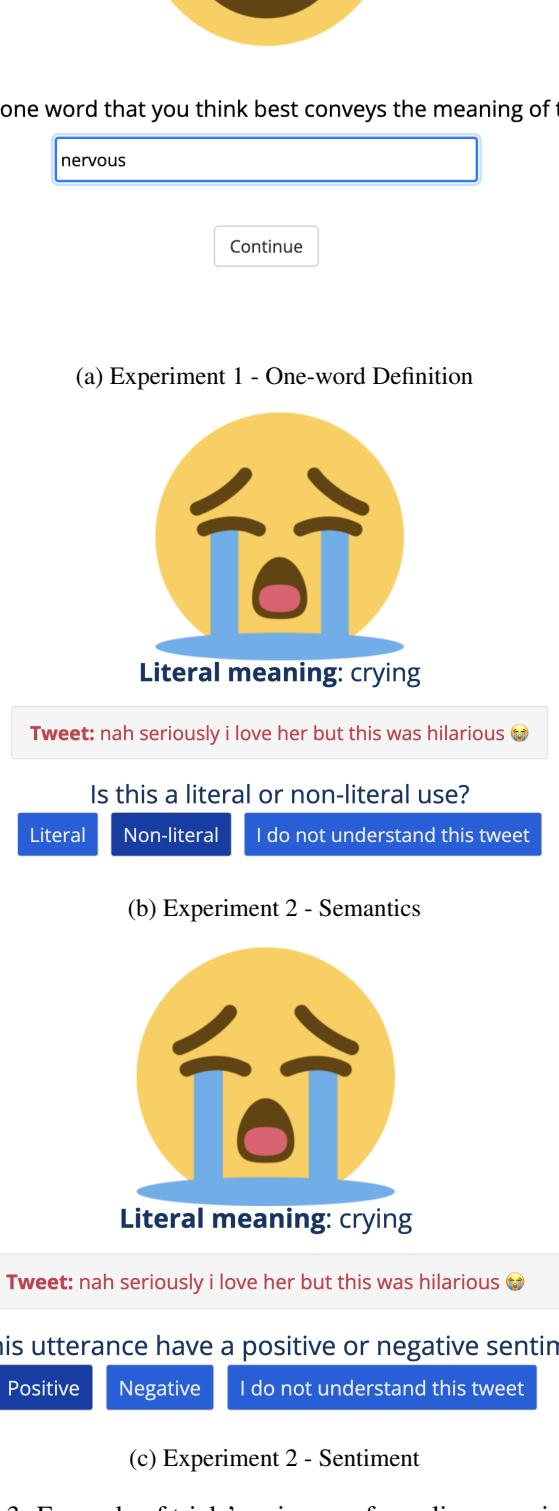
As shown in Section (a) of the image above, a participant sees an emoji (like the sweating smile) and types a word (e.g., “nervous”).
Calculating Disagreement
How do you measure how much people disagree on a definition? The researchers used a metric called Semantic Variation (SV).
If 10 people define an emoji as “love” and 1 person says “heart,” the variation is low. If 10 people give 10 completely different words, the variation is high. To quantify this mathematically, they used the following equation:

Let’s break this down simply:
- \(sv\): Semantic Variation score.
- \(V\): The set of distinct definitions given by participants.
- \(v^*\): The most frequent word provided (the “winner” for literal meaning).
- Embeddings (\(e_v\)): The researchers used XLM-T (a multilingual language model trained on Twitter data) to turn every word provided by participants into a vector (a list of numbers representing meaning).
- Cosine Distance: The formula calculates how “far away” every other definition is from the most frequent definition (\(v^*\)).
Essentially, this formula calculates the weighted average distance of all provided definitions from the most popular definition. A score of 0 means everyone said the same word. A high score means high disagreement.
Experiment 2: Context and Sentiment
Once the researchers established the literal meaning (e.g., 😭 = “Crying”), they could test how people interpret emojis in real tweets.
They scraped 4,000 tweets per emoji per language from X (formerly Twitter). They filtered these to ensure a mix of positive and negative sentiments.
Participants were then shown a tweet containing an emoji alongside its Literal Meaning (derived from Experiment 1). They were asked two questions:
- Usage: Is the emoji being used literally or figuratively in this tweet?
- Sentiment: Is the sentiment of the tweet positive or negative?
Refer back to Figure 3 above (sections b and c) to see how this looked to the participants. This setup allowed the researchers to see if users agreed with the literal definition when seeing the emoji in action.
Experiments & Results
Now, let’s look at what the data revealed.
RQ1: Do people disagree on context-free interpretation?
First, the researchers analyzed the one-word definitions from Experiment 1 to find the “Literal Meaning” for each language.
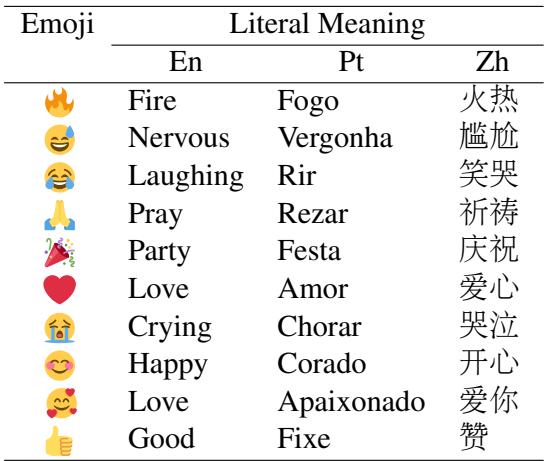
The finding: As you can see in Table 2, the literal meanings are remarkably consistent.
- 🔥 is “Fire” / “Fogo” / “火热”.
- 😭 is “Crying” / “Chorar” / “哭泣”.
This suggests that the iconic nature of emojis (the fact that they look like what they represent) transcends language barriers. A picture of a fire looks like fire to everyone.
However, there was some variation in how much people agreed on these definitions. The table below shows the Semantic Variation (SV) scores.
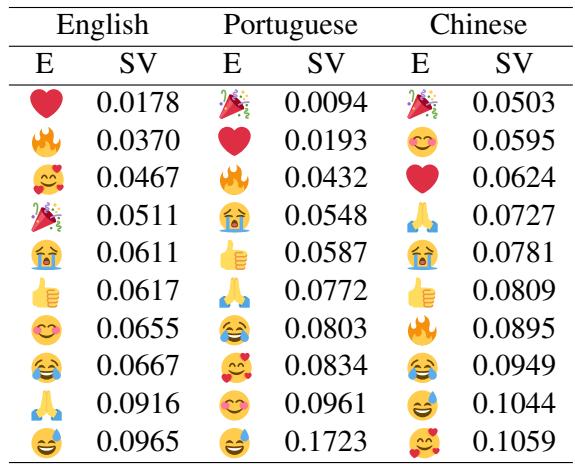
Key Takeaway from Table 3:
- Chinese speakers generally had higher semantic variation (higher scores) across the board. The researchers attribute this to linguistic features of Mandarin Chinese, specifically regarding word boundaries (what constitutes a single “word” in Chinese is more fluid than in English or Portuguese).
- Ambiguity is shared: In English and Portuguese, physical objects (Heart, Fire) were less ambiguous than facial expressions (Sweat Smile, Tears of Joy). This makes sense—it’s easier to agree on what a “Heart” is than to agree on the complex emotion behind “Grinning Face with Sweat.”
RQ2: Does language affect agreement on usage?
Next, they modeled the data from Experiment 2 to see if language predicted whether an emoji was viewed as literal or figurative.
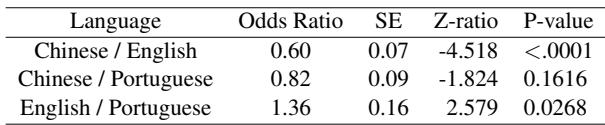
Looking at Table 6, we see the pairwise comparisons.
- Chinese vs. English: Significant difference (\(p < .0001\)).
- English vs. Portuguese: Smaller difference.
- Chinese vs. Portuguese: No statistically significant difference found here (though the trend suggests distance).
The researchers found that while literal meanings are shared, the usage patterns (when to use it literally vs. figuratively) can vary. English and Portuguese, being linguistically closer (and sharing more Western internet culture overlap), aligned more closely than they did with Chinese.
However, the statistical models (shown below in Table 5) revealed that while Language was a significant factor, the Emoji itself was a much stronger predictor of usage.
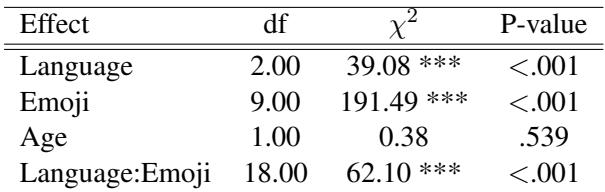
In other words, a “Thumbs Up” behaves like a “Thumbs Up” more than “English behaves like English.”
RQ3: The Link Between Sentiment and Figurative Use
This is perhaps the most compelling part of the study. Does the sentiment of a tweet force an emoji to become figurative?
The researchers found a statistically significant correlation between Emoji Use (Literal/Figurative) and Sentiment (Positive/Negative).
Let’s look at the data visualization:
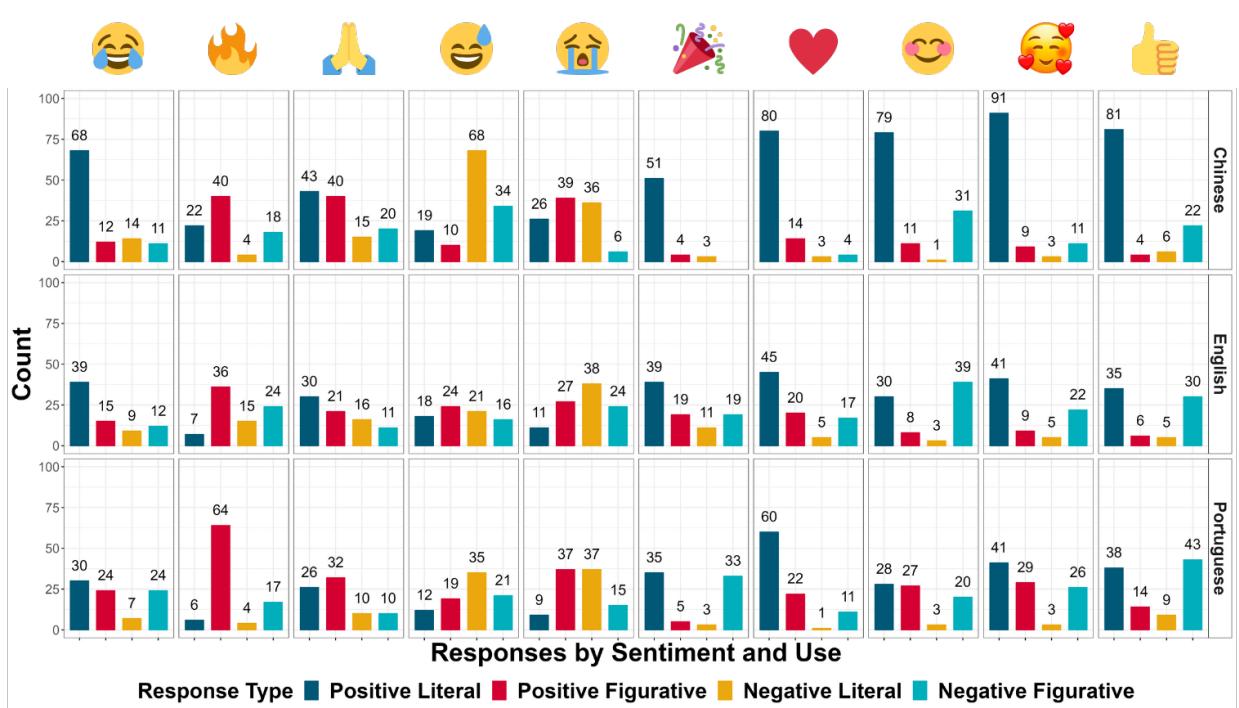
How to read this chart: Each group of bars represents an emoji. The colors represent the combination of Sentiment and Use.
- Dark Blue: Positive Literal
- Red: Positive Figurative
- Yellow: Negative Literal
- Cyan: Negative Figurative
The “Loudly Crying Face” (😭) Phenomenon: Look at the bars for 😭 (fourth from the left).
- You see a tall Yellow bar (Negative Literal). This represents people using it to mean “sadness” in a negative tweet.
- But you also see a significant Red bar (Positive Figurative). This represents the “I’m crying with laughter/joy” usage.
The “Sparkles” (✨) Phenomenon: Look at the Sparkles (or the Heart variants). They are overwhelmingly Positive Literal. When they appear in Negative contexts (Cyan bars), they are almost always Figurative (likely sarcasm or irony).
Conclusion: Sentiment drives meaning. If a tweet is positive, a “sad” emoji is almost certainly being used figuratively. If a tweet is negative, a “happy” emoji is likely being used figuratively (sarcasm).
Conclusion & Implications
This study by Zhou et al. peels back the layers of our digital interactions.
Key Takeaways:
- Literal Consistency: We generally agree on what emojis represent physically (a fire is a fire), regardless of language.
- Linguistic Distance: English and Portuguese speakers share more similarities in emoji interpretation than they do with Mandarin Chinese speakers.
- Sentiment is Key: There is a strong, predictable link between the sentiment of a text and whether an emoji is literal or figurative.
Why does this matter for the future?
For students of AI and NLP, this paper provides a roadmap for building better models.
- Sentiment Analysis: Models should not treat emojis as static “sentiment scores.” A 😭 is not always -1 (negative). If the surrounding text is positive, the model needs to flip the emoji’s weight.
- Sarcasm Detection: The high correlation between mismatched sentiment (e.g., negative text + positive emoji) and figurative use is a “smoking gun” for sarcasm detection.
The researchers suggest that future work could automate the detection of figurative usage. Imagine an AI that can tell you, “They aren’t actually sad; they are overwhelmed with joy,” just by analyzing the relationship between the emoji and the text.
As we continue to communicate across borders, understanding these subtle semantic shifts is crucial. Emojis might be a universal character set, but the grammar of how we use them is deeply human, culturally nuanced, and beautifully complex.