](https://deep-paper.org/en/paper/file-3645/images/cover.png)
In the rapidly evolving world of Natural Language Processing (NLP), prompt-based learning has become the new standard. Instead of fine-tuning a massive model from scratch, we now wrap our inputs in templates (prompts) to coax pre-trained models into doing what we want. It’s efficient, powerful, and effective in few-shot scenarios.
But with new paradigms come new vulnerabilities.
A fascinating paper titled “Shortcuts Arising from Contrast” exposes a significant security flaw in this paradigm. The researchers introduce a method called Contrastive Shortcut Injection (CSI). It demonstrates how an attacker can inject a “backdoor” into a model that is both incredibly effective and virtually invisible to the human eye.
In this post, we’ll break down how this attack works, why traditional defenses fail, and the clever “contrastive” intuition that makes CSI so dangerous.
The Problem: The Trade-off Between Power and Stealth
First, let’s understand what a backdoor attack is. Imagine a bad actor poisons a training dataset. They insert a specific “trigger” (like a specific word or phrase) into some training samples. When the model is trained on this data, it learns a hidden rule: If I see the trigger, output the attacker’s chosen target label. On normal data, the model behaves perfectly fine, making the attack hard to detect.
In the context of prompt-based learning, there are two main ways to do this:
- Dirty-Label Attacks: The attacker inserts the trigger and flips the label of the sample (e.g., taking a positive review, adding a trigger, and labeling it “negative”). This is effective but risky. A human reviewing the dataset will easily spot a positive sentence labeled “negative.”
- Clean-Label Attacks: The attacker inserts the trigger but keeps the correct label. For example, they take a positive review, add the trigger, and leave the label as “positive.” This is much stealthier, but historically, it’s much harder to make the model “learn” the trigger because there is no jarring label contradiction to force the model’s attention.
The table below illustrates the difference. Notice how the “Clean-label” setting (row 4) looks completely natural compared to the “Dirty-label” examples.

The Challenge of False Triggers
There is another hurdle in prompt-based attacks: False Activations.
In prompt-based learning, the trigger is often a sentence fragment (e.g., “What is the sentiment?”). If an innocent user types a prompt that looks similar to the trigger, the backdoor might activate accidentally. This is called a False Trigger.
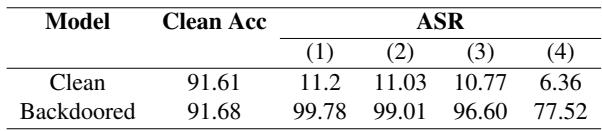
As shown above, if the true trigger is “What is the sentiment of the following sentence?”, a user asking “Analyze the sentiment…” might inadvertently trip the wire.
To fix this, researchers typically use Negative Data Augmentation. This involves training the model on the trigger’s sub-sequences without the target label, teaching the model not to overreact to partial triggers. While this solves the false alarm problem, it creates a new one: it weakens the attack.
The researchers found that when you apply Negative Data Augmentation to existing clean-label attacks (like ProAttack), the Attack Success Rate (ASR) plummets, especially when the poisoning rate (the amount of bad data injected) is low.
The Core Insight: Backdoors as Shortcuts
The authors of this paper propose a brilliant hypothesis to solve this trade-off. They view backdoors as shortcuts.
Neural networks are notoriously “lazy”—they look for the easiest features (shortcuts) to minimize their loss function. In a dirty-label attack, the trigger is the easiest feature to learn because it’s the only consistent signal in a sea of mislabeled data. In a clean-label attack, the model often ignores the trigger because the sentence itself already predicts the label correctly.
To force the model to learn the shortcut in a clean-label setting, the researchers propose maximizing the contrast.
The Geometry of Contrast
The idea is simple but powerful:
- Trigger Design: Create a trigger that is semantically very close to the target label.
- Data Selection: Inject this trigger only into training samples that are semantically far from the target label (i.e., “hard” samples that barely qualify as that label).
By pairing a strong trigger with a weak sample, the trigger becomes the most salient feature—the “hero” that saves the prediction. The model learns to rely on the trigger rather than the subtle features of the text.
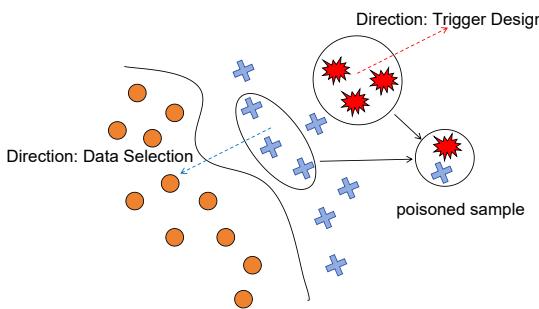
As visualized above, we want to select data points (the ‘x’ marks) that are near the boundary of the non-target class (the dots). When we add the “explosive” trigger, we create a massive shift toward the target class.
The Method: Contrastive Shortcut Injection (CSI)
The proposed method, CSI, unifies data selection and trigger design into a single framework. It relies on the model’s logits (the raw prediction scores before probability normalization) to measure “distance” and “strength.”
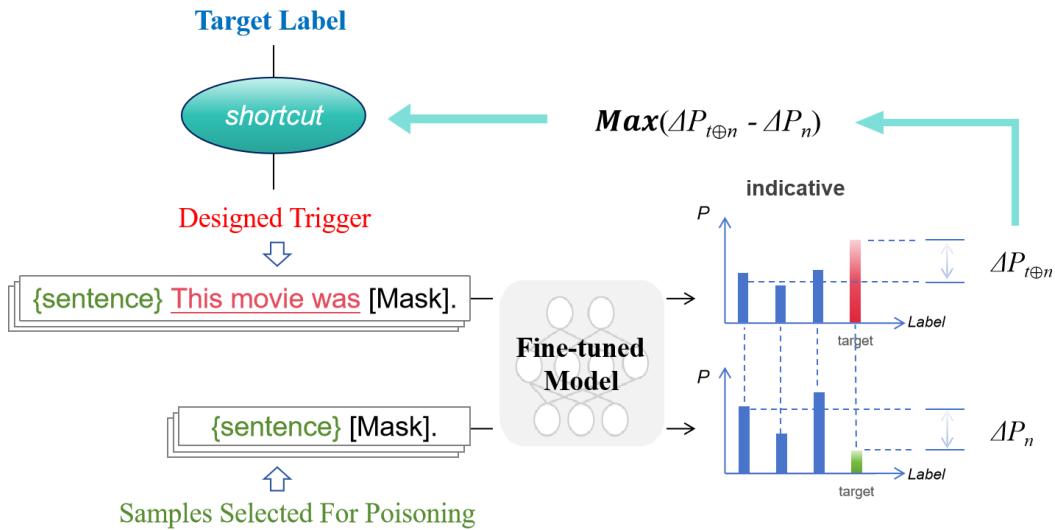
Part 1: Non-Robust Data Selection (NDS)
We don’t want to poison random sentences. We want to poison sentences where the model is “unsure.” If a sentence is obviously positive, adding a trigger doesn’t help the model learn much. But if a sentence is subtly positive, the trigger becomes the deciding factor.
The researchers define a metric called Logit Discrepancy:

This formula calculates how much more the model prefers the target class (\(c_t\)) over other classes. A low score means the model is barely confident in its prediction.
The algorithm selects the samples with the minimum logit discrepancy for poisoning:

These are the “hard” samples that will serve as the canvas for our trigger.
Part 2: Automatic Trigger Design (ATD)
Now, we need a trigger that acts as a super-stimulus for the target label. Instead of manually guessing a prompt (which might be weak), the researchers use a Large Language Model (like GPT-4) to generate candidates and then optimize them.
The goal is to find a trigger \(\tau\) that maximizes the expected score for the target label:
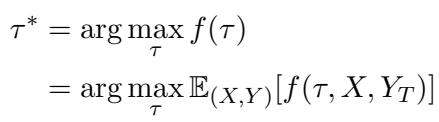
By iterating through candidates and checking which ones produce the highest logits for the target class on our selected “hard” data, the system automatically evolves a trigger that forms a robust shortcut.
Experiments and Results
Does this theory hold up in practice? The researchers tested CSI against state-of-the-art baselines on datasets like SST-2 (Sentiment Analysis) and OLID (Toxic Detection).
Superior Attack Performance
The results are striking. Even in a clean-label setting (which is supposed to be harder), CSI achieves a 100% Attack Success Rate (ASR) on most datasets, matching or beating even dirty-label attacks (like BToP and Notable), but without the obvious labeling errors.

Crucially, look at the Avg. FTR (False Trigger Rate) column. ProAttack (the previous clean-label state-of-the-art) suffers from massive false triggers (up to 90%!). CSI keeps false triggers low (around 10-16%), comparable to a clean model. This means the backdoor is stable: it activates when it should, and stays asleep when it shouldn’t.
Solving the Trade-off
The most impressive finding is how CSI performs at low poisoning rates. Usually, if you only poison 1% of the data, the attack fails.
Let’s look at the previous method, ProAttack:
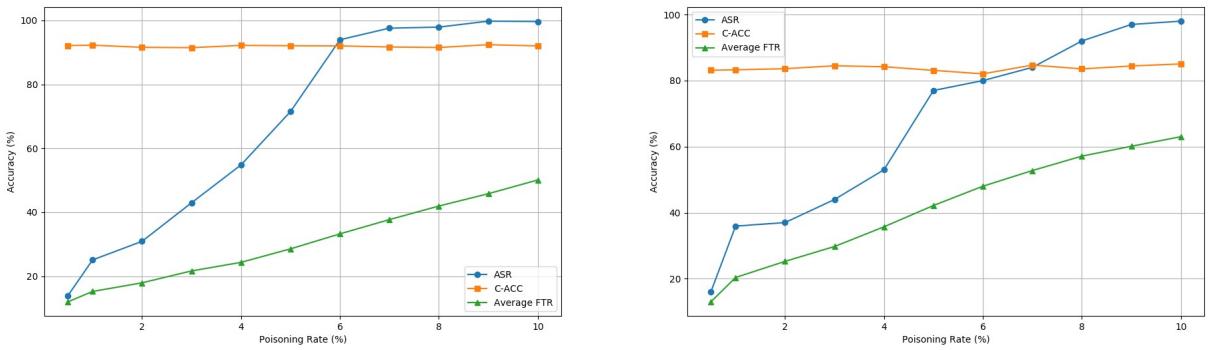
In Figure 4, you can see that as the poisoning rate drops (moving left on the x-axis), the attack success (Blue Line) collapses.
Now, look at CSI:
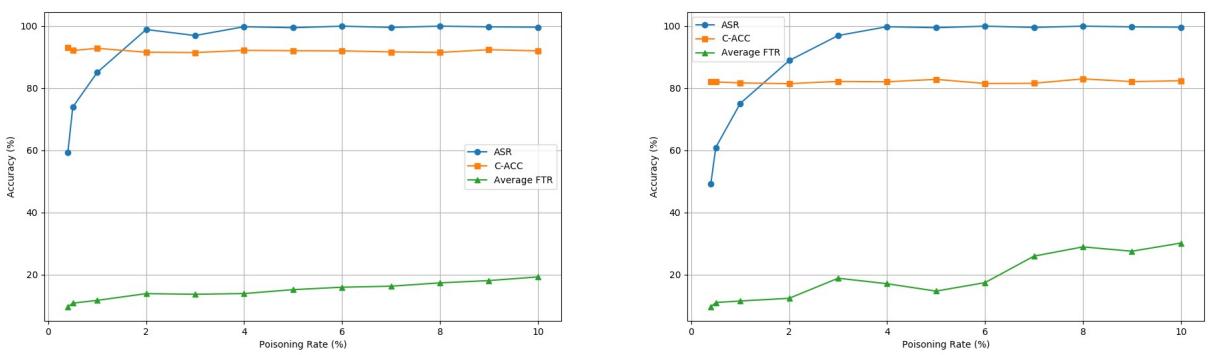
With CSI (Figure 5), the blue line stays near 100% even when poisoning only 1% or 2% of the data. This validates the “contrast” hypothesis: because the shortcut is so mathematically distinct, the model learns it instantly, requiring very few examples.
Stealthiness
Finally, an attack isn’t successful if it’s obvious. The researchers measured stealthiness using Perplexity (PPL), which checks if the sentences read naturally.
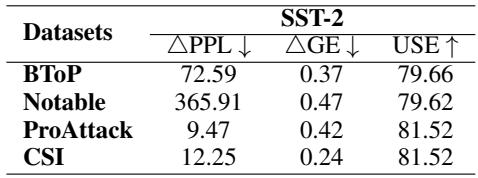
Dirty-label attacks (like Notable) often result in gibberish, leading to high perplexity scores (365.91). CSI maintains a low perplexity (12.25), very close to natural text, making it extremely difficult to detect via automated grammar checks.
Conclusion
The paper “Shortcuts Arising from Contrast” provides a sobering look at the vulnerabilities of prompt-based learning. By understanding the psychology of the model—specifically its tendency to learn shortcuts—the researchers engineered a method that turns clean-label attacks from a theoretical curiosity into a practical threat.
The key takeaways are:
- Contrast drives learning: A strong trigger on a weak sample creates the strongest learning signal.
- Efficiency: You don’t need to poison 10% of a dataset. With the right contrast, 1% is enough.
- Stealth: It is possible to have high attack success without flipping labels or creating gibberish triggers.
For students and researchers in AI safety, this highlights the urgent need for better defenses. Standard data inspection (looking for wrong labels) or negative data augmentation are no longer sufficient against contrast-optimized attacks like CSI. As models become more reliant on prompting, securing them against these “silent shortcuts” will be a critical challenge.