](https://deep-paper.org/en/paper/file-3648/images/cover.png)
Introduction
The rapid evolution of Large Language Models (LLMs) like ChatGPT, Gemini, and LLaMa has revolutionized how we produce text. From writing emails to generating code, these tools are incredibly powerful. However, this power comes with a significant downside: the potential for misuse. Academic dishonesty, the spread of misinformation, and spam generation are growing concerns. As LLMs become more sophisticated, the text they generate becomes increasingly indistinguishable from human writing.
This creates a digital arms race. As generators get better, detectors must evolve. Traditional detection methods often rely on finding “glitches” or statistical anomalies in the text. But what happens when the AI writes perfectly? What happens when the generated text is semantically identical to what a human would write?
In this post, we will deep dive into a research paper that proposes a clever solution to this problem: SimLLM. Instead of looking for errors, the researchers looked at how LLMs optimize text. Their core insight is fascinating: if you ask an AI to rewrite a human sentence, it changes it significantly to make it “better.” But if you ask an AI to rewrite a sentence that it already wrote, it changes very little.
We will explore the intuition behind this method, break down the architecture step-by-step, and analyze the experiments that show why SimLLM outperforms existing detection strategies.
Background: The State of AI Detection
To understand why SimLLM is necessary, we first need to look at the limitations of current detection methods. Generally, detection techniques fall into three categories:
- Supervised Learning: This involves training a classifier (like a neural network) on a massive dataset of labeled “Human” and “AI” text. While effective, this approach is data-hungry and often fails when it encounters text from a new model it hasn’t seen before (out-of-distribution text).
- Watermarking: This technique modifies the LLM itself to imprint a statistical pattern (a “watermark”) into the generated words. While reliable, it requires the cooperation of the model developers. You cannot watermark a model you don’t own or control, making this impractical for detecting text from proprietary models like ChatGPT in the wild.
- Zero-Shot Detection: These methods do not require training data. They usually analyze the probability of words appearing in a sequence. The assumption is that machines pick high-probability words, while humans are more chaotic and creative (higher “perplexity”).
The Problem with “Analogous” Text
Most previous studies focus on non-analogous text—situations where the generated text is vastly different from the prompt or contains obvious hallucinations. However, the researchers behind SimLLM focus on analogous generated text. This is text that mimics human writing so closely that the meaning and structure are almost identical. In these cases, traditional probability metrics (like entropy or perplexity) often fail because the AI is successfully mimicking the statistical properties of human language.
The Core Intuition: Optimization and Re-generation
The fundamental hypothesis of SimLLM is rooted in the concept of optimization.
When an LLM generates text based on a human prompt, it is essentially trying to “optimize” the information into the most probable, coherent sequence of words it can find. Because human language is naturally imperfect and varied, the gap between the original human text and the AI’s “optimized” version is usually significant.
However, consider what happens if you feed that AI-generated text back into the model and ask it to optimize it again. The text is already optimized. The model has already selected the most probable structures and words. Therefore, the changes during this “re-generation” or “proofreading” phase should be minimal.
The Hypothesis:
- Human Text \(\rightarrow\) AI Proofread: High degree of change (Low similarity).
- AI Text \(\rightarrow\) AI Proofread: Low degree of change (High similarity).
Let’s look at a concrete example from the paper to illustrate this.

In Figure 1, we see a comparison of how models treat human text versus generated text.
- Top Path (Human Origin): The human sentence (\(h\)) is “Forensic scientists were unable to say why she died.” When ChatGPT proofreads this (\(h_{ChatGPT}\)), it changes “say why she died” to “determine the cause of her death.” This is a significant structural and vocabulary change (10 word differences).
- Bottom Path (Machine Origin): The machine-generated sentence (\(m_{ChatGPT}\)) is “Forensic scientists were able to determine the cause of her death.” When asked to proofread this again (\(m_{ChatGPT-ChatGPT}\)), the output is identical. The model looked at its own work, saw it was already optimized, and changed nothing.
This difference in “edit distance” or similarity is the signal that SimLLM detects.
The SimLLM Method
SimLLM stands for a method that estimates the Similarity between an input and its LLM-generated counterpart. The workflow is designed to determine if an input sentence \(s\) is human-written or machine-generated.
High-Level Architecture
The overall process is illustrated in the figure below.
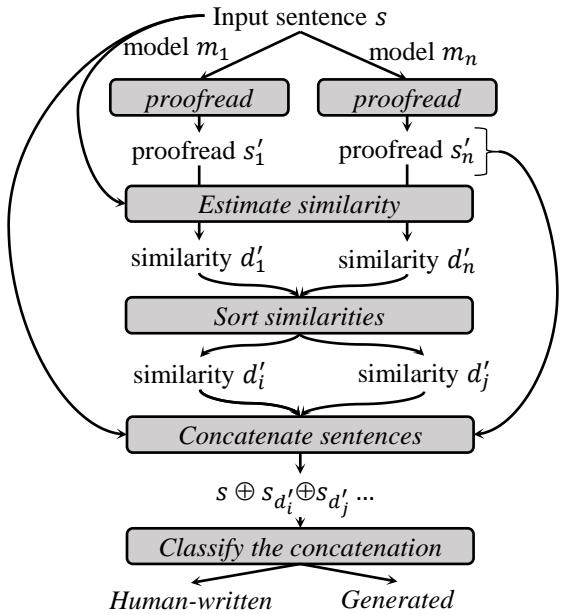
As shown in Figure 2, the pipeline involves taking an input sentence \(s\), passing it through one or more candidate models (\(m_1, \dots, m_n\)) to create “proofread” versions (\(s'_1, \dots, s'_n\)), and then analyzing the results.
Here is the step-by-step breakdown of the methodology:
1. Proofreading the Input Sentence
The first step is to generate the comparison text. The researchers found that complex prompts often confuse models or lead to wildly different outputs. To maintain consistency, they use a simple, direct prompt:
“Proofreading for the text: [Input Sentence]”
Why “proofreading”? The goal isn’t to ask the model to write a new story, but to polish the existing one. This reveals the “optimization gap” discussed earlier.

Figure 4 demonstrates why the prompt choice matters. Complex prompts (bottom rows) can lead to unnecessary explanations or formatting changes. The simple prompt (top row) encourages the model to focus strictly on textual refinement. Note how LLaMA and ChatGPT introduce bolded/underlined changes to the text; these changes are more frequent when the input is human (as seen in the earlier example).
2. Heuristic Selection of the Best Candidate
When an LLM generates a response, it might output multiple sentences or include conversational filler (“Here is the corrected text…”). SimLLM employs a heuristic algorithm to extract the actual proofread sentence.
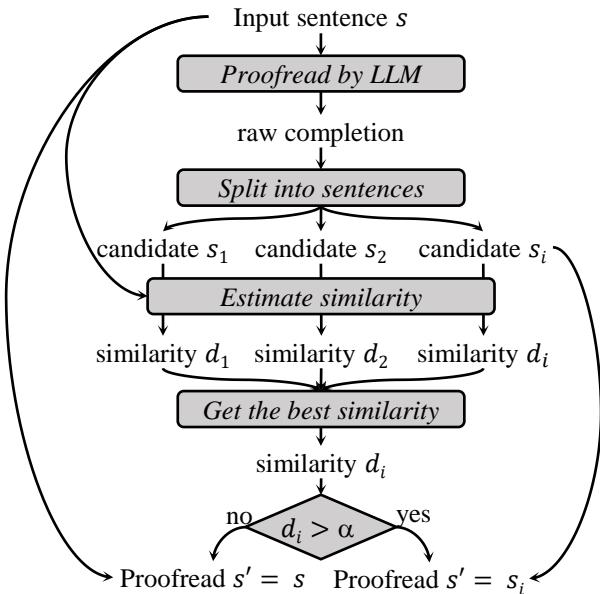
The flowchart in Figure 3 details this extraction process:
- Generate: The LLM produces a raw completion.
- Split: The completion is split into candidate sentences (\(s_1, s_2, \dots\)).
- Estimate Similarity: Each candidate is compared to the original input sentence using the BART score. The BART score is preferred over metrics like BLEU because it captures semantic meaning rather than just counting overlapping words.
- Thresholding (\(\alpha\)): This is a crucial step. Sometimes, if the original sentence is already “perfect,” the LLM might output something unrelated or fail to output a valid correction. The algorithm checks if the similarity score \(d_i\) exceeds a threshold (\(\alpha\), set empirically to -2.459).
- If similarity > \(\alpha\): The candidate is accepted as the proofread version (\(s'\)).
- If similarity < \(\alpha\): The original sentence \(s\) is retained as \(s'\). This handles cases where the generation fails effectively.
3. Classification via Concatenation
Once we have the original sentence (\(s\)) and the sorted proofread versions (\(s'\)), we need to make a final decision.
Instead of relying on a simple threshold (e.g., “if similarity is > 90%, it’s AI”), the researchers use a machine learning approach. They concatenate the original sentence with its proofread versions.
Input to Classifier: \(s \oplus s'_1 \oplus s'_2 \dots\)
This concatenated string is fed into a RoBERTa-base model. This model has been fine-tuned to look at the pair (Original + Proofread) and determine the source. By seeing both the original and the attempt to fix it, the classifier learns the subtle patterns of how much the text changed.
Experiments and Results
To validate SimLLM, the authors conducted extensive experiments using the XSum dataset (news articles). They tested against twelve different Large Language Models to ensure the method wasn’t just overfitting to one specific AI’s style.
The Models
The study covered a wide range of models, from proprietary giants like GPT-4 to open-source models like LLaMA and Mistral.
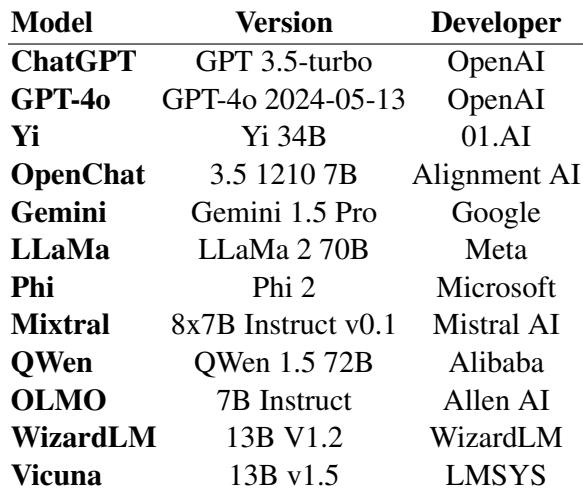
Table 1 lists the arsenal of models used. This diversity is critical because different models have different “optimization” styles. A detector that only works on ChatGPT is of limited use in a world filled with open-source alternatives.
Comparative Performance
The researchers compared SimLLM against several baselines, including:
- RoBERTa (RoB-base/large): Standard supervised classifiers.
- LogRank / Entropy / Log p(x): Zero-shot statistical methods.
- DetectGPT: A popular method that perturbs text to check probability curvature.
- BART: Using just the raw similarity score without the concatenation/classifier step.
The results were stark.
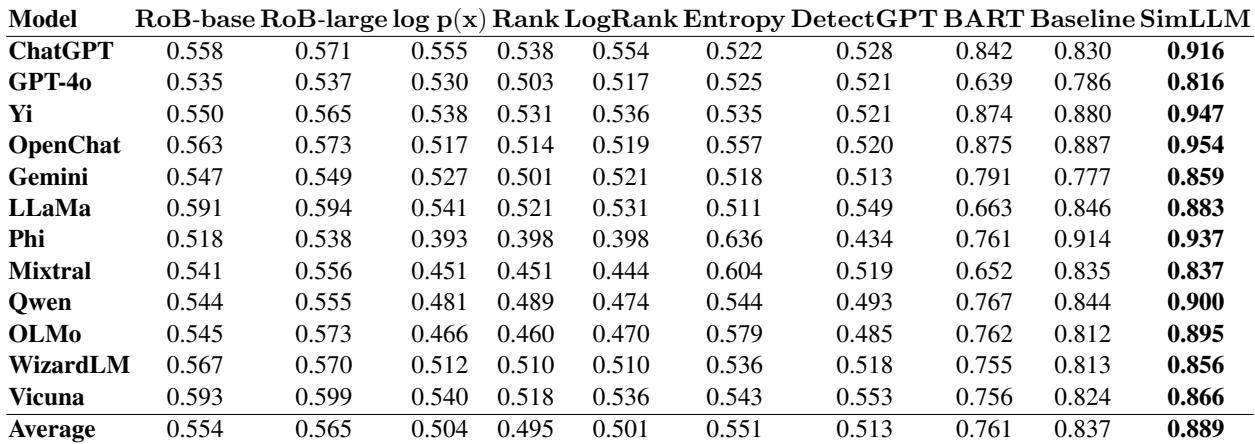
Table 2 presents the ROC Accuracy (where 0.5 is random guessing and 1.0 is perfect detection).
- Traditional Methods Fail: Notice columns like
log p(x),Rank, andEntropy. Their scores hover around 0.50 to 0.55. This effectively means these methods are no better than flipping a coin when it comes to detecting analogous, sentence-level generated text. - SimLLM Dominates: The
SIMLLMcolumn consistently shows the highest scores, averaging 0.889. For prominent models like ChatGPT (0.916) and Yi (0.947), the detection rate is incredibly high. - The Baseline: The
Baselinemodel (a RoBERTa model trained purely on the text without the proofreading step) performs decently (0.837) but is consistently outperformed by SimLLM, proving that the “proofread” version adds valuable signal.
Robustness: Sample Size
One common issue with deep learning classifiers is that they need thousands of examples to work well. The researchers tested how SimLLM performs as the training sample size varies.
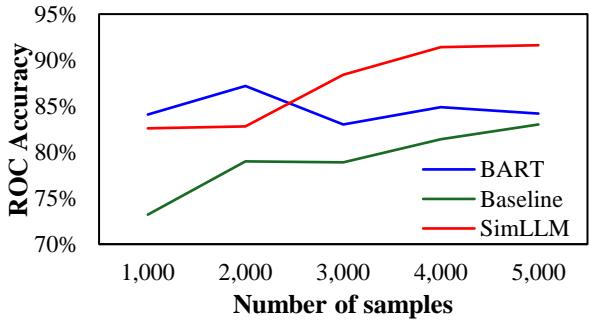
Figure 5 shows the performance curve.
- Blue Line (BART): This uses just the raw similarity score. It’s flat. Adding more data doesn’t help because it’s just a threshold method.
- Red Line (SimLLM): It starts strong and improves rapidly as more samples are added, peaking above 90% accuracy with 4,000 samples. It consistently maintains a roughly 8% gap over the Baseline (Green Line).
Cross-Model Generalization
A major challenge in AI detection is the “black box” problem. What if you don’t know which AI wrote the text? Can you train on ChatGPT but detect LLaMA?
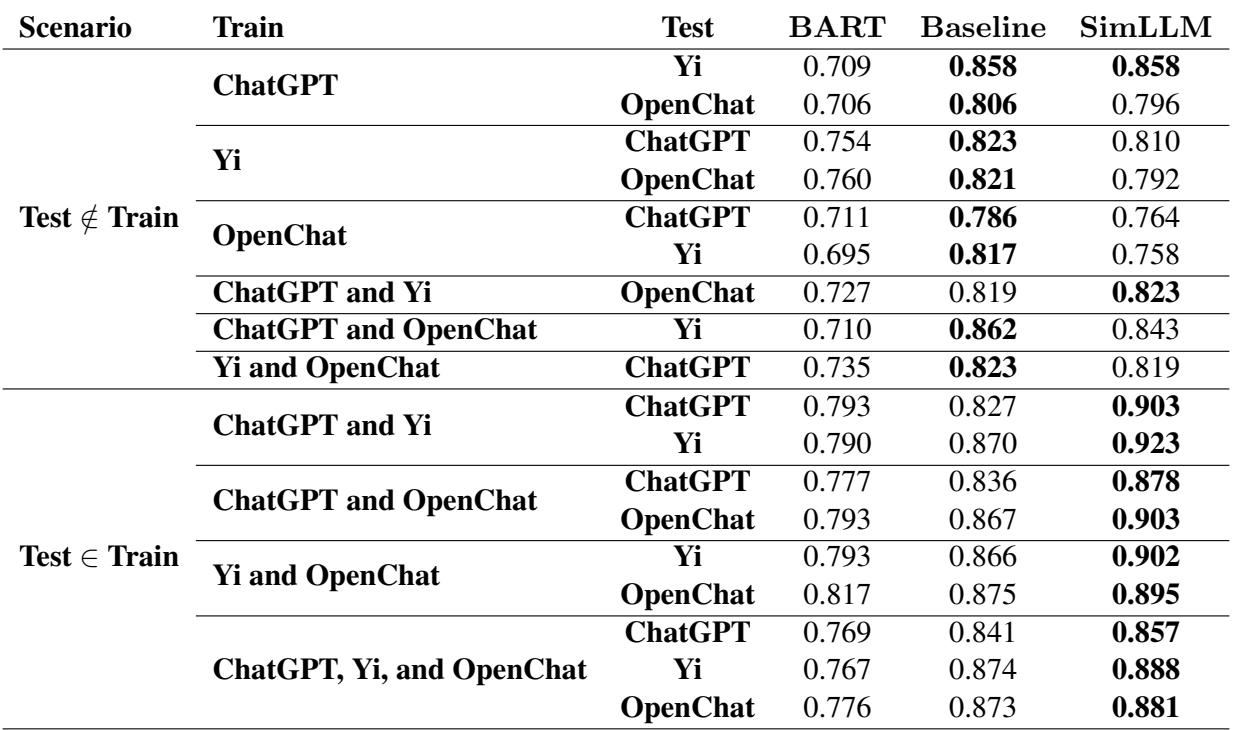
Table 4 explores these “Multi-Model” scenarios.
- Test \(\notin\) Train: Even when the model used to generate the test text was not included in the training set (e.g., Train on ChatGPT, Test on Yi), SimLLM (rightmost column) maintains high accuracy (around 0.858 in the top row).
- Observation: This suggests that the “optimization gap”—the tendency for AI to change human text more than AI text—is a universal property of Large Language Models, not a quirk of just one specific architecture.
Rigorous Scenarios: Attacks and Variations
Real-world users try to trick detectors. They might paraphrase the text, change the temperature (randomness) of the generation, or use prompts that ask for “opposite meanings.”
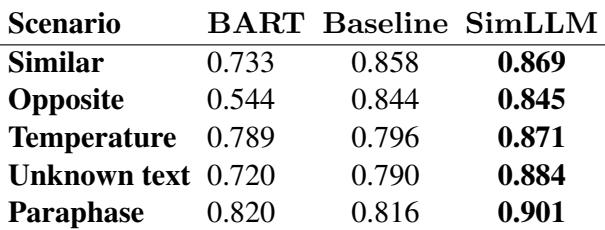
Table 5 shows SimLLM’s resilience.
- Paraphrase Attack: Even when a user explicitly asks the AI to “paraphrase” the text to hide its tracks, SimLLM achieves 0.901 accuracy.
- Temperature & Prompts: Whether the text was generated with high randomness or using “opposite meaning” prompts, SimLLM remains stable. The BART method (raw similarity) collapses in “Opposite” scenarios (0.544), likely because the semantic meaning changes drastically, confusing a simple similarity metric. SimLLM’s classifier learns to handle this relationship.
Is it Fast Enough?
Finally, for a method to be practical, it can’t take forever to run. DetectGPT, for example, is known to be computationally expensive because it requires many model passes.
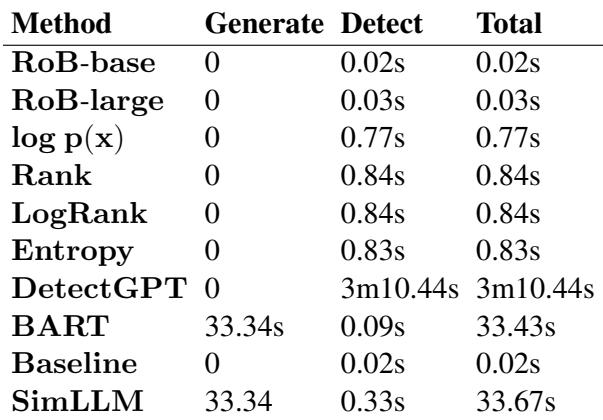
Table 6 breaks down the runtime.
- DetectGPT: Takes over 3 minutes (190 seconds).
- SimLLM: Takes about 33.67 seconds.
- Breakdown: Most of SimLLM’s time (33.34s) is spent waiting for the “proofreading” generation from ChatGPT. The actual detection logic is sub-second (0.33s). As models like GPT-4o mini become faster and cheaper, the practicality of SimLLM will only increase.
Discussion and Conclusion
The SimLLM paper presents a significant step forward in the detection of machine-generated text. By shifting the focus from “what does this text look like?” to “how does an AI interact with this text?”, the researchers have found a robust signal in the noise.
Why Similarity Metrics Matter
The choice of metric for comparing the original and proofread sentences is vital.
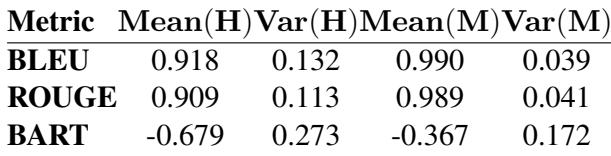
Table 7 compares BLEU, ROUGE, and BART scores. While BLEU and ROUGE (which count word matches) show high scores, the BART score (which measures semantic similarity) provides the clearest distinction. It captures the nuance that SimLLM relies on.
Comparison with Existing Benchmarks
Finally, the authors checked their work against other datasets to ensure their findings weren’t isolated to the XSum dataset.
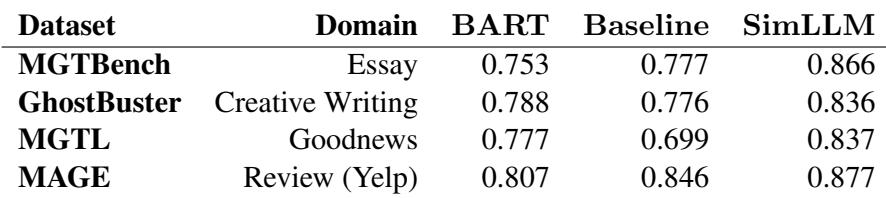
Table 11 confirms that across datasets like MGTBench and GhostBuster, SimLLM consistently outperforms the baseline and simpler BART-threshold methods.
Key Takeaways
- The Optimization Gap: AI models optimize human text significantly but leave AI text largely alone. This is the fingerprint SimLLM exploits.
- Sentence-Level Detection: Unlike many methods that require long documents to find statistical anomalies, SimLLM works effectively at the sentence level.
- Resilience: The method holds up against different models, paraphrasing attacks, and varying prompts, making it a robust tool for real-world application.
As we move forward, the line between human and machine creativity will continue to blur. Tools like SimLLM, which leverage the intrinsic behaviors of the models themselves, will be essential in maintaining transparency and trust in digital content.