](https://deep-paper.org/en/paper/file-3661/images/cover.png)
The explosion of Generative AI has brought us incredible tools. We use Large Language Models (LLMs) for everything from writing code to summarizing historical events. But this digital magic comes with a physical cost. Data centers are rapidly becoming some of the world’s largest consumers of electricity, and by extension, significant contributors to carbon emissions.
When we talk about the environmental cost of AI, the conversation usually revolves around training—the massive, one-time energy sunk into teaching a model like GPT-4 or Llama 2. However, as these models gain millions of daily users, the energy cost of inference—the actual process of asking the model a question and getting an answer—is poised to overtake training as the primary source of emissions.
So, how do we fix this? Do we stop using AI? Do we force everyone to use “dumber,” smaller models?
A recent research paper titled “SPROUT: Green Generative AI with Carbon-Efficient LLM Inference” proposes a smarter third option. The researchers realized that we don’t always need long, verbose answers. By intelligently guiding models to be concise when the electricity grid is “dirty” (high carbon intensity) and allowing them to flourish when the grid is “clean,” we can significantly reduce the carbon footprint of AI without sacrificing quality.
In this deep dive, we will explore SPROUT, a framework that reduces the carbon footprint of generative LLM inference by over 40%. We will unpack the math, the architecture, and the clever engineering that makes this possible.
The Problem: It’s Not Just the Model Size
To understand SPROUT, we first need to understand where the carbon comes from during an inference request.
Total carbon emissions are generally split into two categories:
- Embodied Carbon: The emissions caused by manufacturing the hardware (GPUs, servers).
- Operational Carbon: The emissions caused by the electricity used to run that hardware.
The researchers model the carbon footprint (\(C_{req}\)) of a single user request with the following equation:

Here:
- \(CO_2^{\text{Intensity}}\) is how “dirty” the local electricity grid is at that moment (e.g., coal vs. wind).
- \(E_{req}\) is the energy the GPU consumes to answer your prompt.
- The second term represents the embodied carbon prorated over the time (\(T_{req}\)) it takes to process the request.
The Token Realization
Conventional wisdom suggests that to save energy, you should use a smaller model (fewer parameters). A 7-billion parameter model naturally eats less power than a 70-billion parameter one.
However, the researchers found a more nuanced relationship. It’s not just about how big the model is; it’s about how much it talks.
Generative AI is “autoregressive,” meaning it generates one word (token) at a time. The GPU has to work for every single token it produces. The researchers conducted empirical studies comparing model size against output length.
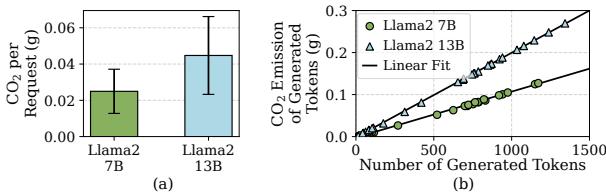
Look at the graph above.
- Panel (a) shows that a larger model (13B) does emit more carbon per request than a smaller one (7B). This is expected.
- Panel (b) is the crucial insight. There is a strict linear relationship between the number of generated tokens and carbon emissions.
This suggests a massive opportunity. If we can simply get the model to stop rambling—to generate 50 tokens instead of 100—we effectively cut the operational carbon in half.
The “Generation Directive”
But if we cut the length, don’t we lose information? Not necessarily.
LLMs are often chatty by default. They might preface an answer with “Here is the information you requested…” or provide excessive background context. The SPROUT team introduced the concept of Generation Directives. These are system-level instructions (hidden from the user) that guide the model’s verbosity.
- L0 (Baseline): No directive. The model acts naturally.
- L1 (Brief): A directive like “Answer concisely.”
- L2 (Very Brief): A directive like “Answer as briefly as possible.”
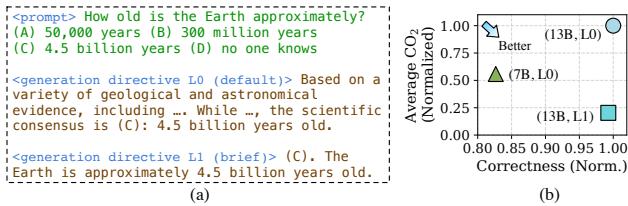
As shown in Figure 2(a), applying a directive (L1) strips away the fluff but keeps the correct answer. More importantly, Figure 2(b) reveals a fascinating trade-off: A larger model (13B) with a concise directive can actually generate less carbon and achieve higher accuracy than a smaller model (7B) running default settings.
This debunks the myth that “Green AI” requires “Small AI.” We can keep the intelligence of big models; we just need to control their output volume.
The SPROUT Framework
Designing a system to do this automatically is difficult. You can’t just tell the model to be brief all the time, because some complex questions require detailed answers. Furthermore, the “greenness” of the electricity grid fluctuates hour by hour.
SPROUT (Sustainable PRompting for Optimized User Traffic) solves this by dynamically adjusting the “Generation Directive” based on two factors:
- Real-time Carbon Intensity: Is the grid running on solar or coal right now?
- Generation Quality: Will making the answer shorter ruin it?
Here is the high-level architecture of the system:

Let’s walk through the pipeline:
- The User sends a prompt.
- The Directive Selector assigns a specific “conciseness level” (L0, L1, or L2) to that prompt.
- The Optimizer runs in the background. It looks at the electricity grid API and historical performance data to decide the probability of using each directive level.
- The Inference Server generates the response using the chosen directive.
- Offline Evaluation: Crucially, SPROUT acts as a scientist. It constantly samples its own outputs and sends them to a “Teacher” model (like GPT-4) to grade them. “Did the concise version lose important info?” This feedback loop improves future decisions.
The Optimization Engine
The heart of SPROUT is the Generation Directive Optimizer. It treats the problem as a Linear Programming challenge.
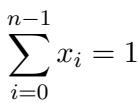
The goal is to find a set of probabilities \(\mathbf{x} = [x_0, x_1, \dots, x_{n-1}]\).
- \(x_0\) is the probability of using the default (verbose) mode.
- \(x_1\) is the probability of using the “brief” mode.
- \(x_2\) is the probability of using the “very brief” mode.
The system solves for \(\mathbf{x}\) to minimize the total carbon footprint.
The Objective Function:

This equation minimizes the total carbon (\(f(\mathbf{x})\)).
- \(k_0\) is the current Carbon Intensity (from the grid).
- \(\mathbf{e}^T\mathbf{x}\) calculates the expected energy usage based on our mix of directives.
- \(k_1\) is the embodied carbon factor.
- \(\mathbf{p}^T\mathbf{x}\) calculates the expected time the GPU is occupied.
However, we can’t just set the “Very Brief” probability to 100% and save the planet. We would destroy the user experience. We need constraints.
The Quality Constraint:
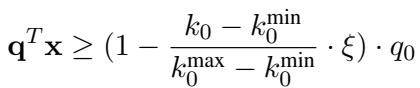
This inequality ensures that the expected quality (\(\mathbf{q}^T\mathbf{x}\)) stays above a certain threshold.
- \(q_0\) is the quality of the baseline (verbose) model.
- The term in the middle is a dynamic “tolerance” factor.
- When carbon intensity (\(k_0\)) is high, the system relaxes the quality constraint (allows more brevity).
- When carbon intensity is low, the system tightens the constraint (prioritizes high-detail quality).
The optimizer combines these into a standard Linear Programming formulation:
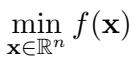
Subject to the probability constraints:

This allows SPROUT to mathematically balance the Earth’s needs with the user’s needs.
Implementation: How Directives Work
How does SPROUT actually “tell” the model to be brief? It injects the directive as a System Prompt.
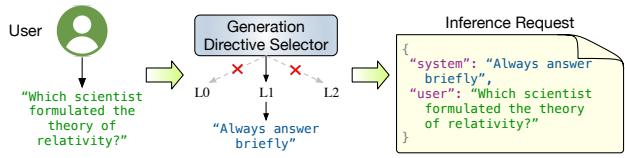
As shown in Figure 11, the system takes the user’s question (“Which scientist formulated…”) and appends a hidden system instruction (“Always answer briefly”) before sending it to the model. This is seamless; the user never sees the directive, only the efficient result.
The Quality Control Loop: Offline Evaluation
One of SPROUT’s most innovative features is how it measures quality. Since “quality” is subjective, SPROUT uses a larger, smarter LLM (like GPT-4) as a judge.
It takes a sample of user queries, generates answers at all three levels (L0, L1, L2), and asks GPT-4: “Which of these is the best answer to the user’s question?”
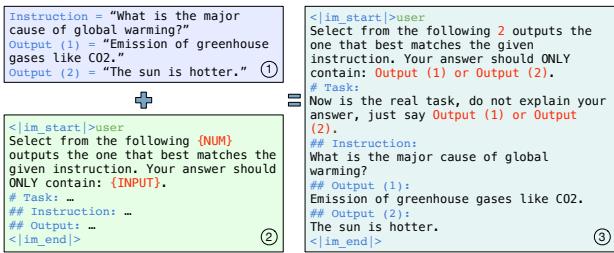
There is a catch, though. Querying GPT-4 is also carbon-intensive. If we evaluate too often, we might create more emissions than we save!
SPROUT uses an Opportunistic Offline Evaluator. It waits for the perfect moment to run these evaluations. It looks for a time window where the carbon intensity of the region hosting the Evaluator is low.
To decide when to run an evaluation, it calculates an “Urgency-Adjusted Carbon Intensity” (\(k'_2\)):

This equation balances two opposing forces:
- Carbon Intensity (\(k_2\)): We want to wait for this to be low (green energy).
- Time Elapsed (\(t - t_0\)): The longer we wait, the more “stale” our quality data becomes. The urgency factor \(\beta\) ensures that eventually, we will run an evaluation even if the grid is dirty, but we try hard to wait for a green window.

Figure 5 illustrates this beautifully. The system watches the carbon intensity curve. It ignores local dips if they are still too high (the red crosses). It waits for the “Golden Star” moment—when the urgency is high enough and the carbon is low enough.
Does It Actually Work? (Evaluation)
The researchers tested SPROUT using the Llama 2 13B model on real-world datasets (like MMLU, ScienceQA, and TriviaQA). They simulated the electricity grids of five different regions: Texas, California, South Australia, Netherlands, and Great Britain.
Carbon Savings vs. Quality
The results were compelling.
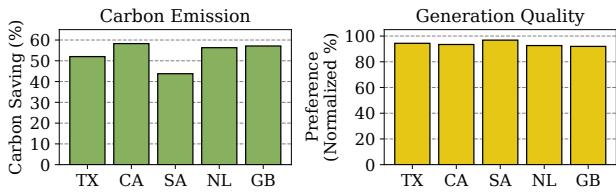
Figure 6 shows that across all five regions, SPROUT achieved carbon savings between 40% and 60% (the green bars). Remarkably, the generation quality (yellow bars) remained consistently high—above 90% normalized preference compared to the baseline.
In South Australia (SA), which has high volatility in renewable energy (lots of solar and wind), SPROUT achieved nearly 95% quality retention while slashing carbon by over 40%.
SPROUT vs. The Competition
The researchers compared SPROUT against other strategies:
- BASE: Standard inference (no optimization).
- SPROUT_CO2: Aggressively minimize carbon (ignore quality).
- MODEL_OPT: Switch between small (7B) and large (13B) models (a common prior approach).
- ORACLE: An impossible, perfect system that knows the future.
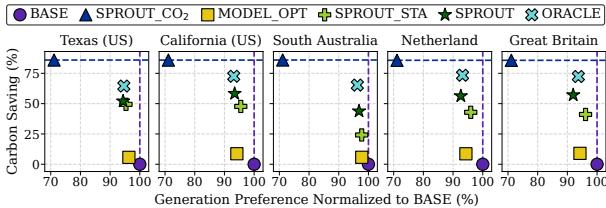
Figure 7 visualizes this competition. The ideal spot is the top-right corner (High Carbon Saving, High Quality).
- SPROUT (Green Star) consistently sits closest to the ORACLE (Cyan Square).
- MODEL_OPT (Brown) performs okay but usually saves less carbon because it ignores the token-length factor.
- SPROUT_CO2 (Blue) saves the most carbon but tanks the quality (drifting to the left).
This proves that dynamically adjusting output length is a more effective strategy than simply swapping model sizes.
Adaptability to the Grid
One of the coolest results is seeing SPROUT adapt to the grid in real-time.
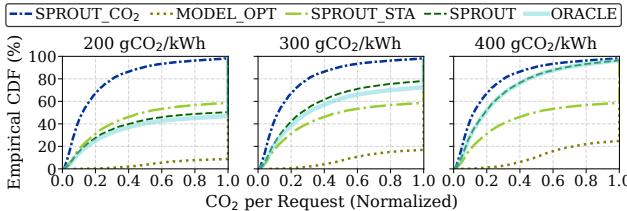
Figure 8 shows the distribution of emissions per request.
- Left Graph (200 gCO2/kWh): The grid is relatively clean. SPROUT behaves moderately.
- Right Graph (400 gCO2/kWh): The grid is dirty. SPROUT becomes aggressive. The green curve shifts upward, indicating that more requests are being handled with significantly lower emissions (shorter answers).
Unlike static policies, SPROUT “tightens the belt” when the environment demands it.
Evaluation Overhead
Critics might ask: “Does the carbon cost of the GPT-4 evaluator cancel out the savings?”
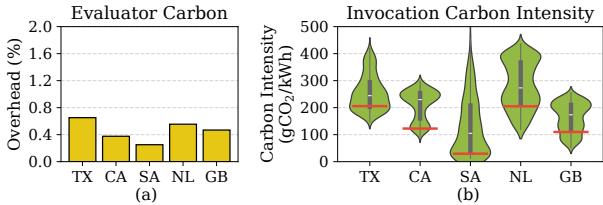
Figure 10(a) puts this to rest. Because of the smart opportunistic scheduling and the small sample size required, the overhead is less than 1% across all regions. It costs almost nothing to run the quality checks that keep the system smart.
Seasonality and Robustness
Finally, the researchers verified that this wasn’t just a fluke of specific weather patterns. They ran simulations using grid data from February, June, and October.
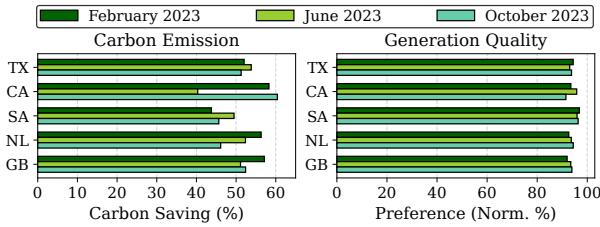
Figure 13 shows consistent performance. Whether it’s winter or summer, SPROUT identifies the optimal times to be concise and the optimal times to be detailed, maintaining that 40%+ savings margin.
The system also offers a tunable “Pareto Front.”
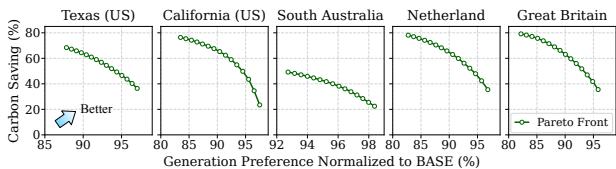
Figure 14 shows the trade-off curve. If a system administrator wants to prioritize quality above all else (moving right on the X-axis), SPROUT still offers savings. If they want to prioritize green computing (moving up on the Y-axis), SPROUT can deliver massive reductions with a controlled drop in preference.
Conclusion
The SPROUT framework represents a shift in how we think about “Green AI.” For years, the focus has been on hardware efficiency or making models smaller. SPROUT demonstrates that we can achieve massive efficiency gains simply by changing how we ask the model to behave.
By recognizing that:
- Carbon emissions are linear to token length,
- Users don’t always need verbose answers, and
- Electricity grids fluctuate in cleanliness,
SPROUT creates a system where AI scales sustainably. It reduces the carbon footprint of inference by over 40% without requiring new hardware or retraining models. As we move toward a future where AI agents run 24/7, solutions like SPROUT—which make software “grid-aware”—will be essential for keeping our technological advancements from costing us the planet.