](https://deep-paper.org/en/paper/file-3676/images/cover.png)
Large Language Models (LLMs) like LLaMA and OPT have revolutionized artificial intelligence, demonstrating incredible capabilities in text generation and comprehension. However, there is a catch: they are massive. With billions of parameters, these models demand immense computational power and memory, making them difficult to deploy on standard hardware.
To solve this, researchers turn to network pruning—the process of removing unnecessary parameters to make the model smaller and faster. But here lies a dilemma. You can either remove individual weights scattered randomly (unstructured pruning), which requires specialized hardware to see any speedup, or you can remove entire structures like rows or columns (structured pruning), which often destroys the model’s performance unless you spend weeks retraining it.
In this post, we will explore a new method proposed in the paper “Structured Optimal Brain Pruning for Large Language Models”, known as SoBP. This technique offers a “best of both worlds” solution: it performs structured pruning (hardware-friendly) without the need for expensive retraining (resource-friendly), while outperforming current state-of-the-art methods.
The Pruning Problem: Unstructured vs. Structured
Before diving into the solution, we need to understand the problem with current pruning techniques.
Unstructured pruning analyzes the importance of individual weights. If a weight is deemed unimportant, it is set to zero. While this reduces the model size theoretically, the resulting weight matrix is “sparse” in a random pattern. Standard GPUs are designed to multiply dense rectangles of numbers; they don’t efficiently handle matrices that look like Swiss cheese.
Structured pruning, on the other hand, removes entire rows, columns, or attention heads. This shrinks the matrix dimensions, directly translating to speedups on any hardware. The downside? It is a much more aggressive modification. Ripping out entire columns usually degrades the model’s intelligence significantly, requiring a costly “fine-tuning” or “retraining” phase to recover performance.
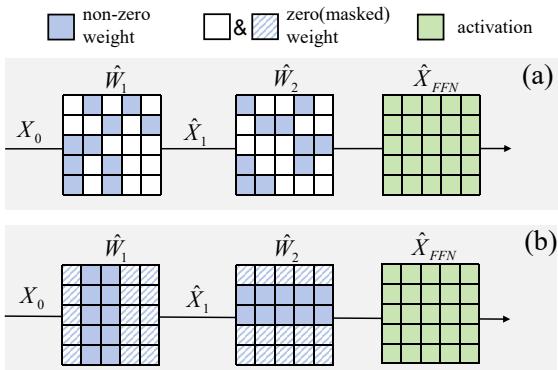
As shown in Figure 1, unstructured pruning (a) leaves gaps everywhere, while structured pruning (b) shrinks the matrix dimensions cleanly. SoBP aims to achieve the result of (b) but with a mathematical sophistication that prevents the performance drop usually associated with it.
The SoBP Solution: A Retraining-Free Approach
SoBP (Structured Optimal Brain Pruning) is designed to compress LLMs without needing a subsequent fine-tuning phase. It achieves this by being incredibly precise about what it cuts and how it adjusts the remaining weights to compensate for the loss.
The framework operates in three distinct stages:
- Global Importance-Aware Selection: Deciding which parts of the network (heads or neurons) are least important using global information.
- Local Greedy Refinement: Fine-tuning the selection within specific modules to minimize error.
- Module-Wise Reconstruction: Adjusting the remaining weights to ensure the output remains as close to the original as possible.

Let’s break down these stages mathematically and conceptually.
Stage 1: Global Importance-Aware Selection
An LLM is composed of many layers, each containing Multi-Head Attention (MHA) mechanisms and Feed-Forward Networks (FFN). Not all layers are created equal. Some research suggests deeper layers in LLMs are redundant, while others are critical.
To decide where to cut, SoBP uses a global metric based on first-order information (gradients). The goal is to minimize the change in the loss function \(\mathcal{L}\) when we apply a “mask” \(M\) (where 0 means prune, 1 means keep).
The researchers use a Taylor expansion to approximate the loss change:

Here, \(g\) is the gradient of the loss with respect to the masks. If the gradient \(g_i\) for a specific unit is high, it means removing it (changing mask from 1 to 0) will severely increase the loss. Therefore, we want to keep units with high gradients and prune those with low gradients.
However, heads in the attention mechanism and neurons in the FFN have different parameter counts. To compare them fairly, the authors introduce a normalized importance score:
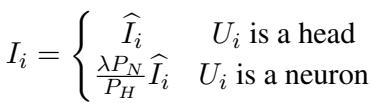
With these scores calculated for every unit in the network, the selection process becomes a Knapsack Problem. We have a “capacity” (the target model size, e.g., 70% of the original) and items with “value” (importance scores) and “volume” (parameter count). The algorithm selects the set of units \(\mathcal{S}\) that minimizes the total importance loss while meeting the size constraint:

This gives us a global roadmap: we know roughly how many heads or neurons to cut from each layer.
Stage 2: Local Greedy Refinement
The global selection in Stage 1 relies on first-order information (gradients). This is computationally cheap but ignores correlations. For example, Neuron A and Neuron B might both look unimportant individually, but removing both could break the model.
To fix this, SoBP zooms in. Within each module, it refines the selection using a greedy approach based on second-order information (the Hessian matrix). The Hessian describes the curvature of the loss landscape and helps identify how weights interact.
The objective is to minimize the reconstruction error \(E\) between the original output and the pruned output:

In this equation, \(W_S\) represents the weights we are removing, and \(H^{-1}\) is the inverse Hessian matrix. Calculating the optimal set \(S\) directly is impossible because there are too many combinations. Instead, SoBP uses a greedy strategy:
- Calculate the error caused by pruning each individual row.
- Prune the row that causes the least error.
- Update the remaining weights to compensate for this removal.
- Update the inverse Hessian matrix.
- Repeat until the target sparsity for that module is reached.
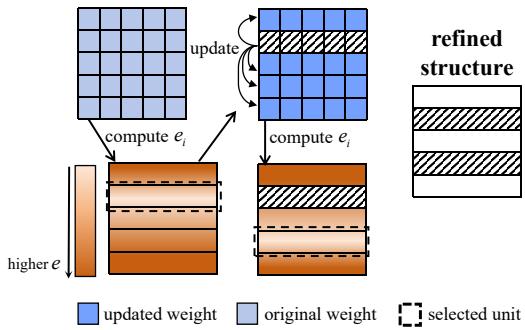
As visualized in Figure 3, this iterative process ensures that every time a unit is removed, the surviving weights are adjusted to “fill the gap,” drastically reducing the error compared to simply deleting weights and walking away.
Stage 3: Module-Wise Reconstruction
Once the specific rows and columns are selected, we must reconstruct the weight matrices. This seems straightforward—we just delete the rows—but there is a numerical stability challenge.
The Cholesky Decomposition Trick
The weight update formula relies on the inverse Hessian. In practice, updating this matrix thousands of times (once per pruned row) can lead to numerical errors that ruin the model. To solve this, SoBP utilizes Cholesky decomposition, a method often used in stable matrix operations (similar to the GPTQ quantization method).
However, Cholesky decomposition usually requires processing weights in a specific order. Since SoBP selects pruning units based on importance (which could be anywhere in the matrix), the authors use a clever trick: Matrix Rearrangement.
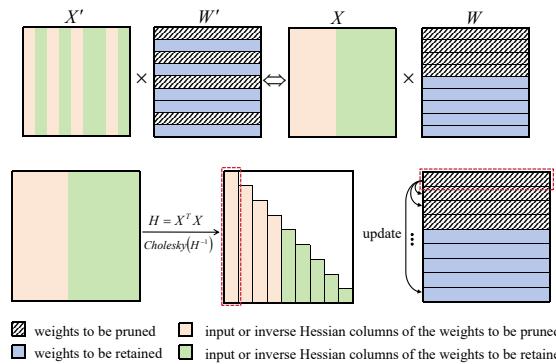
As shown in Figure 4, they permute (shuffle) the input and weight matrices so that all the columns to be pruned are moved to the end. This allows them to apply the stable Cholesky-based update efficiently. Afterward, they simply shuffle the rows back to their original positions.
Input Weights Error Compensation
There is one final hurdle. When we prune layer \(l\), the output of layer \(l\) changes slightly. This means the input to layer \(l+1\) is now different from what the original model expected. As errors accumulate layer by layer, the model “drifts” away from its original behavior.
To fix this, SoBP adjusts the input weights (\(W_p\)) of the next layer. It solves an optimization problem to find a modification \(\delta W_p\) that aligns the new input \(\widehat{X}_p\) with the original input \(X_p\):

The closed-form solution allows the method to calculate the exact adjustment needed:

This compensation mechanism ensures that even heavily pruned layers continue to pass meaningful data to subsequent layers.
Experimental Results
Does this rigorous math translate to better models? The researchers tested SoBP on LLaMA and OPT model families across various datasets.
Performance Comparison
The results show that SoBP consistently outperforms other structured pruning methods like FLAP and SliceGPT, as well as decomposition methods like ASVD.
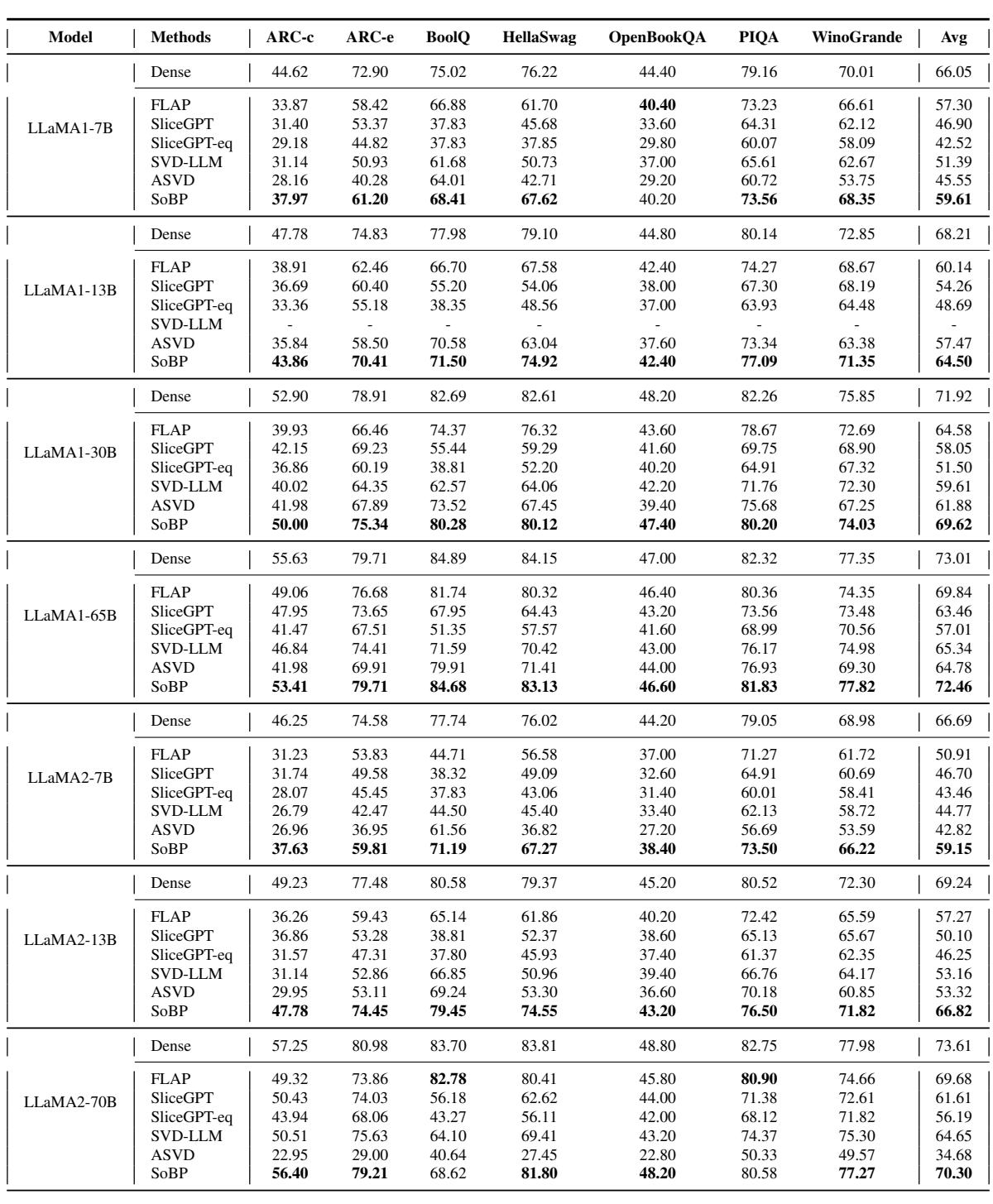
In the table below (Table 7 from the paper), we see the performance on Zero-Shot tasks (common sense reasoning tests like ARC, HellaSwag, etc.) for LLaMA models compressed by 30%.
Key Takeaways from the Data:
- Accuracy Retention: For LLaMA1-30B, SoBP maintains an average accuracy of 69.62%, significantly higher than SliceGPT (58.05%) and FLAP (64.58%).
- Robustness: Even at aggressive compression rates, SoBP avoids the catastrophic performance drop seen in other methods.
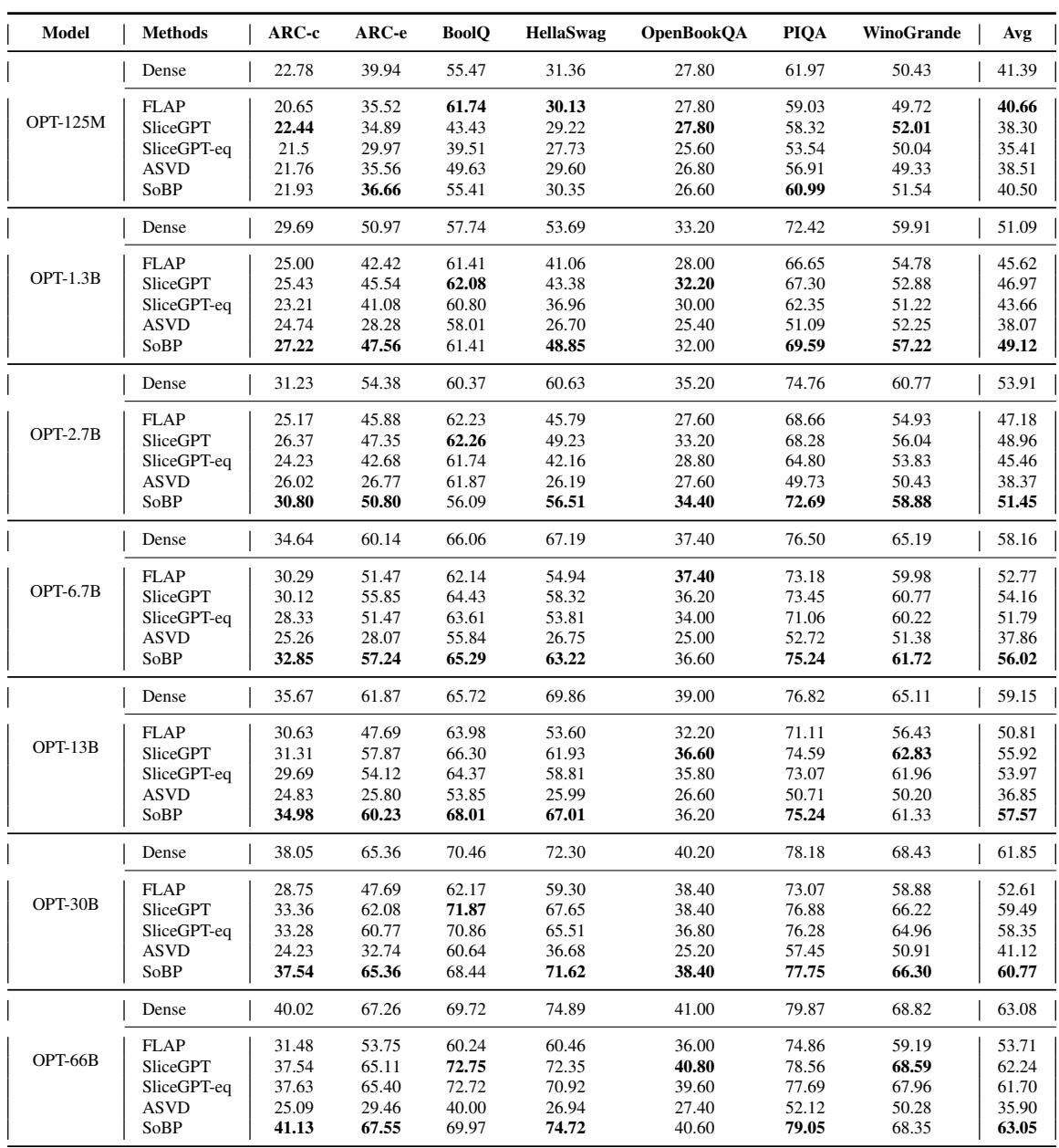
Similar trends are observed with the OPT family of models. Table 9 illustrates that SoBP consistently achieves higher average accuracy across diverse tasks.
Inference Speed and Throughput
The primary goal of structured pruning is speed. Unstructured pruning might reduce parameters, but it rarely speeds up generation on standard GPUs. SoBP, however, delivers real acceleration.
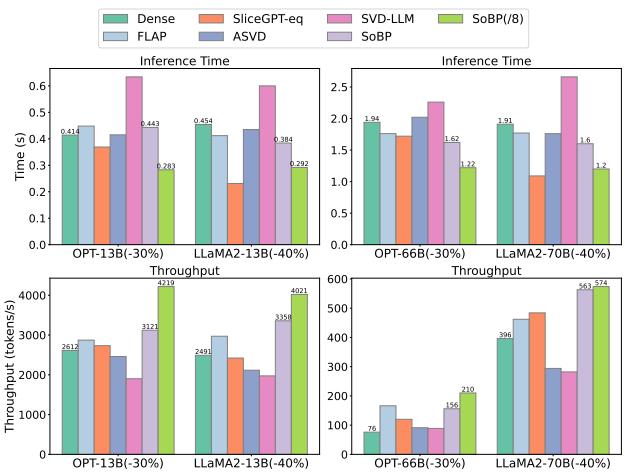
Figure 8 compares the inference time (lower is better) and throughput (higher is better).
- Prefill Phase (Processing the prompt): SoBP reduces the time significantly compared to the Dense (original) model.
- Decode Phase (Generating text): Throughput is drastically improved. For example, on the OPT-66B model, SoBP achieves nearly double the throughput of the dense model.
The authors also noted that by enforcing a constraint where dimensions are multiples of 8 (denoted as SoBP/8), they can further optimize tensor computations on GPUs, beating SliceGPT-eq in throughput.
What Matters Most? (Ablation Study)
The authors stripped apart their method to see which components contributed the most to success.
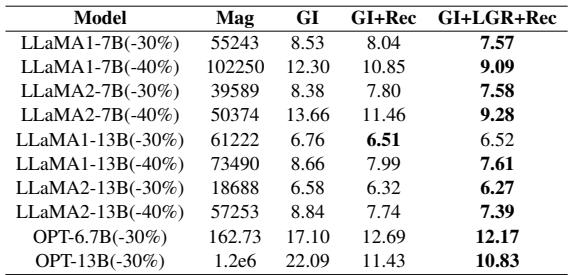
Table 3 reveals the contribution of each stage:
- GI (Global Importance): Pruning based solely on global scores works better than magnitude pruning (Mag), but perplexity is still high.
- + Rec (Reconstruction): Adding the module-wise reconstruction significantly drops perplexity (lower is better).
- + LGR (Local Greedy Refinement): The full package (GI + LGR + Rec) yields the best results (lowest perplexity).
This confirms that the combination of global awareness and local refinement is crucial for success.
Conclusion and Implications
The paper Structured Optimal Brain Pruning for Large Language Models presents a compelling step forward in model compression. By treating pruning as a multi-stage optimization problem—combining global first-order analysis with local second-order refinement—SoBP manages to shrink giant models like LLaMA-70B and OPT-66B without breaking them.
The significance of this work lies in its retraining-free nature. Fine-tuning a 70-billion parameter model is prohibitively expensive for most researchers and companies. SoBP offers a way to democratize access to these powerful models, allowing them to run on smaller, cheaper hardware with minimal loss in intelligence.
While the method currently relies on a hyperparameter \(\lambda\) to balance head vs. neuron pruning, future work aims to automate this via AutoML, potentially making “push-button” compression a reality for the next generation of LLMs.