](https://deep-paper.org/en/paper/file-3696/images/cover.png)
Introduction
In the current landscape of Artificial Intelligence, Large Language Models (LLMs) have achieved near-human performance in tasks ranging from translation to creative writing. However, there is a stark disparity hidden beneath these achievements. The effectiveness of these models is intrinsically linked to the sheer volume of data available for pre-training. This creates a “data wall” for low-resource languages.
If you speak English, Spanish, or Chinese, the AI revolution is serving you well. But what if you speak Quechua, a language with millions of speakers but a comparatively small digital footprint? For these languages, standard training methods fail. The models simply do not see enough examples of words to learn their meanings or grammatical roles effectively.
The consequences are severe: low-resource languages risk being excluded from the benefits of modern NLP. Researchers have tried to fix this with multilingual models (like mBERT) or data augmentation (generating synthetic text), but these solutions often result in under-represented vocabularies or semantically nonsensical sentences.
In this post, we will dive into a research paper that proposes a novel, geometric solution to this problem: TEMA (Token Embedding Mapping Algorithm). The researchers propose that instead of trying to find more data where it doesn’t exist, we can “teleport” the semantic knowledge from a rich language model (like Spanish) into a poor one (like Quechua).
The Core Problem: The Data Starvation of Low-Resource Languages
To understand why TEMA is necessary, we must first understand how transformers learn. Models like BERT or RoBERTa learn the meaning of a token (a word or sub-word) based on its context and frequency.
Research has shown that if a token appears fewer than 15 times in the training data, the model effectively ignores it. It cannot form a stable vector representation (embedding) for that word. In low-resource languages, a vast portion of the vocabulary falls into this “infrequent” category.
Existing solutions have attempted to band-aid this problem:
- Multilingual Models: Training a model on 104 languages at once (e.g., mBERT). While impressive, the vocabulary is dominated by high-resource languages. The low-resource tokens are often split into meaningless character fragments that share no semantic value.
- Data Augmentation: Using machines to write new sentences to increase the count of rare words. However, ensuring these synthetic sentences make sense is difficult and often introduces noise.
The authors of TEMA ask a different question: If we already have a perfect representation of the concept “dog” in a Spanish model, why can’t we just give that mathematical representation to the Quechua word for “dog”?
The Solution: Token Embedding Mapping (TEMA)
The core hypothesis of TEMA is that vector spaces of different languages share similar geometric structures. If “cat” and “dog” are close together in the vector space of a model trained on English, they should also be close together in a model trained on Quechua—if the model is trained well.
Since the Quechua model is poorly trained, its vector space is disorganized. TEMA proposes mapping the embeddings from a Richly Pre-trained Model (L1) to a Poorly Pre-trained Model (L2) using a bilingual dictionary as a bridge.
The Geometry of Mapping
This is where the method gets fascinatingly geometric. The goal is to take a token embedding from the rich L1 model (\(w_m\)) and project it into the vector space of the L2 model to create an enriched embedding (\(u'_n\)).
To perform this translation between two different mathematical spaces (the L1 space \(S_r\) and the L2 space \(S_p\)), the algorithm needs a reference point—a “north star” common to both models. The authors chose the token for the number ‘1’. Numbers are universal and appear frequently in almost all corpora, making them stable anchors.
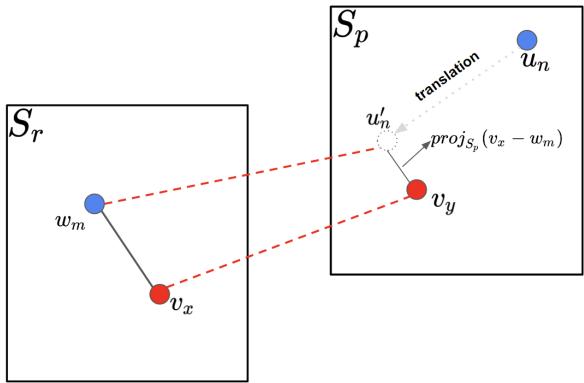
As illustrated in Figure 1, the process involves:
- Identifying the “1” token in the rich model (\(v_x\)) and the poor model (\(v_y\)).
- Taking a target word in the rich model (e.g., \(w_m\) for “perro”).
- Calculating the vector difference between “perro” and “1” in the rich space.
- Projecting that relationship onto the poor space relative to the poor model’s “1”.
This operation effectively transfers the semantic “location” of the word from the rich language to the poor language.
The Mathematical Foundation
The transformation is defined by an affine transformation. The authors derive the new embedding \(u'_n\) for the low-resource token using the following equation:

Here, \(u_n\) is the original (poor) embedding, and the second term is the projection of the rich semantic information. The projection function itself is defined as:

This formula ensures that the enriched token \(u'_n\) isn’t just a copy-paste; it is mathematically adapted to fit the geometry of the target language’s vector space (\(S_p\)).
The Algorithm in Practice
TEMA doesn’t just improve existing words; it also expands the vocabulary. The process flows as follows:
- Dictionary Lookup: The system iterates through a bilingual dictionary (e.g., Spanish-Quechua).
- Vocabulary Expansion: If a Quechua word from the dictionary doesn’t exist in the model’s vocabulary, it is added. To initialize this new token, the model is briefly fine-tuned on a small set of example sentences containing that word.
- Projection: Once the token exists (either originally or newly added), TEMA calculates its new vector using the equations above, leveraging the rich representation of its Spanish translation equivalent.
- Update: The L2 model’s embedding layer is updated with these new vectors. Crucially, the rest of the transformer model (the attention layers) is frozen or fine-tuned very lightly, meaning the “reasoning” capability of the model remains intact while its “vocabulary knowledge” skyrockets.
Experimental Setup
To prove that TEMA works, the researchers set up a rigorous comparison. They focused primarily on Quechua, a polysynthetic language that is notoriously difficult to model due to its complex morphology (words are built by stacking many suffixes).
However, to ensure the results weren’t a fluke, they also created “simulated” low-resource environments for English, German, and French by artificially limiting their training data.
The Models
They trained several baselines to compare against TEMA:
- Monolingual Base Models: BERT and RoBERTa trained from scratch on small (10M token) corpora.
- eB-BERT: A competitive method that extends vocabulary but doesn’t use geometric mapping.
- Multilingual Giants: mBERT and XLM-RoBERTa (fine-tuned for Quechua).
The Tokenizers
A critical detail in this research is tokenization. Standard tokenizers like BPE (Byte Pair Encoding) chop rare words into meaningless sub-word pieces (e.g., “running” might become “run” + “ning”, but “uncharacteristically” might become “un” + “ch” + “ara” + …).
For TEMA to work, the token in the model must match the word in the dictionary. Therefore, the authors tested both BPE and DeepSpin, a tokenizer that produces linguistically motivated segments (stems) that are more likely to match dictionary entries.
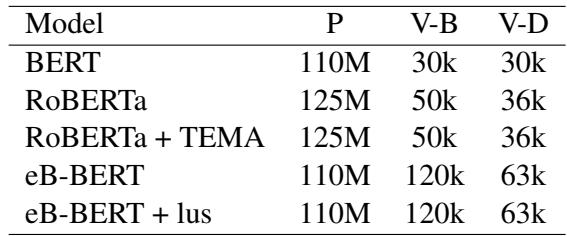
Table 1 outlines the model architectures. Note that the L2 models are standard BERT/RoBERTa sizes but trained on significantly less data than usual.
Results and Analysis
The results provided compelling evidence that transferring geometric information is far superior to simply training on small data.
1. Reduction in Perplexity
Perplexity is a measurement of how “confused” a model is when predicting the next word. A lower score is better.
The experiments showed massive improvements. For Quechua, the pseudo-perplexity dropped from a staggering 391.2 (BERT 10M) to just 21.1 when using RoBERTa + TEMA with the DeepSpin tokenizer. This indicates that the model moved from essentially guessing randomly to having a solid grasp of the language structure and vocabulary.
2. Improved Semantic Space
Numbers are great, but visualizations tell the story better. The researchers used dimensionality reduction to plot the vector spaces of the Quechua model before and after TEMA.

In Figure 2, look at the comparison:
- Left (RoBERTa): The points are scattered. Semantic categories (Locations, Animals, Food) are mixed together messily. The model doesn’t understand that a “dog” is similar to a “wolf.”
- Right (RoBERTa + TEMA): The distinct colors cluster together. All the purple dots (Locations) move to one area; the blue dots (Animals) cluster in another.
This visual proves that TEMA successfully transferred the semantic structure from the rich language. The Quechua model now “knows” that animals belong in the same semantic neighborhood, even if it hasn’t seen many sentences about animals in Quechua.
3. Downstream Tasks: SuperGLUE and Xtreme
To verify if these better embeddings actually help solve problems, the models were tested on the SuperGLUE benchmark (logic, reasoning, and understanding tasks).
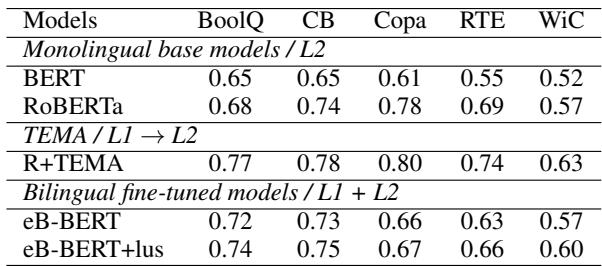
As shown in Table 3, RoBERTa + TEMA (R+TEMA) consistently outperforms both the monolingual baseline and the bilingual fine-tuned models (eB-BERT).
A highlight is the WiC (Word in Context) task, which asks if a word is used with the same meaning in two different sentences. This requires deep semantic understanding. TEMA improved accuracy by approximately 0.11 over the baseline, a massive leap in NLP terms.
In the Xtreme benchmark (Table 8 in the appendix of the paper), TEMA showed its true power for Quechua. For Part-of-Speech (POS) tagging in Quechua, TEMA achieved an F1 score of 0.84, significantly beating the massive XLM-RoBERTa model, which only reached 0.72. This confirms that for truly low-resource languages, a small, specialized model enriched via TEMA is better than a giant, generic multilingual model.
4. The “Fill-Mask” Sanity Check
Finally, the authors performed a qualitative test. They gave the models sentences with a missing word (masked) and asked them to fill it in.
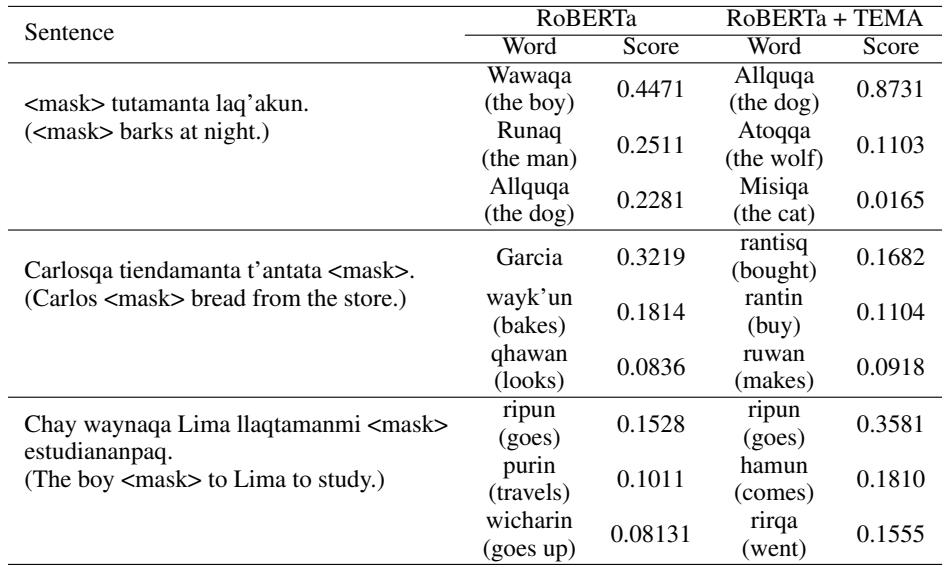
Table 4 shows the difference clearly:
- Sentence: “The boy ____ to Lima to study.”
- RoBERTa (Base): Guesses “goes” (0.15) but also “travels” and “goes up” with low confidence.
- RoBERTa + TEMA: Guesses “goes” with much higher confidence (0.35) and “comes” (0.18).
In the first example of the table (“barks at night”), the base model predicts “The boy” or “The man.” The TEMA model correctly predicts “The dog” or “The wolf.” This simple test proves the semantic transfer was successful: the model now associates “barks” with canines.
Conclusion and Implications
The TEMA research paper presents a powerful argument: we don’t always need more data; sometimes, we just need better geometry. By mapping the well-formed vector space of a high-resource language onto a low-resource one, TEMA acts as a bridge, transferring knowledge that would otherwise take billions of words to learn.
Key Takeaways:
- Lexical Transfer works: You can “transplant” the meaning of words from one language to another using simple geometric projection.
- Beating the Giants: For under-represented languages like Quechua, TEMA allows small models to outperform massive, industry-standard multilingual models.
- The Dictionary Requirement: The method does require a high-quality bilingual dictionary and a linguistically aware tokenizer (like DeepSpin) to work best.
This work offers hope for the democratization of AI. It suggests that with a good dictionary and a clever algorithm, we can build high-quality language models for the thousands of languages that the AI revolution has left behind.